|
Those Detective
Fiction
Weekly Mugs, by Terry Sanford
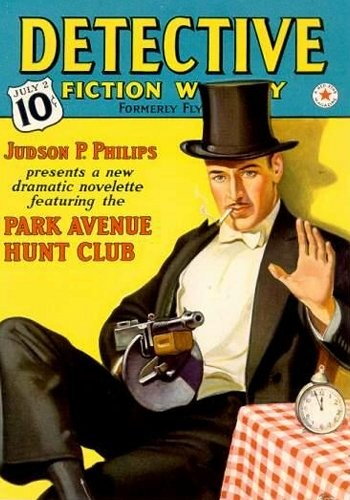 While Detective
Fiction Weekly (hereafter: DFW)
is one of the most reasonably priced detective pulp magazines today,
putting together a collection of them is somewhat onerous. With
predecessors and successors, the magazine ran as a weekly for about
eighteen years, then went monthly for several more years, making the
complete run about one thousand mags. While Detective
Fiction Weekly (hereafter: DFW)
is one of the most reasonably priced detective pulp magazines today,
putting together a collection of them is somewhat onerous. With
predecessors and successors, the magazine ran as a weekly for about
eighteen years, then went monthly for several more years, making the
complete run about one thousand mags. It began eighty years ago as Flynn’s, within two years it was called Flynn’s Weekly, then a year later Flynn’s Weekly Detective Fiction. It was finally reborn as DFW in 1928 until WWII paper shortages in 1942 caused its change to a monthly named Flynn’s Detective, soon to be stretched to Flynn’s Detective Fiction until it stopped in 1944. There was a six-issue rebirth in 1951 as Detective Fiction. My emphasis in collecting DFW is for the stories. In that context, let’s take a look at the bang you get for your buck with DFW... Lawrence Treat’s 1949 novel V As In Victim is considered to be the first American police procedural novel, a sub-genre where Ed McBain reigns as the standard bearer today. However in 1925, Victor Maxwell began a series featuring Detective Sgt. Riordan and harness bull Sgt. Halloran, the latter affectionately dubbed “Ya big lummox.” This series continued into the 1940’s in DFW under its various names. These stories were well done with intelligently handled cases, although filled with Riordan’s particular vernacular. These yarns were set in a fictional mid-size city. Little is known about Victor Maxwell and the name is thought by some to be a pseudonym. There were dozens of these tales in short story and novelette form over the series’ seventeen-year 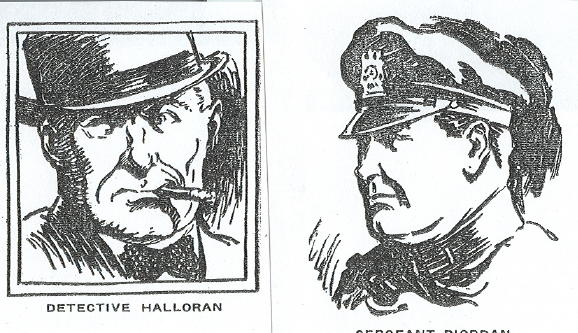 run. (Halloran and Riordan are the two gents pictured here to the
right and below, stalwart fellows both.)
run. (Halloran and Riordan are the two gents pictured here to the
right and below, stalwart fellows both.)Donald Barr Chidsey, later an acclaimed adventure writer, gave us a dozen or so tales of his detectives, Sgt. Wentworth L. Morton, the plodding thinker, and the newly promoted but first-nameless, Detective McGarvey in DFW. Young McGarvey, as the narrator describes him or “Garv” was a brash man-of-action who was mentored by the veteran “Mort,” who knew McGarvey’s father. (The Morton & McGarvey series began in Dime Detective, where Mort’s first name was Wainwright, and they eventually also appeared in Argosy.) Their cases were evenly divided between Morton’s brain power and experience and McGarvey’s quick action with fists or a gun saving the day. These were well-written stories set in what was then the small city of Miami, Florida of the 1930’s. 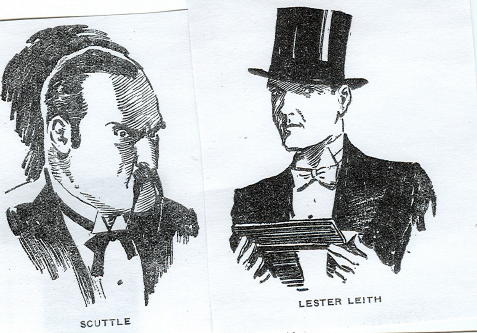 Erle Stanley Gardner was a frequent contributor to DFW. His best character, Lester Leith, lived lavishly on liberated loot. Each story began with Leith asking his butler, police-spy Edward Beaver, whom Leith called Scuttle because he reminded Leith of a pirate, to read the crime news in each day’s newspaper. Scuttle would report any crimes in which Leith showed interest to his superior, Sgt. Ackley, who was very similar to Dilbert’s pointy-haired boss in his ineptitude, thirst for glory and speed in blaming Scuttle for his failures. Leith would dispatch Scuttle to hire an unemployed and comely actress or dancer or secretary, rent an office or studio and obtain supplies for all. With his storefront con in place, he would misdirect the cops and uncover the identity of the thieves, subsequently heisting their booty and making a contribution to his benevolent fund or local charity, including the police widows and orphans fund. This left the police enraged and baffled as they knew more about the crime than Leith did. Gardner had several other minor characters in DFW over the years. These included an avenger, The Man In The Silver Mask, plus The Patent Leather Kid, Sydney Zoom, and Senor Lobo. Mr. Gardner was a member of the pulp elite: the million words a year writers. Crippen & Landru will soon be publishing anthologies featuring each of these characters. 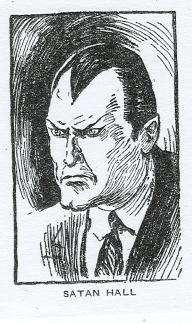 Carroll John Daly brought the hard-boiled writing style to the forefront of pulpdom, and I believe, even coined the term in an early Race Williams novel. Daly’s primary character in DFW was Frank “Satan” Hall, a police detective whose earlier adventures appeared in Black Mask. Satan’s foes were the heads of the underworld or toughest killers. Daly’s melodramatic writing style carried most of these stories fairly well if one can overlook the supposed terror each villain suffered by looking directly at Satan’s visage. (A glimpse of his visage can be seen to the right.) Of course, these face-to-face encounters almost always preceded the bad boys’ demise. DFW also ran several sagas of that opponent of the parole system, Mr. Strang. In addition, Daly introduced a new character, Twist Sullivan, who disappeared after a few short stories. Judson P(entecost) Philips contributed dozens of stories featuring The Park Avenue Hunt Club in DFW. The Club consisted of big-game hunter John Jericho, actor Geoffrey Saville and the rotund, intellectual Arthur Hallam with occasional assists from their Oriental servant, Wu. They had sources all over New York and were aided by the police hierarchy despite being officially wanted for murder and other crimes. When the police couldn’t help or were in on the crime, The Hunt Club was the group to call. Mostly portrayed in novelettes, their adventures were well-crafted and exciting. 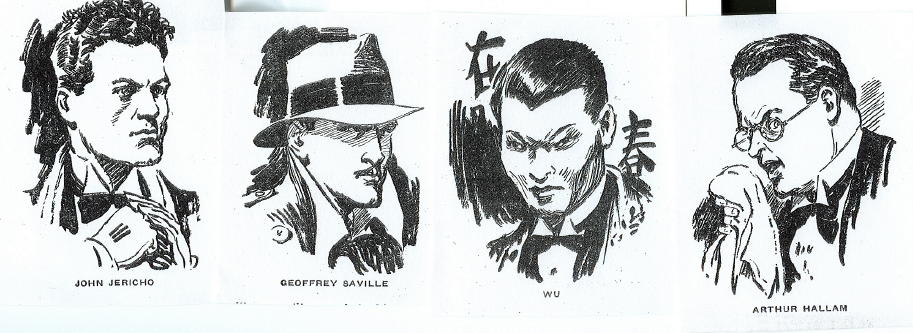 Hannibal Lecter is the super villain of fiction these days. Adventure writer J. Allan Dunn gave us dozens of stories starring The Griffin in DFW. The Griffin was the king of extortionists using a simple threat: Pay me $50,000.00 or you will die on this date and time. The wealthy didn’t get that way by giving their money away. Instead, they hired bodyguards or put their faith in police protection, including being placed in a solitary jail cell. No matter, they all died at the Griffin’s predicted time. 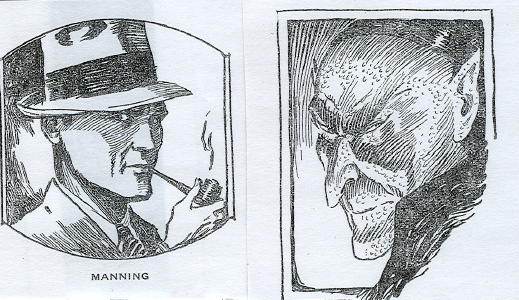 The Griffin had enslaved dozens of people, having learned of their most terrible secrets and blackmailed them into virtual drones. The uneducated ones became assassins who were frequently killed themselves after the murders. Meanwhile his scientists were forced to develop slow-acting but precisely timed poisons. Gordon Manning, who had sworn to get The Griffin, was thrifty, brave, clean, reverent, obedient, cheerful. You get the idea. Time after time, he failed to stop the murders or get the Griffin. Finally, the readers had had enough, and The Griffin was captured!! Only to escape by the end of the story. The stories continued with the usual plot for a few more appearances. 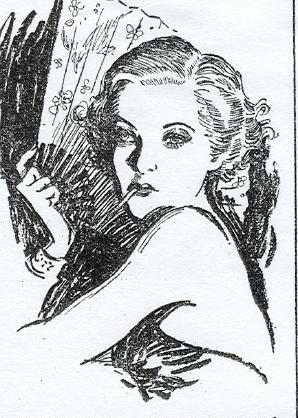 I don’t know who was kidding whom, but author Eugene Thomas was involved in an odd bit of history of the magazine. DFW always had a couple of true stories in each issue. Thomas wrote a “true” story with the catchy name of “The Lady From Hell.” The Lady, Vivian Legrand, was a former blackmailer who had even instigated the murder of her father but gained immunity from prosecution by recovering a letter that the British Secret Service had wanted for some time. Soon the true story section of DFW had a Lady From Hell story in every couple of issues, featuring the red-haired, breath-taking siren in yet another intrigue. How could one woman in the less-liberated 1930’s be so involved, written about so often, and still be an effective informant? Well, she couldn’t. The magazine fessed up and The Lady From Hell moved to the fiction section. Did Thomas scam DFW or were the editors hornswoggling the readers? It remains a mystery. 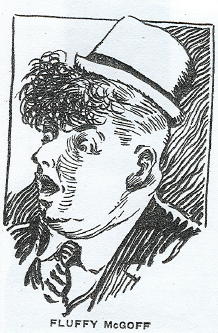 Milo Ray Phelps gave DFW readers their comic relief with each appearance of his absent-minded safecracker, Fluffy McGoff. Fluffy drove Sam, his partner and scribe, mad by bungling one heist after another. Most stories began with the duo just having served a short stint in jail or having made a successful, but arduous, escape which left them flat broke, thus keeping with the “crime does not pay attitude of the times.” Poor Fluffy would forget how much nitro to use or would double the amount because he forgot about dosing the safe the first time, which blew the safe and their loot to smithereens. In other outings, where precise timing was required for a “normal” sound, like a passing train, to cover the safe blasting, something would catch Fluffy’s eye. It was usually the same thing that would distract a child, a toy or a cartoon, but the caper was kaput. If they did succeed in a heist, then one could count on Fluffy to leave his I.D. or some other good clue behind insuring a frantic flight, with Sam vowing this was the last time. 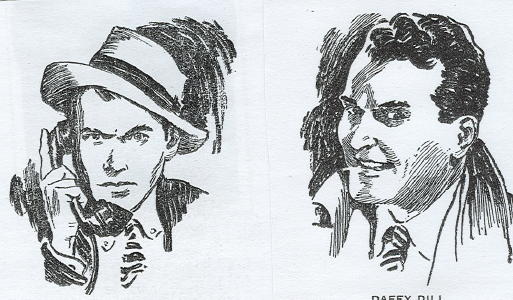 Richard Sale ended up scripting movies like SUDDENLY, which gave Frank Sinatra a fine film noir role. Prior to that, he was pumping out a half-million words a year or more for the pulps. His primary DFW character was newspaper “colyumist” Joe “Daffy” Dill. Daffy’s life was a comic swirl of stress brought on by his editor, “The Old Man,” who took great pleasure in ragging on Mr. Dill and his girlfriend but not-quite fiancée, Dinah Mason, who enjoying verbally skewering Daffy almost as much as she did inserting herself into his cases. His crime column gave him entrée into many a murder and his crime-solving ability was valued by his police contact, Bill “Poppa” Handley. The stories were much better than the formula would suggest. While both of the artistic renditions to the right are of the suave and dapper Mr. Dill, photographers seemed to be popular in the pulps, and DFW wasn’t about to be outdone. Mr. Sale also provided them with “Candid” Jones, who ended up employed by the same newspaper as Daffy Dill. Naturally, these two teamed for several outings in the magazine, and they always solved the murder or were instrumental in the eventual solution. There were many other series characters in DFW. These included Sapper’s Bulldog Drummond and Frank Packard’s Jimmie Dale. Many fine writers appeared in DFW, albeit without series characters in most cases. From the million-word club were Max Brand, Edgar Wallace and Fred MacIsaac, whose writer’s block ended with his suicide. Four writers really stand out because their prose reads as easily today as it did seventy years ago: Frederick Nebel, Cornell Woolrich, Fredric Brown and Norbert Davis. Raymond Chandler sold a story or two to DFW, as did L. Ron Hubbard and David Goodis, and any of their names on the cover will push the price of that issue of DFW skyward today. The Golden Age writers were well represented by Agatha Christie, R. Austin Freeman and J. S. Fletcher. The future kings of paperbacks who appeared include John D. MacDonald, Gil Brewer, Day Keene, Frank Gruber, Brett Halliday, Bruno Fischer and William Campbell Gault. The creator of Zorro, Johnston McCulley wrote for DFW, as did Leigh Brackett who went on to pen the first Star Wars script. Other authors included H. C. Bailey, Raoul Whitfield, Hugh B. Cave, Baynard Kendrick, MacKinlay Kantor plus my favorite author’s name: Denslow M. Dade. Bang for the buck indeed! _____________________________________ YOUR COMMENTS ARE WELCOME. |