Return
to
the Main Page.
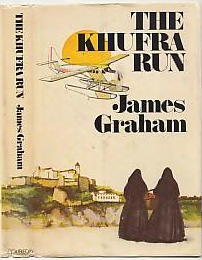
JACK HIGGINS writing as JAMES GRAHAM - The Khufra Run 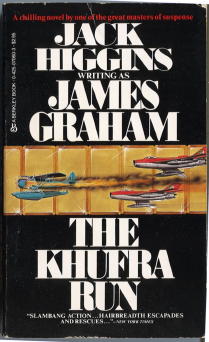 Berkley; paperback reprint; February, 1985. British hardcover edition: Macmillan, 1972. US hardcover edition: Doubleday & Co, 1973. Other paperback editions: Fawcett Crest, 1976; Pocket Books, 1990; Berkley, 2002. Copies of the first US hardcover editions of this book are a little pricey – in the $50 to $100 range – but if a paperback will do, this shouldn’t a very difficult book to find. Here’s what’s interesting, though. In 1985, the book was 213 pages long and sold for $2.95, while in 2002 (the edition that’s still in print) it’s 287 pages long, and if you buy it new, it will set you back $7.99. Well, I found it interesting, and you wonder how they do that. (Yes, I know. Bigger margins. In more ways than one.) Another thing that’s interesting, and you are probably aware of this too, but of the two authors’ names on the cover, neither one is the real guy. Jack Higgins, still writing today, was born in 1929 as Harry Patterson, and his first several books were published that way. The other names he also went under are: Martin Fallon, Hugh Marlowe & Henry Patterson From an “unofficial” Jack Higgins website on the net I discovered the following chronological list. I also didn’t count them, but the website says he’s responsible for 63 books and one short story. I also didn’t note the original author’s by-line on the books below, but by this time, most of them have been reprinted as by Jack Higgins, the name that’s the most well-known.
 If I were
really ambitious, I would check my statement that all of these have
eventually been republished as by Jack Higgins, even if he had to
revise them to do so. Those that haven’t, if any, would therefore
have to be the ones he’s least happy with, looking back at them today. If I were
really ambitious, I would check my statement that all of these have
eventually been republished as by Jack Higgins, even if he had to
revise them to do so. Those that haven’t, if any, would therefore
have to be the ones he’s least happy with, looking back at them today.No matter. It was The Eagle Has Landed, the 1975 thriller about a German attempt to infiltrate England in World War II and capture Winston Churchill, that made Higgins a multi-millionaire. The Khufra Run isn’t in that league, by any means, but it’s great entertainment, and if done with a decent B-level budget, it would make a really decent B-grade action movie. Here’s the opening paragraph: It was late evening when they brought the
coffin down to the lower quay in Cartagena’s outer harbour. There
were no family mourners as far as I could see, just four men from the
undertakers in the hearse, a customs officer in a Land-Rover bringing
up the rear.
Here are the last two paragraphs from Chapter One: I paused on the brow of the road close to
an old ruined mill, a well-known landmark, and got out to admire the
view. I reached for a cigarette and somewhere close at hand, a
woman screamed, high-pitched and full of terror.
A second later, a naked girl ran out of the darkness into the headlights of the jeep. It is the girl who is the key figure in the rest of the story, even though (as you may have guessed) Jack Nelson’s flight from Cartagena to Ibiza (an island off the Spanish coast) had an ulterior motive. Jack Nelson, who tells the story, is an island-hopping pilot and small time smuggler. The naked girl is Claire Bouvier, or as it happens, Sister Claire, of the Little Sisters of Pity, on leave from a convent near Grenoble, and as it eventually transpires, she has a proposition for Jack. Somewhere in the Khufra Marshes, off the Algerian coast, is a fortune in silver, and Claire, one of the most naive and single-minded women you will ever meet, in fiction or not, needs Jack and his friend Turk to help her find it. On page 20, she tells Jack that “you are a good man in spite of yourself.” Jack is not so sure, nor is the reader, except for the reader who knows exactly how predictable such adventurers (and their adventures) are. 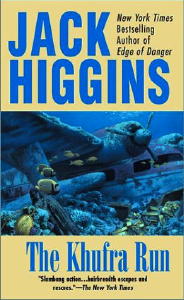 It’s still a rattling good story, though, whatever that means, even if Jack is rather careless about the bad guys on their trail, and yes, there are. If I didn’t mention them, you should have known better. Once they start making their picturesque way through the marshes, a narrative suddenly goes into overdrive, and if you can put the book down after page 138, you are a better man (or woman) than I. The ending is even better. I like the idea of Audrey Hepburn in the role of Claire, while any tall, slim, grizzled tough guy actor could be Jack. But Audrey Hepburn. She may have been a little slim for the part, but other than that, nothing but net. Reference: The Unofficial Jack Higgins Home Page, at www.scintilla.utwente.nl/users/gert/higgins/ PostScript: The Jack Higgins short story mentioned in passing up above is “The Morgan Score,” 1995. It first appeared in Great Irish Tales of Horror, ed. Peter Haining, Souvenir Press, along with stories from such heavyweight authors as J. Sheridan Le Fanu, Sax Rohmer, Brian Moore, Bram Stoker, M. P. Shiel and others. That is good company, to be sure.
January
2005
FOOTNOTE:
This latest title appeared after the review was written.
HUGH
McLEAVE - Second Time Around
Walker; paperback reprint, 1984. Hardcover editions: Robert Hale (UK), 1981; Walker (US), 1981. Unless there’s some duplication of titles between the US and over in England, Hugh McLeave, a new author to me, wrote a total of thirteen spy thrillers for a wide variety of publishers between 1964 and 1987. According to Crime Fiction IV (but see below), four of them feature as their leading protagonist, free-wheeling psychologist Dr. Gregor Maclean, who, as a leading character in Second Time Around, takes on what is very nearly a secondary role. On the other hand, a psychologist is exactly who is needed at the center of this Cold War tale about a reputable London publisher who on occasion checks into various clinics with no memory of who he is or why he is having such terrible dreams. Maclean becomes doubly interested when his acquaintance Dr. Armitage, who was treating him, gets run down by an automobile after confiding his concerns to Maclean, although in the stark, documentary-like style of writing that McLeave employs, Maclean seems to exhibit no great anguish over Armitage’s death – only the delight of tackling the puzzle it seems to supply. Here’s a longish quote from pages 32-33 to illustrate. Deidre is Maclean’s long-suffering live-in assistant: 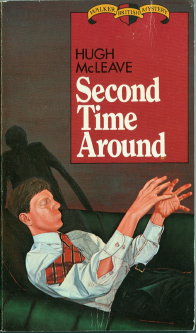 Had he followed Deidre’s advice he would
have handed over the whole case to Scotland Yard; she considered his
idea of investigating the case himself as mad and dangerous.
Then, he always had this tussle with her; she sometimes felt inclined
to view psychiatry as a painless exercise in straightening out mental
kinks with homely advice and would have filled his working ours with
nice, harmless neurotics, from compulsive handwashers and cake-eaters
to to cat-and-bird phobias; Deidre had another criterion, sizing up if
these patients could keep them in high-rent Harley Street; he, on the
other hand, would have been involved with schizophrenics and
paranoiacs, the acute depressive cases and hopeless alcoholics, seeing
some bit of himself in all of them; most of them would touch him for
money rather than expect to pay for his help. So, over the years,
he and Deidre had established a sort of symbiosis; she allowed him a
percentage of problem people with the sort of mental disorders that had
brought him into psychiatry in the first place, while he treated her
affluent neurotics.
“Macushla, just look at him as a patient,” he pleaded. The case – and yes, he certainly does decide to get involved – takes Maclean, Deidre, the man’s daughter, and a male friend of the daughter, not to mention at least one other – on a hastily arranged trip to Germany, both East and West, on the trail of the man whose memory is either coming back, and if so, from where, or he is cracking up completely and probably responsible for the deaths of several prostitutes who reminded him of – whom? This is also very like science fiction, mixed in with a goodly amount of bitter cold war philosophy, but based wholly on fiction, very likely not. And no, this is a book which is very little like anything I have ever read before. It is clear more quickly to the reader what the underlying circumstances are (which I am being so careful not to tell you about) than they are to Maclean. This may be an error, perhaps, on the author’s part, because the tale starts to plod a little, about two-thirds of the way through. While after reading this book I still prefer Ross Thomas and Manning Coles, two writers who otherwise have little in common – or do they? – I have to admit that, one, McLeave still has a small surprise or two up his sleeve, and, two, this very well may be one of the saddest love stories ever written. Is that enough for a recommendation? Either way, it will have to do.  PostScript: I have done some googling on the author, and I have made a few unexpected finds. Categorized as “published works” but available now only as downloaded ebooks from www.fictionwise.com, and not included as any of the thirteen tales mentioned above, are the novels, White Pawn on Red Square, which has to do with the (attempted) theft of Lenin’s body; and The Bent Pyramid, about an Egyptologist and some ancient jewelry. (Where and when these books were previously published, I have not yet been able to determine.) McLeave’s works of non-fiction include The Last Pharaoh, about the life of King Farouk; a history of the Foreign Legion titled The Damned Die Hard; A Man and His Mountain, a biography of the painter, Paul Cézanne; A Moment of Truth, a historical novel based on the life of Zola; and a history of art thievery titled Rogues in the Gallery. A list of nineteen “unpublished works,” mostly fiction but including his autobiography, can be found at www.hugh-mcleave.com. These are also available for downloading. For a gentleman born in 1923, Hugh McLeave is finding the computer age much to his liking. Bibliographic followup: In Crime Fiction IV, Al Hubin wonders if The Icarus Threat (UK) and The Life and Death of Liam Faulds (US) are one and the same. From the book descriptions, they are not. Gregor Maclean is in The Sword and the Scales, not so stated in CF IV. He is also in at least three of of the unpublished novels mentioned above: The Twa Corbies, Who Pray Together Slay Together, and Not All Rivers Reach the Sea. Spies and/or secret agents Paul Brodie and Shane Kingslake (female) appear in A Borderline Case, Double Exposure, The Icarus Threat, and Under the Icefall (all published). A surgeon named Murdo Cameron appears in both A Question of Negligence (published; Maclean also appears) and Sacred Flame (unpublished). January
2005
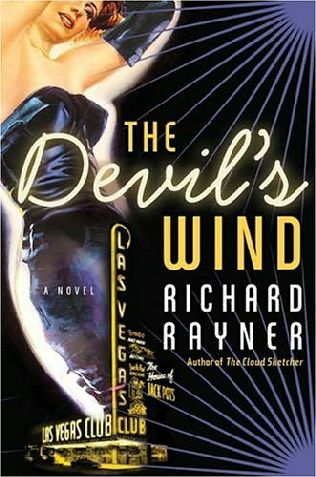 RICHARD RAYNER - The Devil’s Wind HarperCollins; hardcover. First Edition: February 2005. If there were no such word as “coincidence” or “serendipity,” it would have to be invented. The day before I received this book in the mail to read, I happened to be looking up science fiction writer Charles Eric Maine, for some reason or another, no longer remembered – the reason, not the author, although in all likelihood there are not many who remember Maine, either. But I digress. As it happens, Maine, who died in 1981 and whose real name was David McIlwaine, also wrote a handful of mysteries (all scarce, and none published in the US) under the name of – you guessed? – Richard Rayner. Hmm. The Richard Rayner who wrote The Devil’s Wind was born in England, but now lives in Los Angeles, and as in the case of a certain other author (named Chandler, although born in Chicago), it may take someone on the other side of the Atlantic to come to this country to tell us, and show us, what we’re really like. Or what we were in the past, as this book does; back in 1956, the time of HUAC; the atom bomb tests in Nevada and the concomitant growth of Las Vegas; Jimmy Hoffa; inherent racism; and jazz. All essential ingredients of a top-notch noirish thriller (filmed in glorious black-and-white?) based on identities: hidden identities, newly created identities; and revenge: subtle and not-so-subtle, and bullets to match. And jazz. On pages 193-194, wealthy up-and-coming architect – about to become the new Senator for the state of Nevada – Maurice Valentine (not the name he was born under) is listening to the only record a young black musician ever made: I didn’t know what to expect. In the
war, like everyone else, I’d danced to Benny Goodman, Glenn Miller, and
Count Basie; I’d lain on my bunk, smoking, dreaming, while Bing Crosby
or Billie Holliday or Frank Sinatra sang on the radio. I
understood, in a general way, tthat after a war a revolution had
occurred in jazz, that the swing of the music had turned itself inside
out, with bop, bebop, hard bop. I knew, even, of a further
development – West Coast jazz, cool jazz. Especially liking the
sound of those concepts, I’d sped to a Hollywood music store and bought
myself a couple of Art Pepper records. The guy had style.
He wore fine duds, was handsome, white. He played each solo like
it was a seduction. That, I could relate to. And of course
jazz bands were always playing in the Vegas show rooms. I was no
ignoramus on the subject, in other words; nor was I an expert.
But nothing had quite prepared me for what I was about to hear.
It was a quintet: the piano came in first, with bass, drums, and trumpet following behind, and I knew at once this wasn’t the hard stuff; the Dizzy Gillespie kind of jazz; nor was it California cool, man. The tune was a standard, “Come Rain or Come Shine,” and when Wardell Lane entered with his first solo I swear it was like being washed in the purest, freshest water I’d ever known. That horn floated with a sweet clarity that cleansed my blood and eased my bones. Okay, I was exhausted, drugged with fatigue. But I don’t want to underplay the feeling of the moment. The whole room glowed, and Konstantin stood there with a huge grin. “You see now? You understand?” he said. “Listen. He’s almost on the edge, as if he were in danger of falling over.” But somehow Wardell never did. The woman. Mallory Walker is a rich man’s daughter and a would-be architect, a field which in the 1950s in which there were very few openings for women. Valentine is married but eminently capable of being seduced, and he finds himself captivated. From page 8: My first impressions were of a cool
hand and a firm, bony handshake. A slender figure in blue linen
and flat heels. A lean face with hair cropped short and bleached
blond, almost silvery in color. Full lips, nose slightly
upturned. An impression of impudence, of life. Her eyes
were a pale gray-green, and powerful, of startling clarity; she looked
at me as if she knew my every secret.
“Pleased to meet you,” she said, as simply as that. Her voice was clear and clipped, with no identifiable accent. She is a force, a whirlwind, someone who knew her well says on page 256. Clever and proud and ruthless and beautiful, Maurice says earlier on page 40. There is also the hot wind that blows across the Nevada desert. The natural wind. There is also the unnatural wind that arises after the flash and colossal boom of the mushroom clouds that can be seen from the top floor of Las Vegas hotels, the wind that causes disasters in more ways than one. I also have to tell you about one of the notes I wrote to myself while reading and absorbing everything that was happening as quickly as I could. I suddenly sat up and told myself, less than half way through, and I quote, “I have absolutely no idea where this book is going.” Is that adequate as a one-line review? I’d like to think so. I do think so. It’s quite a ride. PostScript: One of this author’s previous novels also qualifies as crime fiction: Murder Book, Houghton Mifflin, 1997. It’s been optioned as a film by actor John Malkovich. If they were to make a movie of The Devil’s Wind, as written, I’d go to see it in a minute, black-and-white or not. January
2005
Note: A
shorter version
of this review appeared in Historical Novels Review.
EDWARD S. AARONS - Girl on the Run Gold Medal R2142; paperback reprint, 1969. Originally published as a paperback original: Gold Medal, 1954. 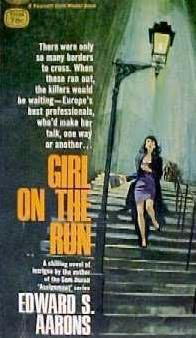 As an author, Aarons
began his career writing for the pulp magazines and for second-tier
hardcover outfits, like Phoenix Press (Death
in a Lighthouse and Murder
Money, both 1938), and after the war, for David McKay, beginning
in 1947. All of his early novels – and his work for the pulps –
were written as by Edward Ronns. His first novel published under
his real name, Aarons, came out in 1948 (Nightmare, David McKay). As
he began writing for the paperbacks in the early 1950s, he gradually
switched over, and most of his work began to appear as by Aarons. As an author, Aarons
began his career writing for the pulp magazines and for second-tier
hardcover outfits, like Phoenix Press (Death
in a Lighthouse and Murder
Money, both 1938), and after the war, for David McKay, beginning
in 1947. All of his early novels – and his work for the pulps –
were written as by Edward Ronns. His first novel published under
his real name, Aarons, came out in 1948 (Nightmare, David McKay). As
he began writing for the paperbacks in the early 1950s, he gradually
switched over, and most of his work began to appear as by Aarons.Including of course the “Assignment” series, featuring the intrepid Cajun CIA operative Sam Durell. The first of these was Assignment to Disaster (Gold Medal, 1955), so Girl on the Run, being published a year earlier, might almost be considered a dry run for the series, without being a series novel itself, with no other books coming between. The hero, Harry Bannock, a structural engineer between jobs and at loose ends in France before heading back to the states, does not happen to work for any espionage organization, however. He’s just a guy, who because of a girl, Lorette O’Bae, whom he earlier loved and lost to a friendly rival, finds himself at her service, and very quickly thereafter, involved way over his head in non-stop action and nail-biting adventure. What the bad guys are after – and this includes his not-now-so-friendly former rival – is either (a) an enormously valuable medieval treasure, or (b) a secret, hidden lode of uranium, either of which will have a great influence on France’s political role in the postwar world. Honed by working in the pulps, one imagines, Aarons’ prose is clear, clipped, crisp and clean. From page 19: Bannock looked at Lorette then. He
felt the urgency of Cobb’s words and knew that Cobb was speaking the
truth about their limited time for decision. The girl’s eyes met
his in a silent appeal. She looked small and trim, the red
leather belt emphasizing her tiny waist and the flare of her softly
curved hips. Looking at her, he knew that everything was
unimportant beside the fact that he was in love with her. An
intense desire for her came over him, and he looked at Cobb and the
huge young man in the doorway and still he saw Lorette and the soft
lines of her breasts and the way her chin lifted just a bit then.
She was very beautiful. Suddenly he knew that going home to New
York was a trifling matter. There was nothing for him in New
York, after his years of absence. He had been on his way there
from force of habit, because there was nowhere else to go. He had
been living in all the far corners of the earth until now because he
had been looking for something he hadn’t wanted to admit to himself,
and now, when he looked at Lorette, he knew what that something was and
he didn’t want to lose it.
From pages 33-34: He tried to tell himself then that nobody
would hurt Lorette as long as her kidnapers didn’t learn what they
wanted to know. He knew he was lying to himself. The
thought of her being in the hands of reckless men made him tremble, and
the sweat stood out all over him. He got up off the cot and
smashed at the steel door with his hands and yelled at the top of his
voice. The cell was dark, and there were no lights in it.
He kept smashing at the door and yelling and presently a dim bulb went
on the corridor and he heard quick footsteps. It was the guard.
Here’s an action scene, from page 53. When [the two men] suddenly jumped, Bannock kneed one and
punched at the other’s face and then lowered his head and tried
to ram between them to get off the aqueduct. The stocky man
tripped him, and before he could rise again the other kicked at him,
and Bannock rolled sideways in pain exploding all through him.
The stones under his body slanted sharply and he shouted and felt
himself slide toward the open end of the bridge. The sound of his
voice was lost in the quick roar of the whirlpool below. For an
instant he glimpsed the wide, staring eyes of the two men. For
another instant he tried to cling to the edge of the slippery
stones. His legs dangled in empty space. His fingers clawed
for a grip. The stocky man grunted and stamped his heel on
Bannock’s hand, and Bannock suddenly let go and fell through space
toward the swift sucking current of the stream below.
On page 93, he becomes philosophical: He thought: I remember a day in Maine in
the spring, when I went fishing instead of going to school, and the sun
was warm like this sun and the earth felt like this earth. I was
twelve years old and Aunt Martha was already dying and I didn’t know
it. If I went back there now and picked up a handful of earth, it
might, by the chemistry of nature, be a handful of Aunt Martha, because
we all belong to the earth and the earth is our final
destination. The earth is our home. I’ve been in many
strange corners of the world and never knew this before. And yet,
because of the accident of birth and the familiarities of childhood,
you can’t call this place or that place your home, but only one
particular place, and for me that is a place far away from
here. But if I went there, I still wouldn’t be home, because
there is this emptiness I always felt and which I filled with of
Lorette O’Bae. So this plot of earth or that one isn’t enough.
He thought: The sun that warms me now also warms Lorette. Somewhere nearby, perhaps within walking distance, she is asleep or just awakening in a bed she thinks is safe; but it isn’t safe, and I want to be with her and guard her and, if she will let me, to love her. And when I am with her again, then this or that earth will make no difference at all because it will be all one and the same. And if anyone tries to stop me from finding her and being with her, no matter who it is, including this thief sitting beside me, then I will send him to join and become part of this soil here. I never wanted to kill anyone and I still don’t want to kill anyone, because it’s an awful thing to take another’s life since there is nothing more important to a man than to continue in the casement of his body that holds his brain and his soul, if he has a soul. When the body is killed and the man is dead, then his identity is gone, and he no longer thinks or feels or observes or enjoys or suffers, and in a small way the earth itself is robbed by his death. There is much to this story that would also be considered hard-boiled, and I would recommend at least the first 75% of the book to you, including the parts I quoted from. It is also true that the tale seems to get away from Aarons, out of control and misfiring at just precisely the wrong time and the wrong place. Beat up and left for dead at one point, for example, but with the use of not a single bullet, Bannock is not dead. He lives, he recovers and he prevails. We knew he would, but all in all, I think (just maybe) it could have been made a teensy bit more of a challenge for him. Not that Bannock – if you were to ask him, given all that he goes through – would agree! February 2005
CAROLE B.
SHMURAK
- DeadmistressSterlingHouse; trade paperback; 2004. Carole and I both taught at Central Connecticut State University for I won’t say how many years, but as far as I can remember, we’ve met only once, and then only briefly, at a talk that author Ron Goulart gave about mystery fiction at the local Newington library. She was in the Department of Education, and I taught math (still do, twice a week), so our paths seem to have never crossed. (But given the committees we each served on over the years, they may have, and we never knew it.) While still teaching, Carole’s writing career began with a series of young adult books in collaboration with Tom Ratliff (as Carroll Thomas), all of them historical fiction and following the adventures of a 16-year-old girl named Matty Trescott living in Connecticut around the time of the Civil War. One of the books, Ring Out Wild Bells, was nominated for an Agatha (the Malice Domestic award) for Best Young Adult Mystery. In this book, and without the use of modern forensics, Matty helps nab a killer while beginning her study of medicine at New England Female Medical College in Boston. Assisting her is her cousin Neely, who is at Mount Holyoke Seminary (not yet college) studying science. 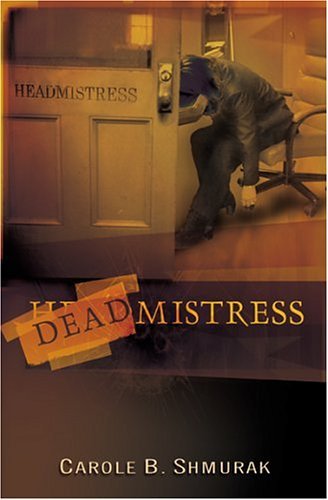 Deadmistress
is Carole’s first work of adult detective fiction, and it’s a good
one. (No mystery novel that starts out with a map in the front
can ever be bad, and I noticed that the Math and English building is
called Lewis Hall. Hmm.) Deadmistress
is Carole’s first work of adult detective fiction, and it’s a good
one. (No mystery novel that starts out with a map in the front
can ever be bad, and I noticed that the Math and English building is
called Lewis Hall. Hmm.)I’m starting off ahead of myself. The map is that of the campus of the Wintonbury Academy for Girls, and the headmistress is the one who has been killed. (No surprise there.) Sabena Lazlo was popular with almost no one, which makes for a lengthy roster of suspects, and what prompts Susan Lombardi, a former instructor there, to add her talents to the investigation, is that the list of suspects includes the large number of friends she left behind when she went to work at Metropolitan University. There is a continual twinkle in the author’s prose, as she allows Susan to tell the story herself. Both the author and Susan know the ins and outs of academic life, including never-ending battles over turf, although Susan, as yet untenured at Metropolitan, is still taken by surprise by how seriously some of the skirmishes are fought. (I’ve been caught unprepared like this, and caught in the middle, once or twice myself.) As for detective work, Susan’s only self-taught, and even though she’s learning on the job, she quickly discovers that she’s also pretty good at it. Even her work-at-home husband, Michael Buckler, inevitably nicknamed Swash, finds himself interested (and carried along) in her activities. Even so, as good as she is, she soon finds that she needs some professional assistance. In this case it’s from an older student, Mark Goldin, who at one time had a short career as a PI for a Hartford insurance company. The end result is a nice compact sort of detective novel, only 184 pages long, and for the most part, it goes down very smoothly. It’s well-written, and there are no typos at all, as far as I noticed, which is generally not the case with smaller publishers (and even with the larger conglomerates). But while there are a lot of suspects involved, there is not the level of complexity in the detective end of things that I would have liked to have seen. There is one clue that will point to the culprit immediately, if you should happen to think about it. On the other hand – and this is important – the author takes good care that you don’t. Think about it, that is. Misdirection is everything, and Carole Shmurak has it. What I found unrealistic, and therefore somewhat off-putting, is the final confrontation scene with the killer, as Susan gets some of the school’s students too directly involved, and how the police would let a show like this go forward, I couldn’t say. Also surprising me a little bit – well, hey, it surprised me a lot – was a bit of edginess that comes up in the relationship between some of the main characters, although one of them doesn’t know it, and that person had certainly better not find out ... ? February 2005
Update (10/05): Death by Committee, the second Susan Lombardi mystery, has been completed and is scheduled for publication sometime in 2006. I also have recently done an interview with Carole, which you can read by going here. HUGH McLEAVE - Vodka on Ice Pyramid T2387; paperback reprint, Feb 1971; hardcover edition: Harcourt, Brace & World, 1969.  I hope you will forgive me, but I’m going to start where the previous review of one of McLeave’s spy thrillers left off, and that’s with a bit of a bibliographic muddle. Most of the sellers of the hardcover edition of this book on ABE mention that the copies they have are the first US editions, but what no one seems to know is what title of the British edition was, nor have I been able to match it up with any of the other titles in his list of works. Mr. McLeave’s website is of no assistance, either, as only the Harcourt edition is mentioned, with no hint of an earlier one. Maybe, until I find the time to ask him to be sure, maybe there wasn’t one. Also incorrect is the setting Al Hubin has for the book in Crime Fiction IV. He gives it as England, and while it’s close, it’s no cigar. It begins in Bulgaria, as Bob McIlhenney, a well-regarded academic in the field of high-energy physics, flies in for a conference to give a paper. His high-flying non-academic conduct, however, which also includes a highly sensationalized taste for vodka – the good stuff extremely difficult to come by in Cold War Bulgaria – immediately attracts the attention of the Russian overseers of the country. Enter “Karen Schultz.” No reader of any number of spy novels, large or small, will believe that that is her real name, or that she could in any way on her own be attracted to this unruly American. McIlhenney does not believe it either, but he is certainly not about to toss any good fortune away that fate may have brought him, and who knows? Sometimes truth can be stranger than fiction. In any case, they soon find themselves working out a plan so that they can stay together. Are there ulterior motives in mind? First stop, Athens, then Paris, with McIlhenney’s plans succeeding on one level, but on another, getting them into more and more trouble as they go. It’s a good story, and if you were to track, say, “light-heartedness” on a chart all the way through both this one and the earlier book of McLeave’s that I read, the lowest point for Vodka on Ice would top the highest point on whatever scale you’re using for Second Time Around, in terms of making a head-to-head comparison. Which is neither good nor bad, I hasten to add, but it is an observation worth making. What is not so good, and I’m not saying that it’s bad, is that whenever there is a point at which the action is about to change, or when you sense that one of McIlhenney’s various charades is going to take a tumble... Well, let’s put it this way, I had several ideas about where the book was going, and the book went unobligingly off in its own steadfast direction and on its own terms. I can’t say that McLeave’s tale is unimaginative, because it’s not, but whenever I end a book thinking my imagination might have had the better of it, well, as I say, that’s what’s not so good. And, if you were looking for a tale with a lot of action, those James Bond fans who may be among you, references to From Russia, with Love on the front cover notwithstanding, this is not the one. For all of its aforementioned lightheartedness, the book is still rather formal and reserved, at least in comparison to Mr. Bond’s books, or at the very least in terms of how I remember them. Note: The cover shown is that of the hardcover edition. PostScript: I was thinking about this book a few weeks after writing the review above, and it occurred to me that the way that books like this differ from most of the thrillers written today, is that in books like this, it’s not the whole world that’s at stake. Books like this center on people, not massive world-destroying armaments. Keep in mind, however, that I don’t read most of the thrillers written today, so I may be completely wrong about this. At this stage it’s only a hypothesis, without enough sample data to support it or not, but at least it’s something to think about. February 2005
JILL
TATTERSALL - Chanters ChaseFawcett Crest; paperback reprint; (February 1979). Hardcover edition: William Morrow & Co., 1978. You cannot always tell a book by its cover. Take a good look. And pull your eyeballs back in. Whatever it is that you are thinking, that is not the kind of book this is. You also cannot always tell a book by the genre that even the publisher thinks it’s in. This one is billed on the cover – you’re going to have to look hard – no, not there, but up over there – as a “superb new romantic thriller.” And that’s the kind of book that Jill Tattersall was known for writing – see the list of titles below – but once again that’s not the kind of book this is. There’s a small amount of romance, it is true, and here and there a thrilling moment, but a romantic thriller? No. 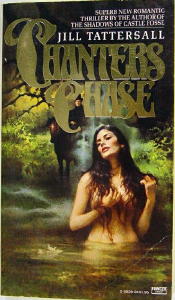 So what kind of book is
this? You may ask. It’s a detective novel, believe it or
not, and I will eventually get around to telling you how, and in what
way. But would it have sold if it had been marketed as a
detective novel? You may ask. And the answer is no, but
except for the fact that there is no castle in the moonlight with a
light in the window on a rugged moor in the background – that didn’t
come out exactly right, but you know what I mean – this could have been
sold as a gothic, and that’s the section of the newsstand where
you would have found it, but no, it’s not a gothic either. It’s a
detective novel. So what kind of book is
this? You may ask. It’s a detective novel, believe it or
not, and I will eventually get around to telling you how, and in what
way. But would it have sold if it had been marketed as a
detective novel? You may ask. And the answer is no, but
except for the fact that there is no castle in the moonlight with a
light in the window on a rugged moor in the background – that didn’t
come out exactly right, but you know what I mean – this could have been
sold as a gothic, and that’s the section of the newsstand where
you would have found it, but no, it’s not a gothic either. It’s a
detective novel.The year is never stated, but it appears to be Regency England, but the setting is not London. It’s a purely rustic or bucolic affair, with a small village atmosphere, even though most of the participants are high born, but not all. It’s also difficult, from the first three chapters, to pinpoint whom the leading characters are going to be, but as it turns out, it is not Mr. Aylmer Montague, whose nature turns out to be far worse than it first appears, nor is it Miss Alice Pargeter, who fancies that she is in love with him. On page 13 is the first appearance of a Miss Rede, a Miss Miranda Rede, who flits in and out of the story with the briefest of whispers, but long enough to suggest to Alice – and this is only a hint – that perhaps she has designs on Aylmer herself. But Aylmer, as it happens, is possessed of a cruel nature, and his way of life, his debts, and his debtors, are what leads to his death, the heir to his baronetcy being his cousin Nathan, who spies Miranda while bathing in a pond – see the cover – and ... Miranda’s grandmother is a sybil, which if you refer to Webster, means she is a prophetess, a hag, and from the context of the story – could it be? – a witch, and Nathan in a drugged, subdued state, unexpectedly finds himself married to Miranda. (Much of the early part of the book reads like an adult fairy tale, and so does much of the rest.) A marriage is all well and good, but what Nathan is also suspected of is the murder of his cousin – that is, it is to say, if the cousin were not disposed of by means of witchcraft. Which notion is not taken too seriously, until later, see below, and what this becomes, in truth, is an extremely early version of one of those English country house murders which were so popular in the 1930s. The inquest, in which forensic analysis takes a large part of the discussion – might it have been foxglove, who could have obtained it, and what forms of vomiting, et cetera, might it have produced? There is, as in the aforementioned English country house murder sort of mystery, an ensuing whirlwind of bewildering secrets and motives and family – keeping all of the names straight becomes somewhat of a challenge – and the death of the old woman by strangulation after the local townsfolk have marched on her home – picture pitchforks and burning torches – only adds to the mystery. Eventually a list of suspects is provided, and by page 241, Nathan confronts the several of those remaining: “There are really only four suspects in this matter, and three of us are here tonight. Shall we cast votes upon it?” Each writes a different name, but the case is closing in on the culprit, as the novel has only just over ten pages to go, which is still time enough to cast suspicion on at least one or another wrong party. What do you think? You do find detective stories often when you least expect them. This one is not a classic perhaps, but a classic of its kind, yes. Perhaps the only one of its kind. And that is a nice cover to go with it, isn’t it? Bibliography: JILL TATTERSALL, 1931 - . The English publisher on each book is listed first, but some of her books seem to have been first published in the US. The mystery here is why, after a long run of being published in hardcover in both this country and in England, did no further novels of crime fiction appear after 1980? A Summer’s Cloud. Collins, 1965. No US edition. Very scarce. (Only one copy is listed on ABE, and it’s a British paperback in fair condition. There may also be no demand for the book. The asking price is a very modest $1.97. A closer look indicates a notation in the description that says Sold.) Enchanter’s Castle. Collins, 1966. No US edition. Scarce. The Midnight Oak. Collins, 1967. No US edition. Scarce. Lyonesse Abbey. Collins, 1968. Morrow, 1968. Fawcett Crest, pb, 1969. A Time at Tarragon. Collins, 1969. No US edition. Scarce. Lady Ingram’s Retreat. Collins, 1970. Published as Lady Ingram’s Room: Morrow 1971. Fawcett Crest, pb, 1972. Midsummer Masque. Collins, 1972. Morrow, 1972. Fawcett Crest, pb, 1973. The Wild Hunt. Hodder & Stoughton, 1974. Morrow, 1974. Fawcett Crest, pb, 1975. The Witches of All Saints. Hodder & Stoughton, 1975. Morrow, 1975. Fawcett Crest, pb, Feb 1976. The Shadows of Castle Fosse. Hodder & Stoughton, 1976. Morrow, 1976. Fawcett Crest, pb, 1977. Chanters Chase. Hodder & Stoughton, 1978. Morrow, 1978. Fawcett Crest, pb, Feb 1979. Dark at Noon. Hodder & Stoughton, 1979. Morrow, 1979. Fawcett Crest, pb, Dec 1979 Damnation Reef. Hodder & Stoughton, 1980. Morrow, 1979. Fawcett Crest, pb, Dec 1980. Part of the answer to the question asked above may come from a further visit to the information you can find on the Internet. Damnation Reef takes place in the Caribbean, and note the titles of the works of non-fiction that turn up, although with very few copies being offered for sale. Columbus: The Great Adventure : His Life, His Times, and His Voyages. Crown, hardcover, 1991. Haunted Greathouses of the Caribbean. Island Legends, slim trade paperback, 1993. Legends of Beef Island. Paramount, softcover, 1996. [British Virgin Islands] One can easily believe that these last three books are by the same Jill Tattersall. March
2005
MICHAEL
PEARCE - The Point in the Market: A Mamur Zapt MysteryPoisoned Pen Press; hardcover; April 2005.  From the list of books found inside the front cover, you might conclude that this is the 12th mystery adventure of Captain Owen, the Mamur Zapt, the British head of the Sultan’s Secret Police in pre-World War I Egypt. But the count is off, and I’m not sure why. If you check the bibliography I’ve created at the end of this review, the number of books in the series certainly seems to be 15. No matter how many there are, this is the first for me, and that’s my error. Your error, too, if you’ve missed them as well, and you have a fondness for historical mysteries with a flair for the foreign and exotic. The British in effect controlled Egypt at that time, but until the war activities began, their power was veiled, careful to pretend that they were there as advisors to the government only. Now that an attack from Turkey seems imminent, the declaration of a British Protectorate and the subsequent ousting of the hereditary ruler called the Khedive have changed all of that. Owen’s case, in this adventure, is slow to come together, but eventually the body found in the Camel Market on page one is learned to be that of an Egyptian who occasionally reported as an agent to the Mamur Zapt. Whether his death was due to his ties to the British or not is part of the puzzle that Owen must solve. In the meantime, he has other problems. The Australians are in town to help fight the war, and they are loud and uncouth, and some Egyptians, starting to chafe under the more overt British rule, are beginning to take offense. Owen’s new wife is Egyptian, and she has begun to find herself cut off from both worlds. Not only that, Owen finds he must deal with a phenomenon totally new to Egypt, a burgeoning feminist movement that neither he nor the male portion of the population of Cairo is nearly ready to deal with. Pearce’s quiet humor and insight go a long way in disguising the fact that there’s no solid center to the story, and sometimes it is difficult to keep some unfamiliar names and places straight. In fact, if the mystery is all you would be interested in reading about, you could easily find yourself disappointed. But the sights and sounds of a country which seems to be on the verge of greatness again are vividly (if not lovingly) depicted, and they feel instinctively correct. And this is what makes this book such a delight to read, along with the people in it, who are drawn with charm, wit and care. The world they live in they find is changing, and they are often perplexed by it. Amusing, perhaps, to us, but of the utmost significance to them. It appears that I have an entire series of books to track down and read, plus more of some others: Bibliography Michael Pearce has two other series of books, the first featuring Dmitri Cameron, an ambitious young lawyer in the provincial 1890s Russian town of Kursk. Dimitri and the Milk Drinkers. Collins, 1997. Dimitri and the One-Legged Lady. Collins, 1999. Both of these are very difficult to find in this country, there being no US editions of either. More recently, another one is: A Dead Man in Trieste. Constable & Robinson, 2004. Carroll & Graf, 2004. Sandor Seymour of the Special Branch is sent to Trieste, 1906, on the behalf of the British Foreign Service. A Dead Man in Istanbul. Constable & Robinson, 2005. Carroll & Graf, September 2005. Sandor Seymour in the middle of trouble again. One non-mystery is The Dragoman’s Story. Severn House, 2000. Described as a comedy of manners involving foreign travel in the mid-Victorian period. But the books in the Mamur Zapt series are below. By my count, there’s now fifteen. The Mamur Zapt and the Return of the Carpet. Collins, 1988. Doubleday, 1990. Poisoned Pen Press, trade paperback, 2001. The Mamur Zapt and the Night of the Dog. Collins 1989. Doubleday, 1991. Poisoned Pen Press, trade paperback, 2002, as The Night of the Dog. The Mamur Zapt and the Donkey-Vous. Collins, 1990. Mysterious Press, hardcover, 1992; paperback, 1993. Poisoned Pen Press, trade paperback, 2002, as The Donkey-Vous. Mamur Zapt and the Men Behind. Collins, 1991. Mysterious Press, hardcover, 1993; paperback edition, 1994. Poisoned Pen Press, 2003, as The Men Behind. The Mamur Zapt and the Girl in the Nile. Collins, 1992. Mysterious Press, 1994. Poisoned Pen Press, trade paperback, 2003, as The Girl in the Nile. The Mamur Zapt and the Spoils of Egypt. Collins, 1992. Mysterious Press, 1995. Poisoned Pen Press, trade paperback, 2003, as The Spoils of Egypt. The Mamur Zapt and the Camel of Destruction. Collins, 1993. Poisoned Pen Press, hardcover, 2002, as The Camel of Destruction; trade paperback, 2003. The Snake-Catcher’s Daughter. Collins, 1994. Poisoned Pen Press, hardcover, 2003; trade paperback, 2003; trade paperback, April 2005. The Mingrelian Conspiracy. Collins, 1995. Poisoned Pen Press, 2003. The Fig Tree Murder. Collins, 1997. Poisoned Pen Press, 2003. The Last Cut. Collins, 1998. Poisoned Pen Press, 2004. Death of an Effendi. Collins, 1999. Poisoned Pen Press, 2004. A Cold Touch of Ice. Collins, 2000. Poisoned Pen Press, 2004. The Face in the Cemetery. HarperCollins, 2001. Poisoned Pen Press, 2004. The Point in the Market. Poisoned Pen Press, 2005. March 2005
Note: A shorter version of this review appeared in Historical Novels Review.
WILLIAM HEFFERNAN - A Time Gone By Akashic Books; trade paperback; 1st pbbk printing, April 2005. Hardcover edition: Simon & Schuster, 2003. As a journalist, investigative reporter and editor, along with many other honors, William Heffernan was nominated three times for the Pulitzer Prize. As a crime fiction writer, it’s not clear how many times he was nominated for the MWA’s Edgar, but he won it once, for Tarnished Blue (1995) as the Best Paperback Original. He’s also not an author I’ve read before. Looking through the list of 16 books he’s written, it’s not difficult to see why. Most of his books are either gangster (Mafia) fiction or hard-edged police procedurals (his Paul Devlin series), neither of which category seem to fall into my hands for bedtime reading. In recent years Heffernan has decided to expand his range, including making use of his extensive journalistic background. Alternating with books in his Devlin series have come Cityside (1999) a look into the more unsavory aspects of big city tabloidism, and Beulah Hill (2001), taking place in 1933 Vermont, with a murder of a white boy by a suspected black causing a severe setback to racial relations in the community. A Time Gone By is Heffernan’s most recent book, and it’s very much of a tour de force. Switching the time frame of a murder mystery back and forth between 1945 and 1975, and making it seem the easiest thing in the world, never clashing gears once, is a challenge I suspect not many authors would be up to. When a crooked judge is murdered in his home in 1945, Jake Dowling was only a rookie cop, and not even his more experienced partner could continue fighting forever when they quickly discover that a political fix is in. Thirty years later Jake, who for the most part tells his own story, finally has the clout and, after the death of his wife, the will to see if the case can be closed at last. There is a definite noir-ish feel to the scenes taking place in 1945, and of course, there is a woman involved, and even though Jake is married, with a child on the way, he falls deeply in lust (if not love) with the judge’s new widow, a former hatcheck girl who has made good. In 1975, Jake knows that the wrong man went to the electric chair. Even though the man had clearly committed other murders, Jake knows that he died for one he didn’t do, but who did? Thus develops the tantalizing interplay between past and present, with an enigmatic puzzle that roots itself into the mind of the reader as well, and refuses to become dislodged. While the transitions always take place smoothly, meshing into place in near perfection, I think the naive Jake of 1945, led around by the young widow by something other than his brain, is better developed than the Jake of 1975. As a chief of detectives for the NYPD, he still seems too callow for the job. How, one wonders, was he able to make all of the advancements he did to come out on top like this? It’s a subtle thing, and maybe it was only me. As for the mystery itself, it’s a winner, with – as the veteran mystery reader will suspect with increasing anticipation all the way through – well, you couldn’t have a detective story written as well as this without having a switch or two, and/or a substantial surprise or three, before it’s done, could you? I daren’t say more. If you’re fond of 1940s noir with a slight but appreciable touch of sexual infidelity, you’ll have to read this one for yourself. BIBLIOGRAPHY * = Paul Devlin series. Devlin is a detective with the New York City police department. Some descriptions of the books make it seem as though he reports directly to the mayor. Broderick. Crown Publishers, hc. 1980. No paperback edition. Caging the Raven. Wyndham Publications, hc. 1981. No paperback edition. The Corsican. Simon & Schuster, hc. 1983. Paperback reprints: Dutton (Onyx?), Aug 1987; Signet, March 1993. Acts of Contrition. New American Library, hc, 1986. Paperback reprint: Onyx, Aug 1987. Ritual. New American Library, hc, 1989. Paperback reprint: Signet, 1993. * Blood Rose. E. P. Dutton, hc, 1991. Paperback reprint: Signet, Dec 1993. Corsican Honor. E. P. Dutton, hc, 1992. Paperback reprint: Signet, Mar 1993. * Scarred. Signet, pb, Dec 1993. Reprinted: Onyx, Apr 1995. * Tarnished Blue. Onyx, pb, Apr 1995. Winner of 1996 Edgar award for Best Paperback Original Novel. * Winter’s Gold. Onyx, pb, Jan 1997. The Dinosaur Club. William Morrow, hc, 1997. Paperback reprint: Pocket Books, Dec 1998. Cityside. William Morrow, hc, 1999. Trade paperback: Akashic Books, Sept 2003. * Red Angel. William Morrow, hc, 2000. Reprint paperback: Avon, Dec 2001. Beulah Hill. Simon & Schuster, hc, 2001. Trade paperback: Akashic Books, Apr 2003. * Unholy Order. William Morrow, hc, 2002. Reprint paperback: Avon, Dec 2002. A Time Gone By. Simon & Schuster, hc, 2003. Trade paperback: Akashic Books, Apr 2005. March 2005
Note: A shorter version of this review appeared in Historical Novels Review. JUDITH SKILLINGS - Dangerous Curves Avon, paperback original, March 2005. Synchronicity strikes again. If I only knew what the deep underlying significance of the coincidence meant, I’d be a wealthy man. There is another mystery novel that came out in exactly the same month as this book, and it has exactly the same title. The gods of the cosmos must be chuckling deeply in their underground grottos, or up their sleeves. Or something. Is there a stock on Nasdaq that we all should be buying? Or should that be NASCAR that we should be looking into? The other author is Pamela Britton, and while this one by Judith Skillings just happened to come first, I will read and report back on Britton’s book very shortly. But before I get to either one, it has occurred to me to investigate. Just how many other books are there with the same title? Here are a few more, working backward through the mysteries, then a few others: DANGEROUS CURVES - Jacey Ford, 2004. DANGEROUS CURVES - Kristina Wright, Silhouette Intimate Moments, 1999. DANGEROUS CURVES - Bart Banarto, 1951. DANGEROUS CURVES - Peter Cheyney, 1939. DANGEROUS CURVES AHEAD - Pat Ballard, 2004 (a collection of romance stories about Rubenesque heroines) DANGEROUS CURVES: THE ART OF THE GUITAR (sorry, I’m getting rather far afield here, and I shall stop) The book by Kristina Wright should be in Hubin’s Crime Fiction IV, by the way, and it isn’t. Peter Cheyney is a hugely prolific British crime fiction author of the 1930s and 1940s, whose work I confess I’ve never read, but which I have always imagined that I will. There never was a real Bart Banarto, a house pseudonym used by a British paperback publisher in the 1950s by the name of Edwin Self. Other titles include Dames Play Dumb, Rackets and Dames, Doublecross Dame, Dangerous Wanton, and Lament for a Blonde, among others. We can only imagine what we are missing. 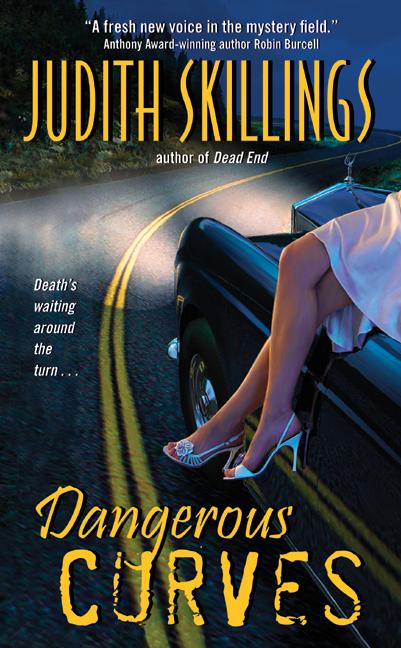 But obviously I digress. Judith Skillings, whose second mystery this book is, is the co-owner and operator of a motorcar restoration shop, along with her husband, in eastern Pennsylvania, and is involved with several other racecar-related activities. Which makes the occupation of her heroine, who appeared earlier in a book called Dead End, not all that surprising. Rebecca Moore, once a top-notch investigative reporter, is now the owner and operator of a classic car restoration shop in suburban Washington DC. That may sound like a snide remark, and it isn’t meant it to be. I know very little about restoring antique cars, and what I learned about it from this book is fascinating. What’s not so intriguing, from a reader’s point of view, is that... Put it this way. If you haven’t read Ms. Skillings’ previous book, you may as well assume you have, once you’ve gone more than a few chapters into this one. The events that took place in the previous book prior to this one are hashed and rehashed, and several times over. Even by page 113 we are not done. There is even more of the backstory we need to be reminded of, and in even more detail. A more experienced writer may have made this more palatable, but Skillings doesn’t yet seem to be at that stage of her career. The death of a young exotic dancer, whose body is found in an antique Bentley parked on a flatbed trailer outside an upscale strip club, makes for a fine opening. But more than who was responsible, is why someone would want to put her there, or how she could get there on her own after being stabbed, going down two floors, across a parking lot, up onto the flatbed and into the car? Or why the car was not locked. Too many questions, too few answered. The strip club does make an ideal place for Rebecca to go to work undercover, but there is also more promise here than there is follow-through. (I do regret saying this.) There is a writing technique that doesn’t generally appeal to me, and it’s one that Skillings tends to use far too often. (Which is to say, at least one time too many.) This is the one in which chapters end on a “cliff-hanger” of sorts, then the scene shifts, and later and only later does the reader find out what happened the chapter or so before. Not only that, but when the follow-through is eventually revealed, but only through the conversation of two people, of whom perhaps one or neither were actually involved themselves, it’s an irksome itch that becomes halfway annoying. But maybe that’s just me. There’s another problem. Besides some very unorthodox police work that is conducted in general, to put it mildly, on page 325 Rebecca muses to herself that on this case she herself hadn’t been much of a detective: “She hadn’t been clever enough to find out who was pulling the strings... She hadn’t been perceptive enough to notice him hiding in the shadows of the dining room.” If you’re going to read a detective mystery that’s over 330 pages long, you really need a stronger leading character than this, one who’s more active in solving the mystery than this, as interesting as her primary (non-sleuthing) occupation may be. Take all of the funky friends and employees she has, throw in the sort-of half-on half-off romance she has with two of them, add the mystery that’s beginning to develop about her parentage, wrap them all up, and no matter how you try to factor it all in, it’s all still background. As a matter of course, most of the issues raised along these lines have not been resolved by book’s end, and this is a good thing. There’s a quite a bit that’s clearly has to hashed out some more next time around, and it’s obvious that a good many readers are going to be coming back for more. But with the detective work itself is as essentially non-consequential as it is in Dangerous Curves, that’s not what it is, unfortunately, that they’ll be looking for. March
2005
KATHARINE HILL - Dear Dead Mother-in-Law E. P. Dutton, hardcover; First Edition, 1944. FOOTNOTE. 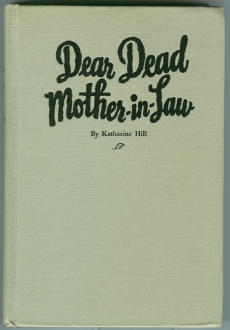 This is the first half of
a two-part series on
Katharine Hill’s complete works of mystery fiction. Part two,
covering her second novel, Case for
Equity, also involving her series character detective, Lorna
Donahue, will be reported on shortly. This is the first half of
a two-part series on
Katharine Hill’s complete works of mystery fiction. Part two,
covering her second novel, Case for
Equity, also involving her series character detective, Lorna
Donahue, will be reported on shortly.In Crime Fiction IV, Al Hubin provides us with no information on Katharine Hill, neither birth nor death date. She seems to have written the two books and vanished. But not quite, or at least not completely. The copyrights on both books were renewed in the early 1970s, so she was still alive then. I also have tracked down the name of a sister, and the sister’s daughter, but – all three have common names, and the hunt has bogged down. If I obtain more information, you can be sure I will let you know about it, and as soon as possible. Lorna Donahue is a widow who lives in Connecticut, the town of Ridgemont, to be precise. Even though fictitious as far as Connecticut is concerned, it’s obviously a wealthy sort of town in the semi-rural Wilton-Weston-Ridgefield suburban part of the state. Or at least in 1943 or so, it would have been quite rural, and with a gasoline shortage a large problem of the day, walking was a common alternative to driving. Only gradually do we learn about Lorna’s prior life: several husbands, on the stage, the newspaper game and now the real estate business, for which she has a partner, thankfully, for it allows her both (a) to be snooping into homes while people are gone and (b) to have someone to run the business while she is busily doing the aforementioned snooping. These last two observations are my own. Found dead at a bridge party is a recent bride’s outspoken mother, emphasis on outspoken, and it is her husband (of the recent bride) who is accused of killing his mother-in-law. And clapped immediately into jail, with no provision for bail, and so he sits, as the daughter (and his wife) moves in with Lorna. Who of course does not believe for a moment that he did it. Much more likely is the snooty woman (my observation) whom the dead woman, not long before she died, accused of cheating at cards on the continent, in partnership with a younger man everyone assumes she was cheating on her husband with (now deceased). Or it could have a tramp. Britain never had a monopoly of tramps to be murder suspects. Without my being able to come up with a better word, the sleuthing that is done is charming, as long as you can ignore the fact that the police department on the job is not on the job, because if they were, Lorna would have hardly a role to play. The small town atmosphere is evoked through many small details, describable only by someone who lived through that small era in time, unreproducible by someone would attempt to write a story taking place in such a setting today. The humor is sneaky but not all subtle. From a brief passage, as Lorna takes in her new guest (Pamela, the daughter), page 39: Mrs. Donahue fitted out her pathetic house
guest with a pair of her own pyjamas, flowered in green on purple and
they were her quietest pair, which would contained three Pamelas, and a
toothbrush in cellophane which she had on hand for emergencies.
Later on, Lorna is trying to envision what kind of defense that Walter (the son-in-law) might be able to raise. From page 166: The inference was therefore inescapable
that the person who killed Ada Mullins by swinging a bottle over her
head had left the scene, carrying the bottle with him. The
disappearance of the bottle proved, ipso facto, the disappearance of
the killer – and that the man who had not disappeared, who had remained
innocently and jovially preparing doubtless mild cocktails for the most
prominent and respected of Ridgemont’s ladies, was not the murderer, in
spite of the circumstances deemed so damning by the prosecution, that
he was a married man whose mother-in-law was not a pauper, and that he
had not been on th best of terms with her every moment of his married
life. Could every member of the jury assent that there had never
been a breeze at breakfast – a time when few of us are at our best –
between him and his mother-in-law?
You have probably decided long before now whether or not this is book you feel urged to seek out and purchase on the Internet, and I don’t blame you at all. The detective work is successful, however, no matter how improbable (and perhaps even naive) its basis in reality may be. Gritty hard-boiled fiction it’s not, but please don’t get me wrong. Following the clues and solving the mystery – that’s the edge that makes this old-fashioned suburban cozy work for me. April 2005
SHANNON DRAKE
- WickedFOOTNOTE:
I’ve done some investigating, and my copy of the
book is not a First Edition after all, even though it is so stated on
the reverse of the title page. On the title page itself the
publisher is given as: Books Inc., Distributed by E. P. Dutton &
Co., Inc., 1944, New York.
I inquired of bookseller Nelson Freck of Second Story Books in Washington DC, and his reply was that his copy did not mention Books, Inc., at all. Even though mine appears to be the same as the Dutton edition, except for the information on the title page, it must have been printed as part of a special arrangement between Books, Inc., and Dutton, using the same plates to publish both editions. HQN (Harlequin), paperback original, 2005. Shannon Drake is one of the pen names of Heather Graham Pozzessere, who has written even more under her own name or as Heather Graham, with (it is said) over 100 books and stories to her credit. Those by Shannon Drake seem largely to be historical romances, some with a bit of crime or mystery component to them, like this one, her most recent. Four them are vampire novels, which is a “hot” category for romances these days, although I confess that I have no understanding why. (Anne Rice may have started this particular craze, but here comes the point where you will have to tell me more, rather than the other way around.) As either Heather Graham or herself, Pozzessere’s list of books seems to be the same mixed bag, but with perhaps a larger percentage of them being crime and/or mystery-related, including a book called Haunted (Mira, 2003), the first in a projected series of cases that Darcy Tremayne, a psychic ghost hunter, is hired to look into. 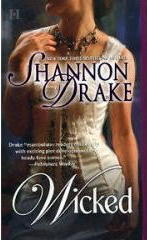 I say “projected” since, as of the date I am writing this, a second installment of the series has yet to appear. If I hear more about a second adventure being published, I will let you know. In the meantime, how about a murder mystery taking place in Victorian England, complete with Egyptian artifacts and mummies, cobras (asps), loads of them, a wounded war hero who wears a ugly mask crafted in the form of a beast to hide his injuries, and the daughter of a prostitute who has earned her way into a position of significance in the Egyptology department of the British Museum? (I almost forgot that this last sentence was a question.) There are a number of suspects in the deaths of the parents of the current Earl of Carlyle, and although he has all but withdrawn from the world and allowed the grounds of his castle to become as overgrown as a jungle, he is keenly intent on bringing the killer to justice. Camille Montgomery is first a pawn in his plans for vengeance, but she very quickly comes to mean much more to him. I will supply no further details along this direction, but in terms of what transpires in many other historical romances, what takes place in this one is, frankly, rather mild and tame. As a work of semi-gothic fiction, this is one of those affairs in which everyone acts suspiciously – and therefore irrationally – but there are a couple of fairly neat twists in the plot before the book is at length concluded, almost 400 pages worth. The rest is sheer melodrama, with several questions left answered (why didn’t he or she do this or that much earlier, and so on) and told in prose and dialogue that resembles that of the Victorian era quite often, if not all of the time. I happen to like stories based on Egypt and Victorian explorations and excavations like this, but my recommendation for you is that you should read this one only if you really, really like them too. And then if you’d rather read the latest Amelia Peabody book instead, then by all means, you should. April 2005
PATRICIA HARWIN - Slaying Is Such Sweet Sorrow Pocket; paperback original; first printing, March 2005. This one caught me by surprise. You don’t know how seldom it is, unless you’ve been paying awfully good attention, that when I pick up a second book in a series to read, I’ve actually read the first one. Nor, looking back to my review of the first Catherine Penny mystery, Arson and Old Lace (Pocket, Feb 2004), did I expect this one to be published so soon. To jog your memory, here are the last couple of sentences in the review of that earlier book I did: “And Catherine Penny, prone as she is to rash and impulsive behavior, is a bit of fascination in herself. It’s too bad that we'll have to wait until Fall of 2005 for a return visit, scheduled to be told in Slaying Is Such Sweet Sorrow.” [NOTE: The review itself is not yet online.] 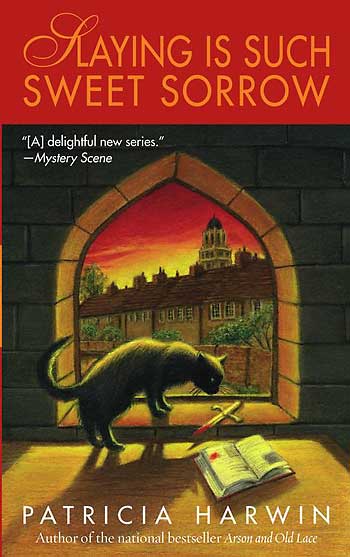 A quick recap is in
order. Catherine Penny, in her 60s and newly (and abruptly)
divorced, has moved to England to be near her daughter, who was
actually closer to her father. On her own, and in her own home, a
cottage in a small town not too far from Oxford, she helped unravel a
mystery soon after arriving. A quick recap is in
order. Catherine Penny, in her 60s and newly (and abruptly)
divorced, has moved to England to be near her daughter, who was
actually closer to her father. On her own, and in her own home, a
cottage in a small town not too far from Oxford, she helped unravel a
mystery soon after arriving.In this followup case, matters cut closer to home. It is her son-in-law who is accused of killing the newly appointed head of his academic department at the University, a man intensely disliked by all – but Peter, to his misfortune, had really thought the job was his. Complicating matters, at least for Catherine, who tells her own story, is the arrival of her former husband Quin, accompanied by the “bimbo” for whom he had left Catherine. I expressed some displeasure at the amount of non-essential background in a book by Judith Skillings a short while back. Here is, I think, a counter-example to the proposition that it can’t be done. Which is to say the feat of combining the personal background of the detective with his or her friends within the main context of a mystery novel, which is, of course, the work that detectives have to do. There is also the knack of working the details of a previous book unobtrusively into the current one. Although she’s also a new author, Patricia Harwin, whose day job is a librarian, seems to have it. Another plus, at least for me, is the large amount of academic talk and continual references to aged British dramatists, which may provide a large yawn from Hammett enthusiasts, but to each our own. There are, it seems, two major stories here. One is Catherine’s prickly relationship to Quin, which is uncomfortable even to the person who is only reading about it. And the other is Catherine’s awkward determination to get Peter out of jail, which she does of course, but as in Harwin’s previous book, with too many pages to go, and in terms of naming the real killer, the long-time mystery reader is there way ahead of her. Which of course signifies only one thing, or at least (once again) it did for me. It may be that when a mystery is well-written, with characters well-developed from the get-go, that the murderer identifies himself (or herself) almost as soon as he (or she) arrives on the scene, and that is the case here. Or could be it that Harwin is almost too careful in setting the scene, and overplays her hand? The nabbing of the culprit also suffers from the same over-planning, allowing the reader to follow along and see exactly (a) where the personalties of those involved lead directly the result and (b) where chance rather than pure detection comes in. I submit to you that (a) is good and that (b) is not so good, but – perhaps? – it is unavoidable. Quite possibly I am overanalyzing this. Where Harwin succeeds, and Skillings did not, is in making the two halves of the story (the mystery vis-à-vis the characters) parallel each other, merge where they need to, and then allowing them to mesh into a satisfactory whole. What she aims to do, she does well, and once again, I’m looking forward to the next one. April 2005.
CARLETON CARPENTER - Deadhead Curtis, paperback original; 1974. Paperback reprint: Black Walnut, 1985. 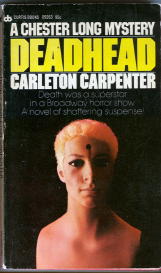 If you were to do a search for Mr. Carpenter on the Internet, you’d find more in the movie and entertainment databases than you will regarding his writing career, which consisted of only a small handful of paperback originals. There’ll be a list of them soon, in case you’re interested, including two new discoveries (both relatively minor) not included in Al Hubin’s Crime Fiction IV. Before concentrating on the books, though, perhaps it suffices to say that Carleton Carpenter was a both a composer and an actor, in both the movies, on television and in Broadway musicals. One of the top musical hits of 1951 was “Aba Daba Honeymoon,” sung by Debbie Reynolds and Carleton Carpenter (from the film TWO WEEKS IN LOVE). His career in the movies and on TV is summed up neatly at imdb.com. I did find a reference on a New York Times website that says, and I quote: “Carleton Carpenter was better known in the 1960s, 1970s and 1980s as a best-selling mystery novelist; one of his more popular books, Deadhead, was adapted into a short-lived Broadway musical.” Without deliberately trying to be negative, I imagine that the best-selling part of that quote is an exaggeration, New York Times or not, but a Broadway play based on a paperback original? What do you think, if it is true, wouldn’t that be a first? (I should point out, however, that all of the other references to Deadhead being on Broadway seem to have been swiped from the NYT website. Additional confirmation is needed.) Here’s a list of Mr. Carpenter’s mystery fiction. As previously mentioned all of these are paperback originals. * = Chester Long mysteries. ** = billed as a Jasper Wild mystery. Games Murderers Play. Curtis 07271, 1973; Black Walnut, 1985. Cat Got Your Tongue? Curtis 07272, 1973; Black Walnut, 1985. * Only Her Hairdresser Knew... Curtis 07299, 1973; Black Walnut, 1985. Pinecastle. Curtis 09187, 1973, as by Ivy Manchester; Black Walnut, as Stumped, as by Carleton Carpenter. * Deadhead. Curtis 09263, 1974; Black Walnut, 1985. ** Sleight of Hand. Popular Library 00661, 1975; Black Walnut, as Sleight of Deadly Hand. The Peabody Experience. Black Walnut, 1985. Short story: “Second Banana.” Alfred Hitchcock’s Mystery Magazine, October 1976. 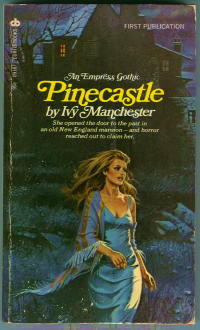 Information
that is not in
the currently unrevised Crime
Fiction IV is in boldface. Little is known about Black
Walnut Books, but they seem to have been in business only to print Mr.
Carpenter’s books. Information
that is not in
the currently unrevised Crime
Fiction IV is in boldface. Little is known about Black
Walnut Books, but they seem to have been in business only to print Mr.
Carpenter’s books. Whether Jasper Wild appeared in any of the earlier books or was intended to be another continuing character is also unknown. It would also be interesting to learn whether the AHMM short story has either Chester Long or Jasper Wild as characters, leading or incidental. Someone with access to that issue will have to let us know. Pinecastle (aka Stumped) was marketed and sold by Curtis as a gothic romance, but a quick scan through my copy indicates that the people who are in it all have a very strong theatrical background, which is not surprising. Chester Long is a hairdresser (straight). Jasper Wild’s occupation: unknown. Someone who has a copy of Sleight of Hand will have to let us know. If by chance he’s a magician as well as a detective, that would be worth knowing. There is a quote on page 34 of Deadhead, which was Chester Long’s second brush with murder, that is interesting. Chester is telling the story: I’ve forgotten which wag said it first. That thing about how everybody has two professions – his own and show business. When Chester is offered a position on the side as the head of the hairdresser crew for a musical bound for Broadway, he jumps at it. For the rest of the book he’s a fascinated observer behind the scenes, giving the reader an equally vicarious (and authentic) look at a world largely foreign to us mere mortals. Even so, as Chester admits on page 81: In my heart I knew I was nothing more than a voyeur who was being overpaid for the opportunity to peep. The going is as light and breezy as this for over 100 pages, chatty and gossipy in trunk loads. The murder of the show’s bizarrely flamboyant producer does not occur until page 104, which gives Chester this follow-up opportunity to show his flair as a sleuth. (Not that there’s any inkling of a previous criminous adventure. Until I checked out the bibliography, I was working under the impression that this was Chester’s first encounter with detective work.) With the entire company on the road and snowed in as a mammoth snowstorm hits Boston, the effect is that of an isolated country house, which means, of course, besides clues and motives, means and opportunities galore. And until the end, when things seem to fall apart, plotwise, there would be much in the reading to recommend. While Carleton Carpenter is a story teller’s story teller, he unaccountably allows Chester’s previously mentioned flair as a sleuth to fizzle out well before the finale, all of his theories disappearing into smoke. On page 189, after the killer has been nabbed, and the case is being rehashed, Chester says: This has been hindsight babbling on. I was just as surprised as anyone else. What’s worse is if that the scene that’s described on page 190 as happening really did happen, it happened offstage, or if not, I did not remember it, nor could I find it when I went back to look. My feeling is that the book was edited, and badly, and a chunk is missing. There was one other sudden jump in locale on page 157, which was disconcerting at the time, but the lapse was not nearly as critical as this one, occurring as it does during the summing up. (To see if the later edition fixed up anything, I checked out the Black Walnut reprint of the novel, but it’s purely a photocopy, or else they used the same printing plates. The two editions are exactly the same.) In any case, all I can offer for a recommendation is hemi-semi-demi-positive one. The book is worth reading for the show business element – that part is simply Grade A all the way – but as a mystery, while it has its moments, the answer, if that’s what you’re asking, is, reluctantly, no. The cast and choreography are excellent, but the book itself? Good, but not up to par. It needs some work. April 2005
KATHARINE HILL - Case for Equity E.P. Dutton, hardcover; First Edition, 1945. Digest paperback reprint: Mystery Novel Classic #74, as The Case of the Absent Corpse, 1946. This is the second half of a two-part series on Katharine Hill’s complete works of mystery fiction. Dear Dead Mother-in-Law (Dutton, 1944), Lorna Donahue’s first foray into fighting crime, was reported on not too long along, and here is her second. As of yet, no additional information has been discovered about the author, but not all of the available resources have been exhausted, so there is still hope. The two books take place in consecutive summers, but if Katharine Hill had another summer (and another mystery to be solved) in mind, it (or they) unfortunately never materialized. Once again the red-headed suburban Connecticut widow, married four times, gets on the wrong side of the local law, in the guise of Chief of Police Starkey, first by parking in an illegal spot in front of the post office, then by calling him out to a isolated home in the country where she’s found a body – but when he gets there, there is no body to be found. The owner of the house is an actor, one with a role in a local play, and when he doesn’t show up later for work, it is, of course, a “Case for Equity.” But is the dead body, the one that disappeared, his? Lorna does not know, and so she goes to work, determined to show Sharkey what’s what. From page 20, as she finds the house empty the next day: 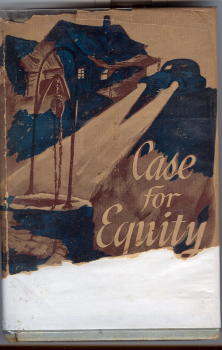 And what a glorious opportunity for an
amateur detective – to have the scene of the crime all to herself
without any interfering officers of the law shouldering about,
collecting and removing clues to be numbered exhibits later;
obliterating all the subtle indications that might tell much to a
perceptive woman, in their eagerness not to overlook the smallest
material evidence – the dropped button, the cigar or cigarette ash, the
bullet embedded in the woodwork!
Later on, from page 33: Surely no professional detective had ever
had such a difficult task as this self-assumed one of hers. With
the corpse just briefly glimpsed once, and not available for
examination, without knowledge of the nature of the wound or the weapon
used – her horrified mind had merely registered that there was a lot of
blood about – with no fingerprints or other regulation aids, this
mystery must be solved, if at all, by psychological methods, by
intuition rather than by deduction – perhaps by nothing more scientific
than that leap across probabilities to the truth which is known as a
hunch.
As even the most seasoned mystery reader knows, without my reminding him or her, it is also awfully difficult to solve a murder when one does not even know who the dead man is. And to Lorna’s credit, her efforts are ... not awful. There are pieces of manuscript salvaged from a fire, and a letter from the missing man (who may be the dead man) which may or may not be forgery. There are also intricate time-tables describing the whereabouts of all of the interested parties, a poker chip left fortuitously under an table, and more. In similar fashion to her previous mystery, Mrs. Donahue takes the missing man’s widow(?) under her wing, and simply moves in with her to facilitate her investigation. There is much of interest to the inveterate mystery buff here, and a very clever plot to be uncovered, so why it just doesn’t work is also a mystery. Part of the reason, though, may be because of the extremely narrow group of people who take an active role this time around. Even the old-fashioned kind of mysteries that invariably take place in isolated English country house mansions have more active suspects and/or active players than Case for Equity does. It’s a closed set, and after a while, even in the wide-open Connecticut countryside, the reading starts to feel cramped. (In Dear Dead Mother-in-Law the town of Ridgemont seemed filled with people. Not so now. It could almost be a ghost town.) While this book has all of the right elements, in other words, they’re not spread around thickly enough and/or they’re simply not laid out properly, without the tight Christie-like control over events. It’s another case of almost, but not quite, and with no intention of being unkind at all, that could also be easily said of Katharine Hill’s writing career. Other the other hand, you should not get me wrong. Read her if you get the chance. Neither of her works of detective fiction deserves obscurity either. April 2005
 PAMELA BRITTON -
Dangerous Curves PAMELA BRITTON -
Dangerous CurvesHQN (Harlequin). Paperback original, 2005. This is the second half of a two-part series on books titled Dangerous Curves published in the same month, March 2005, and of the two, the first one, a couple of books back, has considerably more to offer. Not that this one doesn’t try hard. Up front, of course, it is what it is – a novel of contemporary romance. It’s also set up to appeal to mystery fans – one of the leading characters is Cece Blackwell, a top-notch undercover agent for the FBI – as well as to NASCAR fans – she’s assigned to investigate a raceway accident which may not be so accidental. To her surprise (you will see why in a minute) it was race team owner Blaine Saunders who specifically askedfor her presence on the case. Cece and Blaine grew up together, you see, and they have had a past of sorts together, but it is not one that Cece looks backward upon with pleasure. In other words, she had a crush on him in high school and he humiliated her. Since you know already where this part of the story is going– or if not, read pages 129, 206 and 237– but since this is a mystery journal, or it was the last time I looked, let’s consider the mystery portion of the proceedings. I submit to you that a female FBI agent who worked her way through school waitressing at Bimbo’s may not have a lot of credibility, but you may be more credulous than I. I also submit to you that the backstabbing and infighting that is carried on between various agents and their superiors is mildly off-putting, although you may find it mildly interesting. Unfortunately, I must also submit to you that given the fact that the culprit has been named and is in custody (if not dead) on page 319, and that there are 362 pages in the book, that this shows where the author’s real priorities are, and it has nothing to do with racing. The NASCAR aspect is only a convenient and peripheral backdrop. If you’re an auto racing fan, in other words, I’m sure you can do better. April 2005
IAN ALEXANDER - The Disappearance of Archibald Forsyth Hutchinson & Co., British hardcover, no date [1933] A quick recap seems to be in order. Back in Mystery*File 46, one of the items in Al Hubin’s “Addenda to Crime Fiction IV” columns revealed that Ian Alexander was a previously unknown pen name of Alexander Knox. In the very same issue, and totally unconnected with the Hubin entry, Charlie Shibuk mentioned Alexander Knox as one of the actors who appeared in Andre DeToth’s film NONE SHALL ESCAPE. This very remarkable coincidence went unnoticed by me, but naturally Charlie spotted it right away. He added the following information, which appeared in the letter column of M*F 47: “Knox was born in Canada in 1907 and appeared on stage and screen in England and America. He portrayed the title role in WILSON (1944).” I then added the following:  After taking a
look at Alexander
Knox’s career, I see that Charlie neglected to point out that he was
nominated for an Oscar for his role in WILSON. Concentrating
otherwise only on his literary output, I found the following statement
on the web: “In 1971, Knox would become the proud author of
five adventure novels based on the Canadian wilderness of the 19th
century.”
Two of them can be found in Hubin, Crime Fiction IV: The Enemy I Kill (London: Macmillan, 1972, hc) U.S. title: Totem Dream. Viking, 1973. Raider’s Moon (London: Macmillan, 1975, hc) St. Martin’s, 1976. Two of the others seem to be: The Kidnapped Surgeon (London: Macmillan, 1977, hc) St. Martin’s, 1977. Night of the White Bear (London: Macmillan, 1971, hc) Viking, 1971; Toronto [Canada]: Macmillan, 1971. A fifth title could not be found. The alternate titles for one of them may have caused some confusion. FOOTNOTE (1) As Leonard Blackledge, Knox wrote one crime novel entitled Behind the Evidence (Hutchinson, 1935), and as John Crozier, he wrote two others: Murder in Public (Hutchinson, 1934) and Kidnapped Again (Hutchinson, 1935) Both of these featured a character called “Falcon,” who presumably was not THE Falcon of movie and radio fame, and created in book form by Drexel Drake in 1936. (Or was it Michael Arlen, in a 1940 short story called “Gay Falcon”? The radio series always credited Drake as creator of the character, who was called Michael Waring; Arlen was always the one stated as creating the fellow in the 1940s movie series: either Gay Lawrence (George Sanders) or Tom Lawrence (Tom Conway). I need some help here?) FOOTNOTE (2) And the Internet being what it is, making it easy to search out books – and find them – in a fraction of the time it used to take, no matter how many connections you had with land-based bookshops, I of course went searching, and here is the result: a report on the only book Knox wrote under this nom de plume. The sleuth in the book is a very interesting fellow, indeed, and it’s a shame that this was apparently his only case on record. His name is Eagels, he works and has a growing reputation as a private investigator in London, at least with Scotland Yard. He’s also, well, I’m going to do some extensive quoting here, if you don’t object too loudly. From pages 12-13: Eagels
was a man whom it was impossible to pump. Most people have their
little weaknesses, their penetrable moments, but Conway [from
Scotland Yard] has
never seen this tall figure when it was not utterly self-possessed, the
features composed and unmoving, the dark eyes caves above the high
cheek-bones, caves with fire in their depths. Eagles was a North
American Indian. His father has been a chief of the Iroquois, has
done
well in Canada and given his son an excellent education along the lines
of the white man he saw about him, but he had not neglected to give him
the keys to the great storehouse of the knowledge of his own race.
Eagels never had a Christian name that anybody knew. His skin was remarkably fair for an Indian, and he had served seven years with the Royal Canadian Mounted Police before he was connected with the bootlegging case that made his name in America. He had come to England shortly after, a strange man, gaunt and somewhat uncanny. Already his unusual facilities were being noticed by Scotland Yard. He had worked with the Yard on several cases while he was still connected with the R.C.M.P., and there was a mutual respect between them which the passing months did nothing to diminish. Eagels’ secretary and trusted assistant is Millicent Doe, who also deserves a mention. They make an unusual couple working together. From pages 20-21: They
were working late. Eagels had dinner sent in at about
eight-thirty,
and for half an hour they left their desks and ate a strange, silent
meal by the fire. They were odd companions. The perky,
rather hard
American girl, bred on the Broadway booze racket, efficient, capable,
terse, emotionless, and the Indian, inheritor of a vanishing
race.
When they talked it was as if what went between the lines was more
important than what was said.
Question: Is this the first appearance of an American Indian as a detective? How many others are there? FOOTNOTE (3) Here is something else equally striking. Read this, taken from page 72, as Eagels is thinking over the case so far (and yes, I promise to tell you something about that sometime soon as well): Conway
might go to the house if he liked with a preconceived theory, but he
wouldn’t. With this fact fixed in his mind, the complete refusal
to
theorize in advance which he had learned from Holmes himself the only
time he had met him, Eagels listened to the conversation of the others.
On page 97, Eagels considers what to do about a butler with an unfortunate habit of listening at doors: “I
suppose,” he said, half aloud, half to himself, “that a bribe to keep
his mouth shut would only open it wider. Old proverb: ‘Mouth shut
with
wampum will open with more.’”
From pages 102-103 we find a tidbit of understanding about Eagels’ philosophy of human nature: Eagels
could not help throwing a backward glance at the gloomy house as he
left it, and thinking of the tortured hours the two children were going
through [it is their father who has disappeared, probably
murdered],
hours that would probably echo all through their lives with recurring
misery. He wondered if the influence which was behind it all had
ever
thought of the effect his actions would have on the happiness of the
people he touched. Even the most callous, ordinary person, he
thought,
would have some consideration for other people’s feelings. This
seemed
to him sufficient distinction between the ordinary person and the
person who is capable of murder.
Crimes of sudden passion excepted, Eagels worked on the theory that a murderer is never a perfectly ordinary being. He is lacking in some quality, some essential element of humanity. He was quite convinced that a normal person is as incapable of murder as he is incapable of building a sky-scraper single-handed. I have been thinking about the next quote, whether to include it or not, and I’ve decided, what the hey, let’s go all the way. From pages 126-127: “Anyway,”
said Conway, suddenly heaving a sigh, “this proves one thing that we’ve
been thinking. It’s a gang that’s at the bottom of the whole
business. If it is a murder, there must have been at least two
people
to get the body away from the church, and if it was enforced
disappearance, they must have had more. If he disappeared
himself,
there are strange goings on which I can only explain by bringing in a
gang. I can’t see the motive, though, that’s the worrying part.”
“Yes,” said Eagels, “I’d thought of that. A gang seems the only solution. At least it seems the only solution at present. I don’t like it. If it was murder, it was too clever for a gang. The best murders are done by specialists – no accomplices. If it wasn’t murder, I don’t understand what has happened since. What about the will? Have you looked into Forsyth’s financial position?” “He’s not as rich as he was five years ago, but then, who is?” [Remember that is was 1933.] “He’s quite sound? No wriggling out of debts or anything?” “No debts that I can see. He was a careful old miser.” “What do you think of the note he left?” “The one you pinched from me, you mean?” “The one we made the little mistake about.” “Mistake my eye.” Conway grinned. “I don’t see why you wanted to have it; it was obviously a forgery.” “Too damned obviously.” “What do you mean?” “Well, I haven’t examined it yet, but it looks to me as if Forsyth was disguising his own hand.” Conway whistled. Luckily Miss Doe is a forgery expert, among other skills, but Eagels’ outwardly competent and calm facade does not reveal the torment roiling up inside. From pages 230-231: If
he had been resolved before, Eagels was filled now with a determination
that comes to few men. Down somewhere deep within him there was
smouldering a terrible hatred. He admitted to himself that he had
muddled the case horribly. The detectives of fiction that never
make a
mistake never occurred to him. He remembered the great detectives
of
reality – Sherlock Holmes himself – had sometimes been saved from grave
errors by luck, and luck alone, but could he expect luck now?
Holmes
had never depended on luck. “Get your man.” The catchword
was still
branded on his brain. “Get your man.”
“I’ll free Donald,” he swore to Joan. “Please, please trust me.” There is more. On page 233 Eagels is confronted with an important document that has disappeared from a locked safe: Could
Feeny have taken the paper away with him? No. Eagels had
read it
after he left. Conway? No, he didn’t even know of its
existence, and
the porter had said no one climbed the stair after he went out.
Therefore nobody entered the office at all. But the paper was
gone!
Nobody entered the office. Eagles thought carefully, remembering that if there was a contradiction in facts, it did not mean the facts were definitely wrong. It meant that his connection or interpretation was wrong. There is a lot of confusion just before the end. A lot of action occurs that has no meaning – until at length, in Chapter Sixteen, beginning with page 278, all is revealed. That it takes most of ten pages is quite telling. If this is your kind of detective fiction, as it is mine, usually, and yes, it’s probably an acquired taste today, you’re going to wish that this was not the only recorded appearance of detective Eagels.
April
2005
FOOTNOTE (1). (4/18/06.) Pat Hawk has come up with what presumably is the fifth Canadian wilderness novel: Bride of Quietness, Macmillan-UK, 1933. FOOTNOTE (2). (9/05/06.) Jamie Sturgeon has uncovered some information on the Falcon that Alexander Knox wrote about as by “John Crozier,” namely that Falcon was yet another Native American detective working as a PI in London, with a female secretary perhaps not unlike Millicent Doe in The Disappearance of Archibald Forsyth. Check it out in the Readers Forum. FOOTNOTE (3). My asking the question about Native American detectives prompted me to – guess what? – make a checklist. There are still a number of gaps in my results so far, but if you go here, you can see how far along I am. CHARLES L. LEONARD - Sinister Shelter Unicorn Book Club; reprint edition. Originally published by Doubleday Crime Club, 1949. Digest paperback reprint: Bestseller Mystery B141. Pulp magazine reprint: Two Complete Detective Books, May 1950 (probably abridged).  One way you can read
mystery and
detective novels from the late 1940s and early 50s, if you can’t
come across them in any other way, is to find them in hardcover book
club editions,
either from the three-in-one Detective Book Club, or the four-in-one
volumes that came from the Unicorn Mystery Book Club. Of the two,
the Unicorn Books were classier in appearance, and they look very
handsome on the bookshelf. They didn’t last nearly as long as
their competitors, however, including of course the Dollar Mystery
Guild, which eventually came along. (And still is going strong
today, although you can certainly forget the dollar part of their name.) One way you can read
mystery and
detective novels from the late 1940s and early 50s, if you can’t
come across them in any other way, is to find them in hardcover book
club editions,
either from the three-in-one Detective Book Club, or the four-in-one
volumes that came from the Unicorn Mystery Book Club. Of the two,
the Unicorn Books were classier in appearance, and they look very
handsome on the bookshelf. They didn’t last nearly as long as
their competitors, however, including of course the Dollar Mystery
Guild, which eventually came along. (And still is going strong
today, although you can certainly forget the dollar part of their name.)In any case, without going further into their history (for now), I just bought about 20 of the Unicorn books on eBay, and over the next few weeks I’m planning on using them for reading material. Whether I skip around or read whole volumes at a time, I haven’t decided, but if it makes any difference, I think I’ll try reading this particular grouping all the way through. Stay tuned. In real life Charles L. Leonard, author of eleven private eye Paul Kilgerrin novels, of which this one, was M. V. Heberden, who also wrote two other series of PI novels under that name, one featuring Desmond Shannon (17 books), the other being Rick Vanner, who appeared in three. I’m not sure when the secret came out, but I imagine some eyebrows were raised when the initials M. V. were revealed to stand for Mary Violet. It’s been a while since I read any of them, but what little bibliographic information is about her books on the Internet suggests that they were tough, rugged and a little hard-boiled, reminiscent not at all of “shrinking violets.” While nominally a private eye, in this particular book Kilgerrin given an assignment by the government to help stop a flood of illegal immigrants from coming into the US after World War II. And from the list of titles he appeared in, he seems have been an undercover spy much more often than he worked out of an office where good-looking women who came in were apt to be his clients. Here’s the list, below. I think you’ll come to the same conclusion as I did. (All of the books were first published in hardcover by Doubleday Crime Club.) The Stolen Squadron (1942) Deadline for Destruction (1942) The Fanatic of Fez (1943) Secret of the Spa (1944) Expert in Murder (1945) Pursuit in Peru (1946) Search for a Scientist (1947) The Fourth Funeral (1948) Sinister Shelter (1949) Secrets for Sale (1950) Treachery in Trieste (1951) Not that there aren’t good-looking women involved. While he is working undercover to get a line on the people smugglers, Kilgerrin befriends the members of a refugee family who are trying to make their way into the United States via Argentina. Among them is a young widow and her young boy who are living with her husband’s parent, said husband having disappeared after being arrested by the Nazis some time before. Kilgerrin is kind and gentle with the family, especially with Irma, and if he is hard-boiled about some other things, with her he does not seem to be. The essence and general ambience reminded me more of Hammett than it did Chandler, and for a long time, it was difficult to understand why. (I’ll return to this later.) Kilgerrin works with a firm goal in mind, but he has the capability of being able to improvise quickly, such as when the elderly father meets someone the family had known well back in Austria. Marie Louise, now Louise Ritter, is the other woman in the story, and while her strong, enigmatic presence shifts the story quickly into second gear, it will occur to more than one reader, I am sure, that while coincidences like this often happen in the real world, fiction is never quite that strange. In a way, there is a morality play going on. How does one comport oneself in the face of tyranny, the elderly father wonders on page 121, one man, acting alone, against evil? Kilgerrin himself tries to be understanding with Irma, but often finds himself frustrated when she cannot forget the past, when it stays with her and she cannot free herself from it. The puzzle presented by the novel’s other lady of mystery gradually absorbs more and more of his attention. Kilgerrin has more in common with Louise Ritter, and he soon realizes it, making the question of how deeply she is involved with the smuggling gang all the more a matter of importance. (This could have been handled, unfortunately, somewhat more eptly.) Two entirely different women, and to Kilgerrin each is a mystery in different ways. The scene in which he last sees Irma is when (for me) the Hammett-Chandler comparison suddenly snaps into focus. There is very little action, surprisingly enough, until the end. Character studies need some patience on the part of their readers, and that’s what, in large part, this story is comprised of. On the other hand, just to be sure that you know there is one, I’m going to quote the last few lines of the book. I’ve tried to be very careful in setting this up properly. If I’ve done it correctly, this will demonstrate, more than anything else, that there’s more involved here than character studies. “... There are still gaps,” Morengo ended
unhappily. “It is a pity ... is dead.”
Kilgerrin shook his head. “When anyone with that much guts goes wrong, he or she has got to be killed,” he said.
April 2005
DAVID HILTBRAND - Deader Than Disco Avon, paperback original, April 2005. Here’s the first paragraph of my review of Hiltbrand’s first mystery, Killer Solo, which came out in January, 2004:  I was going to start this review by stating that this is the best rock
music detective novel I have ever read. It then occurred to me
that this may be the only rock music detective novel I have ever
read. I know there are others. Unless there are some that
aren’t coming to mind right now, though, I just haven’t read them.
I was going to start this review by stating that this is the best rock
music detective novel I have ever read. It then occurred to me
that this may be the only rock music detective novel I have ever
read. I know there are others. Unless there are some that
aren’t coming to mind right now, though, I just haven’t read them.Deader Than Disco, Hiltbrand’s second novel, also marks the second appearance of rock ’n roll detective Jim McNamara. I may as well say, up front and for the record, that Killer Solo is the better of the two, but with no other contender in sight, that leaves the first book still in the top position. Although other real life people in the world of show business (Gwenyth Paltrow, Sheryl Crow) are mentioned in passing, McNamara’s client is only an excellent clone (and reasonable facsimile) of singer superstar Madonna, a lady named Angel (Chiavone), who’s deeply involved with the murder of a superstar pro basketball player in her home, after a party, and she is strictly not talking about it, not to any one, and certainly not to McNamara, who was actually hired by Angel’s publicist, a lady named Lani. McNamara’s own demons, the ones that forced him out of active show business himself, drinking and a bad drug problem, are past him, and yet not entirely. He finds AA meetings to attend wherever he goes, which in this book includes a long stint in Hollywood, followed by a shorter one in Manhattan, and all the while keeping in touch with his sponsor back in New England. The latter being, by the way, a very good way of having someone around to bounce ideas off of. As a writer, Hiltbrand has a neat way of characterizing his characters quickly and sharply, even the ones who are only passing through. About 80% of McNamara’s investigation goes down well, but once he decides that the decamped diva has disappeared off to Detroit (well, Michigan, but it doesn’t match the alliteration) – and how’d he know, I do not know – all of the well-characterized characters recede into the background. With at that point only three players to play around with (Angel, MacNamara, and the killer) the well-honed tale (up to then) recedes as well into a badly rehearsed made-for-cable late night thriller. Chapter 40 begins with “It took a while to sort things out.” But unlike some complicated detective stories with lots of twists and turns in the plot, three more pages and it’s over.
May 2005
MEGAN ABBOTT - Die a Little Simon & Schuster; hardcover; First Edition, February 2005. There are books that come along, every once in a while – mystery fiction, that is – which belong almost in a category of their own. Die a Little, a first novel, is one of them. It might be been described as Southern Calilfornia “noir,” but if I were to say that, it would probably bring someone like Raymond Chandler immediately to mind. But while the milieu is the same – Los Angeles, Hollywood – brought up to date into the early 50s, rather than the 30s and 40s, this is not a book that I can imagine Chandler could have possibly written.  The problem I’m facing
right now is that “noir” is one of those words that means something
different to almost everyone. To me it’s when a story is has a
sense of darkness to it – well, yes, I know – a sense of desperation
and/or despair. Woolrich is noir, and in a way, I can almost
imagine that he could have written Die
a Little. Almost. The problem I’m facing
right now is that “noir” is one of those words that means something
different to almost everyone. To me it’s when a story is has a
sense of darkness to it – well, yes, I know – a sense of desperation
and/or despair. Woolrich is noir, and in a way, I can almost
imagine that he could have written Die
a Little. Almost.“Noir” to me is a story that happens to everyday people. Everyday people, that is, who sometimes, not always, have a bit of shady side to them. They find themselves in situations in which they struggle to get to out, and all they do is find themselves more and more caught up in the webs that fate has trapped them in. “Noir” is not everyday cheap thugs messing up their own lives in crummy, violent ways. “Noir” is not a private eye going about his everyday business, snooping into the business of others. “Noir” is not bizarre sex, the kinky stuff. Although, on the other hand – and this is important – any of these might be. It’s the tone, it’s the feeling, and it’s instinctive. I know it when I read it. And this book has it. “Noir” from a female point of view. Megan Abbott is not the first woman to write noir, but no one, male or female, has used the female point of view in quite the same way before — that of fascination and frustration, worry and envy. Could Woolrich have written this book? Keep reading. Lora King is a schoolteacher. Her brother Bill works for the L.A. district attorney’s office. They seem very close to each other, at least so far as the reader can tell from the way Lora tells the story. We never are privy to any of Bill’s thoughts, only Lora’s, and when Bill falls in love with – and marries – a victim of a minor automobile accident named Alice, it is, although she does not quite say this (although she does), it is as though her world has been turned upside down. And inside out. Alice, shall we say, is flamboyant, glittery, coarse (in a refined way), loud, trashy, with a mysterious (or even worse, dishonorable) past, with uncouth (and couth) friends and associates, but mostly uncouth, as Lora quickly discovers – very much the opposite of the siblings Laura and Bill. Bill is enchanted, Lora is protective, and Lora (although she never says so) is fascinated. Alice is a someone who has lived. Bill and Lora, up to now, never have. There is an eerie sense of mystery that envelops the three of them, so massively that at times there seems to be no room to breathe, for either the characters or the reader. When Lora goes with Alice to visit the latter’s friend Lois, Lora briefly eavesdrops on the other two when they do not know she is listening. From page 71, here is how she tells what happens: The words, their whispery, insinuating
tones, their voices blending together – I can’t tell them apart, they
seem the same, one long, slithery tail whipping back and forth.
My head shakes with the sounds, the hard urgency, and my growing
anxiety at being somehow involved in this, even by accident, by gesture.
The voice – as it seems only one now – becomes abruptly lower, inaudible, sliding from reach. The more I strain, the more I lose to the ambient sounds of the courtyard, the radio, a creaking chair, the cat, the vague clatter of someone knocking shoes together, a bottle rolling. Lora begins to investigate Alice, her past, and the hold she has on her brother. From pages 110-111: It is with a vague twitch of guilt that I
begin watching her. Before I know it, I find myself watching her
everywhere. At Sunday dinner, at social events, at the new school
year’s first department meetings, I keep watching to see a connection,
a clue. A clue to what, though, after all.
There is a string I am pulling together, a string a question marks so long they are beginning to clatter against each other, and loudly. I count them on my fingers, beginning to feel the fool; the missing credentials, the unexplained absences, the playing card, the postcard, and now the address book. And perhaps most of all, Alice herself. Something in her. The hold so tight over my brother, and suddenly it appears more and more as thought she is this brooding darkness lurking around him, creeping toward him, swarming over him. Her glamour like some awful curse. In a book like this, it is the men who are the fragile ones. Alice is obviously the strongest, most inscrutable, of the three, but Lora, as it turns out – but that would be telling.
May 2005
Note: A shorter version of this review appeared in Historical Novels Review. J. A. S. McCOMBIE - Mandate for Murder Manor 15349; paperback original, 1978. I’m a sucker for books by obscure, one-shot mystery writers, and here’s one that qualifies on both counts. The copy of this book that I purchased off ABE was the only one that was available for sale at the time, and at the moment, a couple of months later, there haven’t been any others that have turned up for sale. Nor I can find a record of any other books written by Mr. McCombie, mystery fiction or not. Hubin’s Crime Fiction IV supplies some information: The initials stand for John Alexander Somerville, and he was born in 1925, but that’s it. But a search on Google suggested that McCombie was involved with the movie business, and so it was off to the Internet Movie Data Base. Pay dirt. Sometimes known as J. A. S. McCrombie, he was the screenwriter or wrote the story for: ● Evil in the Deep (aka The Treasure of Jamaica Reef). 1975. Stephen Boyd, David Ladd, Roosevelt Grier, Cheryl Ladd (before she was a Ladd). An adventure-drama about the search for a treasure-laden Spanish Galleon that sank over 200 years ago. ● Money to Burn. 1983. Jack Kruschen, Meegan King, David Wallace. Comedy: A school counselor and two misfit students decide to plan a bank robbery. ● Run If You Can. 1987. Martin Landau, Yvette Nipar, Jerry Van Dyke. Thriller: A young woman accidentally sees snuff films through a satellite dish aberration and alerts the police.  Coincidentally, or not, all three films were directed by Virginia L. Stone, who was also the co-producer, along with McCombie. (On the other hand, Virginia Stone was married to long-time director Andrew L. Stone, about whom more might be said at some later date.) In any case, I should have known that McCombie was involved with the movies or television, just from reading the book he wrote. Not that I’ve ever watched the current television smash hit 24, but I thought to myself, and more than once, that the person who came up with some of the hard action twists in Mandate for Murder really ought to be writing for more money than Manor Books ever paid him. The book’s set mostly in Hong Kong and the area surrounding. When a wealthy sophisticated terrorist kidnaps the consular general, the nephew of the US Secretary of State and the husband of a Senator’s daughter (and the goddaughter of the President), what he hopes to gain is the leverage to free a cohort from a northern California prison. Which may be all you need to know. There is torture, there are multiple deaths, some of them occurring surprisingly early, and there is a lot of local color. The writing, although sometimes very sloppy, is vivid and cinematic (not surprisingly) and moderately compelling. The author also seems to know airplanes and other flying craft, of which there are several that are flown and/or blown up during the course of this book. (No animals were harmed, however, as I recall.) Unfortunately, which I believe is the correct word, the big surprise that McCombie has in store for the reader is one which I had anticipated long before. When the smaller twists start accumulating too quickly, one of the side effects that can happen is that the reader starts thinking too much about the larger picture and what the author may have up his (or her) sleeve. Or in other words, from a structural point of view, unless the author is adroit and nimble-fingered enough at the keyboard, too many twists can be counter-effective, since it can leave the big, would-be jolt naked and exposed and not so terribly difficult to smoke out in advance. And so it is in this case.
May
2005
[UPDATE] 06-03-07. There are now four copies listed on ABE, in case you might be interested, and I did watch the final four weeks of 24 in last season’s series. PHILIP MacDONALD - The Rasp British hardcover: Collins, 1924 (see photo). US hardcover: Dial Press, 1925. Hardcover reprints (US): Scribner’s (S.S.Van Dine Detective Library), 1929; Mason Publishing Co., 1936 (see photo). Contained in Three for Midnight (with Murder Gone Mad and The Rynox Murder), Nelson Doubleday, 1962. Paperback reprints (US): Penguin #586, 1946; Avon G1257, 1965; Avon (Classic Crime Collection) PN268, 1970; Dover, 1979; Vintage, June 1984 (see photo); Carroll & Graf, 1984. 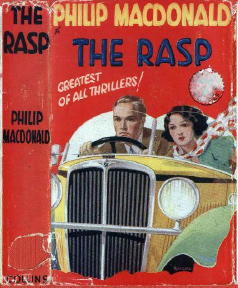 There was a British film
based on the novel that came out in 1932, and Philip MacDonald also
wrote the screenplay. According to IMDB,
the featured players that appeared in the movie were Claude Horton (as
Anthony Gethryn), Phyllis Loring (Lucia Masterson), C.M. Hallard (Sir
Arthur Coates), James Raglan (Alan Deacon), Thomas Weguelin (Inspector
Boyd), Carol Coombe (Dora Masterson) and Leonard Brett (Jimmy
Masterson). If you think you’d like to see this on DVD sometime
soon, so would I, and so would a lot of other people. This is a
“lost” film, with no known copies in existence. There was a British film
based on the novel that came out in 1932, and Philip MacDonald also
wrote the screenplay. According to IMDB,
the featured players that appeared in the movie were Claude Horton (as
Anthony Gethryn), Phyllis Loring (Lucia Masterson), C.M. Hallard (Sir
Arthur Coates), James Raglan (Alan Deacon), Thomas Weguelin (Inspector
Boyd), Carol Coombe (Dora Masterson) and Leonard Brett (Jimmy
Masterson). If you think you’d like to see this on DVD sometime
soon, so would I, and so would a lot of other people. This is a
“lost” film, with no known copies in existence.I hadn’t realized it before this, but MacDonald was involved in a good number of other movies, all as author of the original story, as screenwriter, or – as also with Rynox, also made in 1932 – both. I’ll go into some of the other fare at some other time, but the good news for Rynox is that after also having been lost for 40 years, it turned out to only have been misplaced. A print was discovered in 1990 after 50 years in the Pinewood Studios vaults, acquired by the National Film Archive and transferred onto safety film. Is it on DVD yet? Probably not, but maybe? As for the book itself, now that my usual opening digression is over, a nice copy of the British first in jacket will set you back, I am sure, a figure in the low four-digit range. If all you care to do is to find a copy to read, you shouldn’t have to pay more than three or four dollars. Although I have several other editions, the one I just read was the 1984 edition from Vintage Books, and as far as the story’s concerned, there was still plenty of value left. As a Haycraft-Queen Cornerstone title, there may be more value from historical perspective than there is from a pure story point of view, although I was certainly entertained all of the way through. On the other hand, most readers of contemporary detective fiction will probably not get all that far into it, if they even pick it up in the first place. This was MacDonald’s first book. It was therefore also obviously the debut of his long-time detective character, Colonel Anthony Gethryn. Gethryn’s career started fast, with ten recorded cases between 1924 and 1933, then one in 1938, followed by a long gap until The List of Adrian Messenger came out in 1960. (There may have been some shorter fiction that appeared in the interim, but during the war years, there was very little if anything that MacDonald produced in the way of mystery fiction.) To most mystery readers day – to return to the thought I was having a paragraph or so before – a book that was written in 1924 is going to appear as a period piece, stodgy, if not out-and-out primitive. The “rules” of detective fiction were still being formalized – what constituted “fair play” and all that goes with it. This comment does not apply to thrillers, for which authors had other objectives. Working largely without a “Watson” to bounce his ideas off of, Gethryn notices a lot of things but often keeps them to himself, or at least the significance of them, which helps to explain the necessity of the entirely remarkable 46 page letter that Gethryn writes to the police afterward, laying out in immaculate detail all of his thought processes as he worked his way through the case. Let me repeat that. Forty-six pages. Is there a denouement longer than this to be found in any other work of detective fiction?  Dead, you may (at last) be
interested in knowing, is a noted member of the government. A
cabinet minister, in fact, a fellow named John Hoode. The murder
weapon is the titular woodworking tool. The place, the study in
Hoode’s country residence. The suspects are primarily the few
friends, relatives, staff and servants who were also in attendance that
fateful evening, as Gethryn soon eliminates The Woman in the case, to
his relief, for he has become madly infatuated with her. She is
Mrs.
Lucia Lemesurier, a widow – her previous husband apparently being
eliminated in the movie version – as soon as he meets her it is with an
all-but adolescent passion that renders him near speechless in her
presence. Dead, you may (at last) be
interested in knowing, is a noted member of the government. A
cabinet minister, in fact, a fellow named John Hoode. The murder
weapon is the titular woodworking tool. The place, the study in
Hoode’s country residence. The suspects are primarily the few
friends, relatives, staff and servants who were also in attendance that
fateful evening, as Gethryn soon eliminates The Woman in the case, to
his relief, for he has become madly infatuated with her. She is
Mrs.
Lucia Lemesurier, a widow – her previous husband apparently being
eliminated in the movie version – as soon as he meets her it is with an
all-but adolescent passion that renders him near speechless in her
presence.Accused by the C.I.D. is Hoode’s secretary, Alan Deacon, to whom all of the evidence seems to point. This includes the most damning: his and only his fingerprints were found on the woodmaking murder weapon. There is a good summation of the facts against Deacon on page 121. Gethryn demurs, however, and reassures the gentleman’s lady friend that all shall be well. Another detective writer’s creation is mentioned on page 43, where Gethryn declaims somewhat unhappily:
“And I feel as futile as if I were Sherlock Holmes trying to
solve a case of Lecoq’s.” He put a hand to his head.
“There’s something about this room that’s haunting me! What is
the damned thing? Boyd, there’s something wrong about this
blasted place, I tell you!”
For the most part, however, Gethryn putters about most happily, this game of investigation invigorating him no end, ending days of malaise after his return from the war (the first one). Most of Chapter Two is a mini-biography of Anthony Ruthven Gethryn, for those who would like to know more, but in essence he is the well-to-do bored genius, who needs the incentive of a murder to be solved to be at ease with himself. At least that’s his persona in this, his first appearance. Whether, like Ellery Queen, he changed over the years, at the moment I cannot tell you. Perhaps you can tell me. PostScript: I found another quote that I intended to include, and I didn’t. I can’t find an appropriate place to put it now, without interrupting whatever train of thought I was riding at a particular juncture, so I’ll put it here. What this seems to do is reinforce several of the ideas I was working on, especially toward the end of what I was saying. From pages 111-112, with Gethryn visiting Lucia in her drawing room:  For a moment his eyes
closed. Behind the lids there arose a picture of her face – a
picture strangely more clear than any given by actual sight. For a moment his eyes
closed. Behind the lids there arose a picture of her face – a
picture strangely more clear than any given by actual sight.“You,” said Lucia, “ought to be asleep. Yes, you ought! Not tiring yourself out to make conversation for a hysterical woman that can’t keep her emotions under control.” “The closing of the eyes,” Anthony said, opening them, “merely indicates that the great detective is what we call thrashing out a knotty problem. He always closes his eyes you know. He couldn’t do anything with ’em open.” She smiled. “I’m afraid I don’t believe you, you know. I think you’ve simply done so much to-day that you’re simply tired out.” “Really, I assure you, no. We never sleep until a case is finished. Never.” PostScript #2. I really do not know what to make of the cover of the paperback edition that I read.
May
2005
Update [06-02-07] I’ve belatedly decided to include a list of all of the Gethryn novels. UK editions only, but the US titles are given if they were changed: * The Rasp (n.) Collins 1924
[England]
* The White Crow (n.) Collins 1928 [England] * The Link (n.) Collins 1930 [England] * The Noose (n.) Collins 1930 [London] * The Choice (n.) Collins 1931 [England] US: The Polferry Riddle * The Wraith (n.) Collins 1931 [England; 1920] * The Crime Conductor (n.) Collins 1932 [London] * The Maze (n.) Collins 1932 [London] US: Persons Unknown * Rope to Spare (n.) Collins 1932 [England] * Death on My Left (n.) Collins 1933 [England] * The Nursemaid Who Disappeared (n.) Collins 1938 [London] * The List of Adrian Messenger (n.) Jenkins 1960 [London]  LESLIE FORD - The
Woman in Black LESLIE FORD - The
Woman in BlackPopular Library K63; reprint paperback, December1963. Hardcover: Charles Scribner’s Sons, May 1947. British hardcover: Collins (Crime Club), 1948. US hardcover reprint: Detective Book Club, 1948 [3-in-1 edition]. Other US paperback editions: Dell #447, mapback, 1950; Popular Library 60-2443, circa 1969. Magazine appearance: The Saturday Evening Post, a seven-part weekly serial from January 18 through March 1, 1947. As far as I can recall, this is the first mystery by Leslie Ford that I can recall reading. In doing so, it was with a small amount of bias, shall we say, when I started, having been given negative impressions about her work from others who have read her recently. This negativity was said to lie in Ms. Ford’s attitudes toward racial minorities, but perhaps by 1947, when The Woman in Black was published, this lack of sensitivity had begun to disappear from her work. Mrs. Grace Latham’s housekeeper Lilac is apparently black, but it is not so stated. The only way you will realize it is from her speech patterns. Here’s a sample, taken from page 19, the first time we meet her in the story. She’s helping to hide a young married woman who has come to Mrs. Latham for some advice: “You come downstairs with me, child,” she
said. She took Susan by the arm. “Mis’ Grace’ll go to the
door herself. You settle you’self and come with me.”
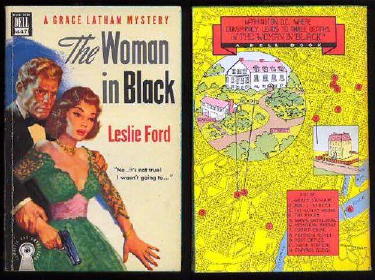 By itself I think this is
not only fairly innocuous but a pretty good example of a way with
words. What the reader gets in these two lines, with no further
description, a pretty good picture in his or her mind of who Lilac is
and what she may even look like. Is it harmful? Is it
demeaning? I’m predisposed to say no, but if you were to press
me, I don’t think that it would be too difficult to convince me
that any negative stereotyping, wherever or however it occurs, is
ever entirely wholesome. By itself I think this is
not only fairly innocuous but a pretty good example of a way with
words. What the reader gets in these two lines, with no further
description, a pretty good picture in his or her mind of who Lilac is
and what she may even look like. Is it harmful? Is it
demeaning? I’m predisposed to say no, but if you were to press
me, I don’t think that it would be too difficult to convince me
that any negative stereotyping, wherever or however it occurs, is
ever entirely wholesome.In any case, however, any racial attitudes that are displayed in the author’s earlier books, even done unconsciously, do not manifest themselves in this one to any degree more visibly than this. Not that I’m saying that the case is closed, but I also think that the backgrounds and settings of mystery novels, taken as a snapshot in time, do more to illustrate the attitudes and opinions of everyday people – for better or worse – than any number of history textbooks I ever studied from when I was in school. Grace Latham, who appeared in many of Ms. Ford’s books, is a widow and apparently a Washington socialite of some stature and renown. She has also made her mark as a sleuth of some distinction, even if only peripherally, as in this one, since the bulk of the real detective work is done by Colonel Primrose’s stalwart assistant, Sergeant Buck, and Captain Lamb of the Washington police department, who also appeared in many of Mrs. Latham’s adventures, but not all. After retiring from the military, John Primrose and Phineas T. Buck operated in tandem what Grace calls on page 13 a “subterranean private investigation business,” their clients very often being various governmental agencies. Primrose himself does not make an official appearance in this book. He’s quarantined with the measles throughout its duration. Behind the scene, however, he’s actively behind the investigation into the murder that occurs in this case, making numerous suggestions and keeping Grace out of trouble, or trying to. Dead is a woman who may have been blackmailing a wealthy industrialist who may have his eye on the White House, the blackmailer therefore being in two ways the lady in the title of the book. One of the various people surrounding the would-be presidential candidate, all of whom were at the same cocktail party, is very likely to have been the killer. Most of them are known to Grace, if not close friends, which many of them are, which makes solving the murder all the more difficult for her. Leslie Ford’s prose is sometimes not easy to read, and sometimes the time and location of where her characters are at any one time seem to be taken too much for granted. The difficulty in reading is also due to a “fretful” way of talking that sometimes seems to bunch itself up too much, making it slow going at times to work one’s way through. I think the following paragraph, the one quoted at some length below, may go a long way in illustrating this. Grace is with Sergeant Buck, who is trying to reassure her that Susan Kent (the woman being comforted in the quote up above) is not the killer. Grace, by the way, tells the story herself – all but a short Chapter One, which acts like a prologue, which I generally dislike, and once again, yes, I generally dislike it here as well. But to return to page 96, which I was leading up to, before that last digression: 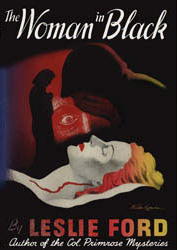 I said, “Thank you, Sergeant.” It
didn’t seem to matter, really, that that wasn’t what was worrying
me. I was grateful for what seemed to me a surprising mark of
confidence from one who’d regarded me as a plain sieve, always to be
viewed with the jaundiced and bilious eye of mistrust. But it had
never seriously entered my mind that Susan had shot Betty Livingstone,
puzzling as it was that she’d known her and actually had been at this
house. It wouldn’t make sense, I wondered again, then, about her
saying she didn’t know whether she was going to shoot Mr. Stubblefield [the
wealthy industrialist] or not.
I wished now I hadn’t been so abrupt and had been a little more
patient, and found out what she thought she meant, what she had really
trying to say when she said it. It seemed very involved and
bewildering, and I doubted, with her violent resentment toward me, that
I’d ever get a chance to have her clear it up.
Don’t get me wrong, though. Leslie Ford seems to have had an excellent insight into people, why they react the way they do; and into marriages that work, and those that don’t. The mystery element – the whodunit part – is also done in a highly acceptable fashion, all wrapped up in a package that in the end is worth unwrapping. To be completely honest, though, for those willing to stop reading a book that seems unsatisfactory before finishing it, there may easily be doubts along the way.
June
2005
KEN PETTUS - Say Goodbye to April Knightsbridge, paperback original; 1st printing, 1991. Knightsbridge was a short-lived company that published a wide variety of books, both fiction and non-fiction, including ones by Ralph Nader and Vince Bugliosi, not to mention 24 first edition mysteries listed in Crime Fiction IV, all from 1990-91. I’ve always suspected there was a connection between Knightsbridge and Kensington, an imprint from Zebra (or is it the other way around?) that is still going strong today, but a quick search on Google came up dry, so perhaps not. This connection was suggested, by the way, by the fact that the first mystery written by Jim McCahery, a friend of mine through DAPA-Em (I’ll explain some other time), was published by Knightsbridge (Grave Undertaking) and the second by Kensington (What Evil Lurks). The detective of record in both books was Lavina London, an elderly retired Old Time Radio actress. Knightsbridge also reprinted several books in Bill Pronzini’s “Nameless” PI series, most (or all?) in two-in-one packaging. Ones I know about are Dragonfire/Casefile, Hoodwink/Scattershot, and Labyrinth/Bones. They’re all scarce in the Knightsbridge editions: only seven combined copies of the three books are available at the moment on ABE. FOOTNOTE.  Say Goodbye to April is almost, but not quite, as difficult to come by. There are 12 copies now on ABE, and believe it or not, four of them can be purchased for a dollar each. If you’re one of the first ones to read this, you can get one cheap, in other words, but if you’re not quick off the mark, I’ll be willing to wager that a number of Mystery*File’s readership will have gotten there ahead of you, this book not being widely known before now as a private eye story. Which it is, and yes, I’m finally getting there. Ken Pettus had a long career before writing this, apparently his first and only book in print, as a high honcho in the world of television mystery and action-adventure drama, his credits including stints as scriptwriter for (I’ll start with the earliest ones first) Bonanza, Combat!, The Gallant Men, Branded, The Big Valley, The Wild Wild West, The Green Hornet, Mission: Impossible, The High Chaparral, Hawaii Five-O, Cannon, Jigsaw, Battlestar Galactica, Magnum P.I., and Shannon. It’s quite a resume, and there’s not one of these shows I wouldn’t mind having boxed DVD sets for. (Some more than others.) Pettus’s last TV credit appears to have been in 1985. Goodbye to April was published in 1991, but of course it could have been written at any time before then, only to filed away in a cabinet somewhere, waiting for a publisher to come along and pick it up. And if that’s the case, which of course is a matter of high conjecture only, it should have seen print long before it ever did. It’s no classic, but ... let me get into that now. The private eye who tells the story is Tug Cash, an ex-cop with a disability discharge. His partner on the police force, a heavy-set fellow by the name of Checkers (no first name discernible), is now retired and is running a PI agency. Tug works for him on occasion. The “April” in the title is April Tyson, their client in this case, who may be the long-lost missing granddaughter of one of those aged and reclusive multi-millionaires that California is so well known for. When the lawyer who is representing her, and who is also her live-in lover, is found murdered, she calls on the Checkers agency for help. That’s one of the story lines. Another has to do with a gang of hoodlums and drug-runners that April’s lawyer seems to have been mixed up with. It is not entirely clear for a good long while whether it was they who are involved in his death, or the gang of hangers-on surrounding the frail Mr. Tyson – including servants, crooked lawyers, crooked doctors, and a right-wing evangelist who, it goes without saying, is as crooked as they come. (The servants are a pretty devious pair themselves.) There is twist after twist in this tale, and they are not subtle ones. More like bombshells that explore on contact every once in a while. Pettus has a nice breezy style of writing, it almost goes without saying, with a tendency perhaps of being a little too “prime time,” which is to say that he has a tendency to allow dramatic happenings to overshadow the characters a little too much. Which forces Tug Cash to do some very strange things and to make some very strange decisions, some of which had me shaking my head at the time he made them, and sure enough, some very bad things happen as a result. On page 223, Cash calls himself a “crown prince of fools,” and no, I can’t disagree with his judgment there. A little lower on the same page, this concept is reinforced by the following. He’s walking on Venice (California) pier: I examined open-air shows with their
geegaw merchandise and browsed a bookstore, buying a paperback private
eye novel to see how a smart investigator operated. I sat on a
bench and read three chapters. It was depressing. The
fictional PI, as dumb as a brick wall, was still smarter than I.
In terms of his way with words, here, for what it’s worth, is Pettus’s take on the Santa Ana winds. Judge him for yourself in comparison with how Raymond Chandler (for example) may have said something along the same lines. From page 249: I went back into hibernation, and before
I noticed it July left and August arrived with unseasonable Santa Ana
winds, ready for a brush fire it could fan into an inferno and burn a
few thousand acres of brush and at least scorch a few
neighborhoods. Temperatures rocketed. I lived in shorts and
pair of mellowly mature huarachis.
A lot of people eventually die in this book, a staggering number so, and all because of one chance event – well, not a chance event, it was deliberate – and for Tug, it turns the entire case around. It was something also made me sit up and think about it as well. While what happened was something I was wondering about all of the way through, it did not at all occur to me that this (I can’t tell you more) is what it was that turns out to have happened. If you were wondering, at the end of the book there is only a small hint that Tug Cash is destined to appear again in a followup adventure. In any case, for whatever other reason there was, as it turns out, no he didn’t. It’s no classic, but for a book by a professional writer, one with which I found only minor problems to quibble about, as suggested above, you could do worse than keep an eye out for this one. August 2005
FOOTNOTE. A short note from Bill Pronzini confirms that these three doubles are the only books of his that Knightsbridge did. He also passes along all of the information he has about the short-loved company. E. V. CUNNINGHAM - The Case of the
One-Penny Orange
Detective Book Club three-in-one edition; hardcover; March 1978. Hardcover edition: Holt, Rinehart & Winston, 1977. Paperback reprints: Jove, February 1979; Holt/Owl, December 1981. That E. V. Cunningham was a pen name of Howard Fast is a fact that has been known for a long time, and Fast is someone whose literary career you could write a book about, so I won’t even try. It seems to accepted as common knowledge, though, that after being blacklisted for his Communist activities in the 1940s and early 1950s, he was forced to turn to self-publishing (the novel Spartacus) or to write under other names. (There is a wikipedia entry for him on-line, in case you’d like to learn more, and some googlizing will turn up a whole lot more, including an interview with him that appeared a few years before his death in 2003 at the age of 89.) Besides the Sgt. Masao Masuto series, of which this is one, E. V. Cunningham is also well known for a series of mystery or crime fiction in which the books are notable for having only the first names of women as their title: Sylvia, Doubleday, 1960. Phyllis, Doubleday, 1962. Alice, Doubleday, 1963. Shirley, Doubleday, 1964. Lydia, Doubleday, 1964 (HK). Penelope, Doubleday, 1965 (JC/LC). Helen, Doubleday, 1966. Margie, Morrow, 1966 (JC/LC). Sally, Morrow, 1967. Samantha, Morrow, 1967 (MM). Cynthia, Morrow, 1968 (HK). JC/LC = series characters John Comaday and Larry Cohen. HK = series character Harvey Krim MM = series character Masao Masuto John Comaday is a New York City police commissioner, and Larry Cohen is a Manhattan Assistant DA. Harvey Krim is a NYPD police detective. Masao Masuto is a Nisei detective with the Beverly Hills, California, police force. I’ve not read more than one of these, and if I did, it was so long ago it is impossible for me to say even which one it was. The Masao Masuto books are as follows: Samantha, Morrow, 1967. The Case of the One-Penny Orange, Holt, 1977. The Case of the Russian Diplomat, Holt, 1978. The Case of the Poisoned Eclairs, Holt, 1979. The Case of the Sliding Pool, Delacorte, 1981. The Case of the Kidnapped Angel, Delacorte, 1982. The Case of the Murdered Mackenzie, Delacorte, 1984. 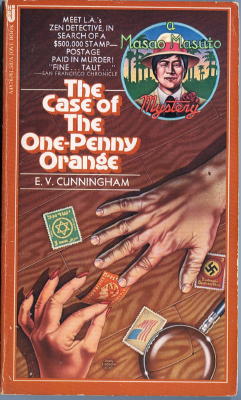 I’ve read a few of these, but none recently, so when I read Orange just now, it was as if Masuto was a brand new character to me. But you will (obviously) have noticed (A) the overlap between the two series, and (B) the ten-year gap between the first and second appearance of Sergeant Masuto. At this late date, one can only wonder what brought Fast around again to using him as a character. Masuto is a Zen Buddhist, and so was Fast, and perhaps that had something to do with it. Zen Buddhism certainly has something to do with One-Penny Orange as a novel, of that I am sure, and as you keep reading, you will agree as well. Perhaps I should start with the word Nisei, however, which according to one source refers specifically to Japanese-Americans who lived on the West Coast and were interned during WW2 because it was feared that they would support Japan in the war. On page 4 of Orange, however, in describing Masuto to the reader for the first time, Fast/Cunningham says that Nisei “means a native-born American who parents were Japanese immigrants.” I haven’t yet sorted out the difference between the two definitions, but it does occur to me to suggest that Masao Masuto may be the first detective in crime fiction to be a Nisei, and perhaps – some investigation is in order – the only one? I also do not know, but it is possible, that he is also the first Zen Buddhist detective in the world of mystery fiction. The category of Buddhist detectives includes John Burdett’s Thai-American detective Sonchai (Bangkok 8 and Bangkok Tattoo), and the investigations of Jonathan Lethem’s detective Lionel Essrog, who suffers from Tourette’s syndrome, in Motherless Brooklyn somehow involves him with a school of Zen Buddhism in Manhattan. Dutch author Janwillem van de Wetering, I am informed, is a former Zen Buddhist monk; whether either of his primary series characters, Detective-Adjutant Henk Grijpstra and his assistant Detective-Sergeant Rinus de Gier, are Buddhist, I do not know, but I do not remember them as so. But a quick search here and there do not turn up any other Nisei detectives in mystery fiction. If Masuto is not the only one, you will have to tell me. (Mr. Moto was Japanese, yes, but he was not Japanese-American, but Dale Furutani’s character Ken Tanaka may be.) It may have to do with his religion, or it may have to do with his ancestry, but one major aspect of Masao Masuto as a detective is – well, let me quote a short paragraph from page 6, where he is helping look into a breaking-and-entering in an expensive Beverly Hills home:
[The man’s] wife
folded down to the floor, crosslegged, and began to weep gently, a
broken ashtray in her hands, her position as broken and forlorn as the
cheap piece of crockery. As Masuto left the room, followed by
Beckman,
he felt a wave of compassion for the woman – yet objectively.
Perhaps
his greatest virtue as a detective lay in the fact that he was always
an outsider.
This burglary, in which nothing was taken, is followed by the shooting death of a stamp dealer named Gaycheck, and again nothing is found to be taken. This establishes a tenuous connection between the two incidents, at best, leaving it to the reader to decide how strongly to rely on Masuto’s belief that they are related. And more, that a fabulously valuable penny stamp (from the British colony of Mauritius and issued in 1848) is also involved. The reader must read carefully, for Masuto is also, as described by his colleagues and even himself, inscrutable. Here is another quote, this time from page 67. Masuto is being quizzed by his superior officer:
Wainwright stopped by his
desk. “What have you got, Masao?”
“A few pieces.” “Do you know who killed Gaycheck?” “I think so.” “You wouldn’t want to share that knowledge?” “I could be wrong.” “You give me a pain in the ass – so help me God, you do, Masao.” “Being inscrutable is part of the ploy. Look, Captain, I think I know who killed Gaycheck. I have no evidence, absolutely nothing.” By the time the book ends, there have been up to three murders (two known), and perhaps (Masuto believes) three different killers. You will have to read the book to see if he is right. You will also have to read the book to be able to enjoy what I consider to be both a strikingly unusual and yet beautifully appropriate ending. Masuto’s upbringing and background have a good deal to do not only with what he sees and understands, but also with the choices he makes.
No
one went unpunished, each made his own atonement, his own karma; and
for two people ... the pain was established and would never go
away.
He knew that.
Mysteries can seldom be described as gently told, but here’s one that’s certainly an exception. And as a one-time stamp collector myself, all that part of the tale did for me was nothing more than double the pleasure. 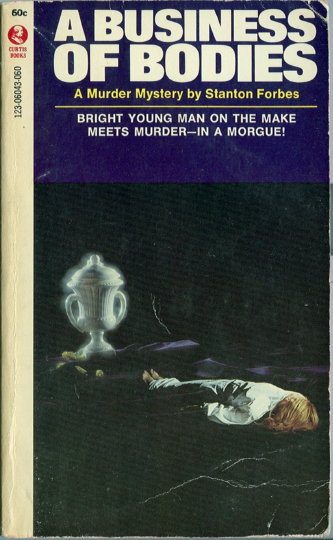 STANTON FORBES - A Business of Bodies Curtis, paperback reprint; no date, but circa 1966-67. Hardcover edition: Doubleday Crime Club, 1966. Hardcover reprint: Detective Book Club, three-in-one edition, January 1967. Curtis is one of those few publishing companies that never included a publishing date in the paperbacks they published. Comparing the stock number with the others for which the date is known, A Business of Bodies would seem to have come out in 1966, but I’m uneasy with the idea that it appeared before the hardcover DBC edition. One of these days, I keep telling myself, I’ll put together a complete checklist of all of the Curtis titles. It will not be easy. Their books were poorly distributed, and many of them are rare. Not pricey, for the most part, since there’s little demand for them, but hard to find if you’re looking for them. Only six copies of the Curtis paperback show up on ABE, for example, as opposed to 13 copies of the Doubleday hardcover edition. As to the author, Stanton Forbes was but one of three pen names used by DeLoris Stanton Forbes, the others being Forbes Rydell and Tobias Wells. She was born in 1923, with her first book, Annalisa, appearing in 1959 under the Rydell byline (which I have just discovered to be a joint one which she shared with Helen B. Rydell). The three books that have appeared after 2000 have all been under her full name, the only three (I believe) to have done so: One Man Died on Base, Five Star, hc, 2001. When the Hearse Goes By, Mystery and Suspense Press, trade pb, 2002. The Perils of Marie Louise, Five Star, hc, 2003. According to the Amazon listing for the middle book listed above, DeLoris Stanton Forbes “lives and works in Sanford, Fla., where as a volunteer she also manages a Habitat for Humanity boutique.” Another Internet website describes her as an “American author, broadcaster, newspaper editor, and clothing store owner, resident in French West Indies.” I’ve long been intrigued by some of the titles for the books she wrote, ones such as She Was Only the Sheriff’s Daughter; The Sad, Sudden Death of My Fair Lady; The Will and Last Testament of Constance Cobble; and (saving the best for last) If Laurel Shot Hardy the World Would End. These are all as by Stanton Forbes. Her series character, Knute Severson, appeared only in the Tobias Wells books, and I’ve read one or two of those. He’s a detective on the Boston police force, and (if I remember correctly) he later takes becomes head of the department over in Wellesley. Otherwise all of Forbes’ other books seem to be one-shots, such as this one, the one at hand, A Business of Bodies, which may have something of relative uniqueness to point out, and that is the fact that the primary setting is a funeral home. There have been books in which morgues have had significant importance – Jonathan Latimer’s The Lady in the Morgue comes swiftly to mind – but funeral homes? You’ll have to tell me. FOOTNOTE. And the book is told, surprisingly enough, from the viewpoint of an 18-year-old boy, Bill Beresford, who, about to head off for college in the fall, and needing a summer job, answers an Help Wanted ad placed by the Greeley Howe Funeral Home. From page one: I’d been accepted at State and I’d managed
to earn a partial scholarship, but I needed room and board money.
A job in a funeral home is better than no job at all, that’s the way I
reasoned. Besides, I told myself, why be dumb about it?
People died. Somebody had to bury them.
Then, of course, comes the night, early one, when he has to be the only one there once it’s become dark. From the opening of Chapter Two (page 13): There’s absolutely no reason why a funeral
home should be spooky at night. I mean, if a person dies he has
to be somewhere until he’s buried and there’s no place better for that
purpose than a funeral home. It’s a natural as being born and
living and dying.
What Bill also discovers, soon after taking the job, sort of a custodial position, is that the body of an elderly lady, supposedly sent out to be cremated, is still on the premises. Who was it, the question arises, who was in the casket when off it went? Not that Bill doesn’t also find time, not to be disrespectful, for matters that are important to a healthy young teenager. Take Mr. Howe’s daughter, for example, a couple of years older, but nice looking, even though a bit snobbish and stuck on the local sheriff Rex Ross. Who is married, but not happily, and Bill had always thought something would have sparked a romance earlier between Rex and his widowed mother but it never did. His mother instead seems more interested in Gabe Burke, editor of the local newspaper, but whom Bill dislikes, mostly on a matter of principle. Gabe does own a Mustang, however, and in 1966, well, forgive me, one more quote, this time from page 38: As much as I hated to admit it, the
Mustang was neat. Every so often somebody would look at us as we
went by. It was that kind of car, just enough, not too
much. My favorite was a T-bird, but some of the guys said they
were square since only old men could afford them so I’d kind of gotten
off it. The Mustang, though, was pretty cool.
Now, maybe you haven’t noticed, but what I’ve also been trying to do here is to demonstrate how perfectly I think that Stanton Forbes has picked up on the point of view of an 18-year-old buy. She’s not perfect at it, but as I was typing out these few quotes, I realized all the more she was doing it even better than I could, and at one time I was an 18-year-old boy. The romance with Cecilia Howe does not go far – nowhere at all, as a matter of fact – but being a detective seems to give a guy some confidence as far as girls go, and one by the name of Helen Casey soon enough to come along. Not only that, but she seems to have some Nancy Drew genes in her DNA – a statement that may not be technically correct; I never took biology – and she and Bill soon make a pretty good team together. Bill’s primary motivation for staying involved, to get back to the mystery, is to help Rex Ross, whose wife, with whom he was not getting along, seems to have disappeared, although supposedly off on vacation. This, I’ll say right here, is one of those mystery novels that keeps going off in directions you don’t expect. Characters you believe will be important when you first meet them sometimes fade away; while others of no significance, you think, turn out to have major roles. The resulting free-flowing story reminded me a bit of the pulp magazines, for some reason, or at least one written by an author who starts writing and simply lets the story take over, although not completely. Everything (to me) was perfect but the ending. It’s the right ending, but it’s not perfect. In the sense of Bill Beresford’s future, though, by the time the book ends, I think things are looking good. It would not be a summer that he would ever forget, and I kind of wish I might have had an adventure like this at the same age, but alas (and thank goodness) not. August 2005
FOOTNOTE.
A preliminary
checklist of mystery novels taking place in and around funeral
homes has been completed. Any additions or corrections would be
welcome.HARRY SHANNON - Eye of the Burning Man Five Star; hardcover, November 2005. I’ve done no investigation into the matter, but Harry Shannon’s latest work may be the first mystery novel to take place in part at Nevada’s hugely popular counter-cultural Burning Man festival, held every year over Labor Day weekend. On the other hand, Edward D. Hoch’s short story “Midsummer Night’s Scheme,” has it beat by a bit by appearing in the May 2004 issue of Ellery Queen’s Mystery Magazine. (And if neither is the true first, please help keep the record straight and let me know.)  Shannon’s series character – well, that’s what he is now, having made his first appearance in the author’s earlier mystery novel, Memorial Day (Five Star, 2004) – is a talk radio psychologist personality named Mick Callahan, who seems to specialize in rescuing women from bad situations. He’s cocky and he’s flawed, with a reputation (deserved) for self-destruction. Now in AA himself, he’s a larger-than-life figure that simply dominates Burning Man more than any other leading character in any book I’ve read in recent weeks, and that’s no exaggeration. In fact, all of the people in Callahan’s everyday life are strong, well-constructed individuals. They are people who will stay with you longer than the stock stick-like creations you find in many another mystery thriller, which is what Burning Man is, and not a detective novel by any stretch of the term. This is Harry Shannon’s second mystery novel, as far as I’ve been able to determine, but if you were to check out his website at www.harryshannon.com, as I did, you’ll find that he had three horror novels that were published before the Callahan books, not to mention a considerable amount of shorter stuff in the field of horror fiction. And horror fiction is what this reads like, toned down only a notch or two, so fans of sedate form of armchair detection, you might tread carefully here. Intuition and the stuff of nightmares, not logic, are what holds sway here, and decidedly so. There are scenes in this book that will cause you (the reader) to start yelling (figuratively) to the characters not to go there, not to do that, and (just like in the movies) they do anyway. Other scenes are designed to shock you out of your shoes. Some of them don’t – there’s a small amount of fizzle involved – but at least one of them will. Guaranteed. Here’s something else, but nonetheless in much the same vein. If you’re the kind of reader who likes to challenge yourself by trying to “solve the case” along with the detective on the case – that is to say Mick Callahan – it does not help to realize that this book is (in actuality) a sequel to Memorial Day, with an entire entourage of carry-over baggage. This time around it is Callahan who does his best to aid a girl who came to his rescue at the end of the previous one. While his efforts are perfectly readable on their own, you’re going to be far better off reading the first book first. The characters do not exactly spin their wheels in this book, but if you were to ask me, I’d have to tell you. They do come close. What Mr. Shannon succeeds in doing, though – and it’s worth repeating – is to make individuals out of them. And if you pick this thriller up – given the understanding of what it is, and what it is not – you are not likely to put it down too many times. STEPHEN MARLOWE - Homicide Is My Game Gold Medal 880, paperback original; 1st printing, May 1959. After first appearing in a couple of nondescript titles – The Second Longest Night (Gold Medal 523, October 1955) and Mecca for Murder (Gold Medal 575, May 1956) – Stephen Marlowe’s private eye Chester Drum began showing up in two sequences of titles. The first group was perfectly designed to catch the eye of an adolescent teenager. Ask me how I know? I graduated from high school in 1959, I was one, and I had them all: Trouble Is My Name. Gold Medal 627, January 1957. Murder Is My Dish. Gold Medal 658, March 1957. Killers Are My Meat. Gold Medal 693, August 1957. Violence Is My Business. Gold Medal 769, May 1958. Terror Is My Trade. Gold Medal 813, October 1958. Homicide Is My Game. Gold Medal 880, May 1959. Danger Is My Line. Gold Medal 947, January 1960. Death Is My Comrade. Gold Medal 986, April 1960. Peril Is My Pay. Gold Medal 1018, July 1960. Manhunt Is My Mission. Gold Medal s1116, May 1961. Jeopardy Is My Job. Gold Medal s1214, May 1962. Somewhere along the line Drum’s assignments began to take him more and more outside of the US, finding him working as a foreign agent in one guise or another. But the string of cases up above was interrupted briefly by a tour de force of considerable magnitude, Double in Trouble (Gold Medal d926, September 1959), co-authored by Richard S. Prather, in which Drum teams up with the former’s PI character, Shell Scott. Is this the first crossover/team-up between two series characters by separate authors in the same book? Let me know. After a book entitled Francesca (Gold Medal k1285, March1963), Drum began a new sequence of patterned titles in which (I believe) he worked only as an overseas operative. (This is not a new concept. While there were probably many others, Charles L. Leonard’s Paul Kilgerrin was also a private eye who also often did foreign intrigue duty. As you will recall, I read and reviewed one of his adventures, chronicled in a book called Sinister Shelter, not too long ago.) Drum Beat – Berlin. Gold Medal k1420, 1964. Drum Beat – Dominique. Gold Medal k1508, 1965. Drum Beat – Madrid. Gold Medal d1686, 1966. Drum Beat – Erica. Gold Medal d1796, 1967. Drum Beat – Marianne. Gold Medal d1909, 1968. 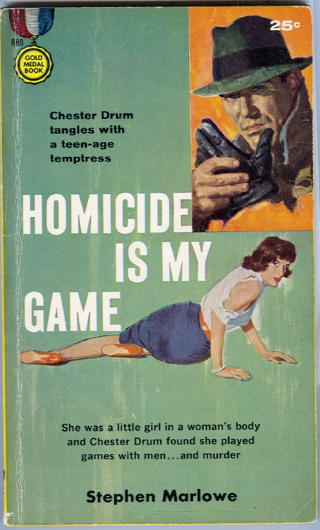 In the 1960s I was in
college, and so I no longer was as able to keep track of the monthly
Gold Medal titles as closely as I did in high school. Other than
James Bond, I also gradually decided that wasn’t all that interested in
spy stuff, and so I filled most of the Drum Beat’s into my collection
later. In the 1960s I was in
college, and so I no longer was as able to keep track of the monthly
Gold Medal titles as closely as I did in high school. Other than
James Bond, I also gradually decided that wasn’t all that interested in
spy stuff, and so I filled most of the Drum Beat’s into my collection
later.Do I remember most of the stories, the plot lines? Not really. I can pick almost any book that I read for the first time more than 45 years ago, and do you know what? It’s a brand new book. It’s as if I’ve never looked inside before. Do books like this stand up? Sometimes. Sometimes not. Sometimes only in part. And this one’s a pretty good example. Take the first three paragraphs. What could set the stage better than this? If a jagged streak of lightning hadn’t
illuminated the night just as I drove past, I never would have laid
eyes on her.
She was jogging along the shoulder of the road through the rain, running the way a girl runs – her hands out and flapping like wings, her knees thrusting high in tight jeans, her feet kicking up gouts of muddy rain water. For a moment she was etched clearly against the night, then the thunder cracked and rolled, and the darkness swallowed her. On one hand, this is pretty good. It sucks the reader right in. On the other hand, I’m now at an age where – this isn’t the only book that I’ve read that opens in very much the same way, is it? The girl is running to get help for her brother. The two of them had been in a car that was forced off the road by another. Two men jumped out and began beating her brother up. Suffering from cerebral palsy, he was not able to defend himself. Luckily for Anita and Donny Fortune, the car that stops for her was being driven by a private detective, Chester Drum. It is difficult to think of a sex-crazed teenaged girl as being a relic, but as a relic of the days of 1950s and 60s paperback originals, that’s exactly what Anita Fortune is. From page 15: Instead of answering, she blinked a final
tear out of each eye, stared at me very solemnly and tried to
smile. “You’re terrific,” she said. “I never knew – well, I
never knew that an older man could be so understanding and all.
You don’t even know who we are. “You don’t even know one little
thing about us.”
The next thing I knew she had flung her arms around my neck and was rubbing against me. Her lips came so close they went out of focus. I turned my head so they landed on my cheek. What she’d had in mind wasn’t the kind of kiss she’d give to an uncle, but I had fifteen years on her, so I broke it up in a hurry. To top it all off, she had stirred me. She must have seen that in my face, for she said, “I never knew an older man would be so shy, either.” Whew. I read that, and I’m seventeen years old again myself. Unfortunately I never met any Anita Fortune’s when I was. If there were any around, maybe they were all looking for older men. Donny Fortune is a professional photographer, and (a) he seems to have something on somebody, and (b) he is trying to break up a secret deal and coverup that is going on in the town of Jefferson Courthouse, Virginia, just outside of Washington DC. Drum’s assistance to Donny’s sister gets him mixed up, as he says, “in it up to my crewcut.” One of the town’s more notable citizens, the owner of the local supermarket, as it had been discovered, had taken movies and pictures of unsuspecting teenaged girls doing immoral things at the parties he commonly threw for girls working for him, taken, it is claimed, for his later viewing and enjoyment. (Anita was one of the girls.) To spare innocent young girls the trauma of a trial, arrangements were made, with the connivance of the D.A.’s office and a US Senator, to send Linus Piper to Brazil. Don Sparrow was against the deal, however, for reasons no one knows, and when he later is found murdered, but Piper already in another country, with no possibility of extradition, there is no one to turn to but Drum, as a private citizen, to go down to Brasilia and do what he does best. Take a deep breath. And of course he does. There is a lot of story in this slim novel (144 pages of small print), largely consisting of Drum fighting against the establishment, but you now have the essentials. And yet. Perhaps I should mention the march on the mansion by a mob of native Brazilians carrying torches, angered by the presence of a “sex deviate” in their midst. That’s a scene that might come back to mind every once in a while. Perhaps I should mention what was really in the photograph that Don Sparrow had, but I won’t, but by today’s standards, it is rather tame. How Sparrow got the photo is a major question (in my mind) that is simply shrugged off. Why he was so incensed by it, well, perhaps you had to be there, back in the late 1950s, when life and the times were quite different from the way things are now. Luckily we still have handy little time capsules around, like this one.
September 2005
PostScript. Here’s some more information, which I just obtained by Googling around the Internet. Stephen Marlowe’s original name was Milton Lesser. He changed it legally to Marlowe in 1958. Other pseudonyms he wrote under are Adam Chase (SF house name co-shared with Paul W. Fairman), Andrew Frazer, Darius John Granger (SF only), Ellery Queen, Jason Ridgway, S.M. Tenneshaw (SF only), and C.H. Thames. MICHAEL Z. LEWIN - Night Cover Detective Book Club; reprint hardcover, three-in-one edition. First edition hardcover: Alfred A. Knopf, 1976. Paperback reprints: Berkley, January 1980; Perennial Library, 1984; Foul Play Press, September 1995. For those who are interested, there is a slew of information about Michael Z. Lewin on his website, located at www.michaelzlewin.com. The first of his novels that I remember reading was one of the first three cases tackled by his private eye character, Albert Samson. I enjoyed them, and maybe I read all three, but the particulars? Right now, I couldn’t tell you. Ask the Right Question. Putnam, 1971. The Way We Die Now. Putnam, 1973. The Enemies Within. Knopf, 1974 A gap of few years was filled in by the book I just read (1976), followed by five others, with a hiatus of 13 years between the last two: The Silent Salesman. Knopf, 1978. Missing Woman. Knopf, 1981. Out of Season. Morrow, 1984. Called by a Panther. Mysterious Press, 1991. Eye Opener. Five Star, 2004. As for the aforementioned book in hand, it’s the first title in Lewin’s Lt. Roy (Leroy) Powder series: Night Cover. Knopf, 1976. Hard Line. Morrow, 1982. Late Payments. Morrow, 1986. In addition to his own series, however, Samson also makes a small but significant appearance in Night Cover. Al Hubin, in Crime Fiction IV, does not mention Samson as having any role in the other two books, so with no first-hand knowledge of my own, it may be safe to assume that he does not. But on the other hand, maybe not. Not only does (Mrs.) Adele Buffington, a probation officer, appear in Night Cover, but she has a solo adventure of her own: And Baby Will Fall. Morrow, 1988. And not only that, a description I found of this book suggests that in it Adele is Samson’s girl friend, which puts a totally different light on something I was going to mention when I got to the review itself. Now that I think about it, I will anyway, but in any case, some further investigation is going to be needed. What I would like to know is simple. Which series characters are in which books? FOOTNOTE. All three are in Night Cover, that much I do know, but there is no doubt that this is Powder’s book. He’s the lieutenant in charge of the Indianapolis police squad’s night squad (Homicide and Robbery), and I confess that I had him pegged wrong from the start. Powder is loud and obnoxious, his private life is a mess (married but not divorced), bullies his subordinates with exactitude, and only occasionally does he allow a hint of solicitude to creep in. Tough love? Maybe. As for civilians, watch out. They’re on their own when they deal with him. I also pictured him as somewhat obese, with a sagging belly, caused by too many doughnuts from being out on the streets on too many cases on too many nights. And yet. He’s fit enough to be attracted to the aforementioned Adele Buffington, the probation officer for the missing teen-aged girl that Powder is (in desultory fashion) looking for. And (more importantly) she to him. You can credit author Michael Z. Lewin for this. Looking back over the first couple of chapters, I can find no reference to Powder’s outward appearance. We learn about him only through what he says and what he does. Which is plenty. Up close and personal – but no physical description. He meets private eye Albert Samson for the first time, and they definitely do not get along. If – and this is a big if – if Adele is Samson’s girl friend at the time – it is not so revealed, so I could easily be way out on a limb here, even in bringing it up – it puts a completely different slant on their later interactions, Samson, Powder and Adele. A twist in the plot that only those in the know would know about, if indeed there is anything to know. But surely I digress. When a Mao-quoting teen-aged boy comes in with a complaint about his teacher and his (questionable) grading policies, Powder indulges him (surprisingly) for a while. When the boy mentions a girl he knows who seems to have disappeared, Powder asks around and shunts him off to Samson. As a police procedural, which is what Night Cover is, there are a small multitude of other cases to be investigated and solved. Powder’s intuition on cases far exceeds those who work under him, to his great disappointment and frustration. Besides the missing girl, a sequence of murders suggests a copy-cat killer at work, requiring a vigorous search through back records to uncover patterns before the culprit(s) is/are nabbed. There are parts of this tale which are amusing, if not at times laugh-out-loud funny. Lewin has a knack for understated humor, a wry look at the world that you should experience for yourself. But there’s a serious side of the story as well. As Powder’s life story becomes more and more clear, he finds himself looking at himself and his career with a greater intensity than he ever has before. Being able to keep track of series characters in their daily life as they go from book to book is rather common in mystery fiction published today. Watching one change before one’s eyes from the beginning of one book to the end is not so common, neither now nor thirty years ago, when this book was first written.
September
2005
FOOTNOTE: According to an email received from Michael Z. Lewin, Powder has also appeared in another Indianapolis novel, Underdog, and two short stories published in Ellery Queen’s Mystery Magazine – “Night Shift” and “911.” Go to the Readers Forum to read more of Mr. Lewin’s comments about his “Indianapolis” series. DONALD
E.
WESTLAKE - Pity Him Afterwards
Carroll & Graf; paperback reprint, 1996. Hardcover edition: Random House, 1964. British hardcover: T. V. Boardman, 1965 (American Bloodhound #499). Paperback, UK: Penguin, 1970. It seems odd that there was no prior paperback edition before this one from Carroll & Graf – I’m assuming that the one from Penguin I found on ABE is a British edition. It was written at the beginning of Westlake’s career, however, and it was written just before it went in a different direction, and a terrifically successful one at that, so perhaps it got lost somehow in the transition. Let me show you what I mean. Here are Westlake’s first five books – I’m ignoring the non-mysteries and the ones he wrote under different names. (A topic that needs some attention, perhaps, and one that if not done already by someone else may indeed be discussed at further length here someday.) The Mercenaries, Random House, 1960. Killing Time, Random House, 1961. 361, Random House, 1962. Killy, Random House, 1963. Pity Him Afterwards, Random House, 1964. All tough guy thrillers, more or less, in one way or another.  Then came: The Fugitive Pigeon, Random House, 1965. The Busy Body, Random House, 1966. The Spy in the Ointment, Random House, 1966. God Save the Mark, Random House, 1967. Comic capers all of them, in one form or another. And all were picked up by the Mystery Guild, as was Killy in the first grouping, but that was the only one of the five that was, and it is one that has never had a paperback edition in the US at all. (Can that be? That doesn’t seem right. But no, all I’ve found is a British PB from Penguin.) What I am trying to say is that until he started writing the funny stuff, no one knew who Donald E. Westlake was. And then all of a sudden they did, and there wasn’t a publisher around who wanted to confuse the reader by saying, hey, here’s Westlake, and he wrote this other stuff, too. Or I’m making this up out of nothing. It’s pure conjecture, nothing more. It isn’t as though Pity Him Afterwards is a bad book. Far from it, and it’s about time I started the review, isn’t it? If you remember OTR (Old Time Radio) and as a kid you listened to shows like Inner Sanctum, Suspense and The Whistler soon before bedtime, you will remember quite a few of them that began with an mad lunatic escaping from a mental institution, an asylum, a building which in my imagination had festooned with turrets and outside walls covered with barbed wire and unimaginable things taking place inside. And a motorist comes along and gives the madman, a hitchhiker, a lift, to his everlasting regret, a regret which sometimes did not that long at all. You can pick up the story from there. As often as it happened in real life, it happened 10 to 100 times more frequently on the airwaves of the 1940s and early 50s. I’m not sure how often it occurred in the world of mystery fiction. I do remember Margaret Millar’s The Iron Gates (Random House, 1945) as falling into the category, but no others come to mind, at the moment. Other than Pity Him Afterwards, that is. Just like I remembered it. Perfectly. Back then it was pull-up-the-covers time, but since I’m a few years older now, no, it didn’t bother me as nearly as much as madmen on the prowl did back then, when I was a kid, lying on the floor next to the radio, my heart pounding. Robert Ellington is one such escapee, although Westlake refers to him almost exclusively as the madman. Taking the identity of the fellow who picked him up, a young actor, the madman finds his way to Cartier Isle, and the summer playhouse where he becomes one of the troupe of players. The madman has a gift of mimicry and role-playing, and with a few well-chosen lies, he manages to fit right in. But which one of three newcomers to this season’s program is he? 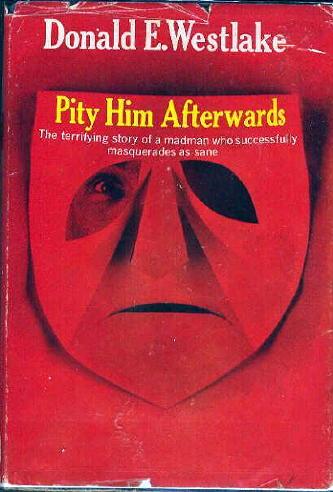 He kills his first victim
the second day he is on
the job. Cartier Isle, a wealthy, upscale summer community, no
state mentioned, has only a four-man police force, headed by Dr. Eric
Sondgard, who is a mere college professor the rest of the year.
It is this other half of his professional life that allows him to judge
people quickly. He’s a quick profiler, in other words, but while
reluctant to call in the state troopers, he soon begins to feel in over
his head a whole lot sooner than he expected. He kills his first victim
the second day he is on
the job. Cartier Isle, a wealthy, upscale summer community, no
state mentioned, has only a four-man police force, headed by Dr. Eric
Sondgard, who is a mere college professor the rest of the year.
It is this other half of his professional life that allows him to judge
people quickly. He’s a quick profiler, in other words, but while
reluctant to call in the state troopers, he soon begins to feel in over
his head a whole lot sooner than he expected.The reader may become confused right about here. Not about the story itself, which is perfectly clear, but rather the category the story falls into. A detective story, perhaps? On page 58 a detailed timetable is created, eliminating all of the people staying in the boarding house next door to the theatre except for the aforementioned three newcomers. (The idea of a wandering tramp being responsible is discarded as soon as messages from the killer are found written with soap in the bathroom and with jam on the kitchen table.) Sondgard tries a bluff based on a fingerprint that he does not actually have, but it is a clever idea. On pages 127-128, however, he is beginning to worry that he is using the wrong approach: Sondgard shook his head in
angry
irritation. It was worse than a double crostic. Worse than Finnegans
Wake without a pony. Worse than
the detective books so many of his fellow professors – but not his
fellow captains – insisted on writing every summer, in which the final
clue came from the author’s specialty; an inverted signature in a
first-edition Gutenberg De civitate Dei, the misspelling of the Kurd
word for bird, the inscription on a Ming Dynasty vase, or the odd
mineral traces found embedded in the handle of the kris.
And so, no, in spite of first impressions, that’s not the kind of story it is. A thriller, then, as it started out to be? Pressured by the bluff, the killer ... but no, that would be telling. Let me go back and show you some more what kind of writer Westlake was when he was in his early 30s. Lyrical and clear, pungent and confident, a glorious let-it-all-out sort of prose, written almost with the sheer joy of writing. It may not work for everyone, but there are passages in this book that made me only sit back and quietly admire them. For descriptive writing, from page 91, for example, and of an ordinary bar, no less, down the street from the theatre: The facade of the Lounge was
Southern
plantation, complete with pillars and a veranda and white front
door. But inside the disguise was dropped completely; the
interior was the stock bar décor to be found anywhere in the
United States. A horseshoe-shaped bar dominated the center of the
room, with booths at the side walls. The normal beer and whiskey
displays, with all their flashing lights and moving parts, were crowded
together at the back bar amid the cash registers and the rows of
bottles. Most of the light came from these back-bar displays,
aided only slightly by the colored fluorescent tubes hidden away in the
trough that girdled the room high up on the wall. Lithographs of
fox-hunting scenes predictably dotted the walls, and the imitation gas
lamps jutting from the wall over each booth said Schlitz around their bases.
With a setting such as a summer playhouse, a story works only if the author knows his way around summer playhouses, and the people who inhabit them. Westlake does, or he does well enough to convince me. Besides having the ability to describe bars, he also knows people, including the awkward boy-girl situation in which neither quite knows what the other party is thinking. From page 167: Mel was not at all sure of
himself. Mary Ann seemed open and honest and friendly, and she
had no objection to being here alone with him, but he wasn’t at all
sure how much that meant. Because she was assuming more and more
importance to him, he wanted to make no rash or ill-advised moves,
wanted to avoid inadvertently driving her farther away from himself.
So he hadn’t yet kissed her. He’d been thinking about it, more or less constantly, ever since they’d landed here [on a small island in the middle of a lake], but as yet he hadn’t even begun a move in that direction. He argued with himself about it, telling himself that after all she had come out here with him, and after all under circumstances like this she had to expect him to kiss her, didn’t she? But God alone knew went on in the minds of girls; she might not be expecting to be kissed at all. She might be thinking of them now as sister and brother. On the other hand, what if he didn’t try to kiss, and she’d been waiting all day for him to make the first move? Wouldn’t that be just as bad? If she did want to be kissed, and he didn’t kiss her, wouldn’t that drive her away from him just as surely as if she didn’t want to be kissed and he did try? It was a problem. A problem indeed, and a universal one. A problem, you will pleased to know, is finally resolved a page or so later, ignoring the madman, the two of them in fact ignoring the world around them and working out the problem on their own. The problem of the madman is another matter, and in a short book, only 185 pages long, the matter seems to end too quickly and abruptly. Not that I’m displeased. It’s a ending worthy of being called an ending, with only a doctor, the head of the asylum from which the madman escaped, regretting the loss of the madman’s intelligence and potential, if only he could have been cured. The title, not so incidentally, comes from Dr. Samuel Johnson (Boswell: Life of Johnson. Entry for April 3, 1776.): MURRAY. ‘It seems to me
that we
are not angry at a man for controverting an opinion which we believe
and value; we rather pity him.’
JOHNSON. ‘Why, Sir; to be sure when you wish a man to have that belief which you think is of infinite advantage, you wish well to him; but your primary consideration is your own quiet. If a madman were to come into this room with a stick in his hand, no doubt we should pity the state of his mind; but our primary consideration would be to take care of ourselves. We should knock him down first, and pity him afterwards.’ September 2005
UPDATE [05-28-07] On his blog a
couple of days ago, Ed
Gorman
reviewed this same book by Donald Westlake, and if you were to stop
over there to read it, it’s pretty clear that we were reading the same
book. A slightly different perspective, it goes without saying, but
it’s the same book, and it’s one we both think you should read
(speaking for Ed without a prior consultation on doing so, but I don’t
think he’s going to disagree).
MARY McMULLEN - Death by Request Detective Book Club; hardcover 3-in-1 edition, March 1978. First edition hardcover: Doubleday Crime Club, October 1977. Paperback reprint: Penguin, 1978. As my bibliography of Helen Reilly mentions, and as said here elsewhere perhaps several times before, Mary McMullen was one of two daughters of Helen Reilly who also wrote mysteries, the other being Ursula Curtiss. Al Hubin’s Crime Fiction IV states that Mary McMullen was a pseudonym of Mary Reilly Wilson. I do not at the present time know where the McMullen came in, but it sounds like a question to ask. She was born in 1920 and died in 1986, and here’s another question about her career: Her first book, entitled Strangle Hold, was published in 1951 by Harper & Brothers when she was 31, but her second, The Doom Campaign, did not appear until 1974. After this she averaged slightly over a book a year until her death. Why the 23 year gap? Motherhood and family, one supposes, but of course that’s only a guess, even though it’s a logical one. All of but the first of McMullen’s 19 novels were published by Doubleday as part of their long-running Crime Club series, with many of them coming out later in paperback and book club editions. And all, as far as I know, having read only two or three at the most – all fall into the “malice domestic” category, rather than, say, romantic suspense, even before there was a category called “malice domestic.” Death by Request is no change of horse in midstream, in case you were wondering.  What is
surprising is how
slight a mystery it is. Here’s the opening paragraph: What is
surprising is how
slight a mystery it is. Here’s the opening paragraph: It was between Trenton
and Princeton Junction, on the train from Philadelphia to New York,
that Waldo St. Clair conceived the idea of killing his wife.
That sums it up right about there. Waldo had just come from looking at the contents of the house his wife Elizabeth’s reclusive aunt had left her, and he had found it filled with unique and valuable furniture, antiques worth a fortune. Not to mention that Waldo has a lover on the side, and what better way to convince this lover on the side that she ought to make the relationship permanent? What Waldo doesn’t reckon with is that Elizabeth has a lover as well, that man being Waldo’s boss (something akin to dueling love affairs) and that Elizabeth has a long-lost, un-liked (and unlikable) cousin who wants to have a share of the estate as well, having been left out of the will. The combination of all of these – well, I hate to say it, but – not very nice people, and seeing how they react to one another’s foibles and faults, is what constitutes the story, which takes leave of New York City about half-way through and heads off for Ireland, the land of soft rain, damp peat and tinker’s curses. There is some detective work that is done, sort of surprisingly enough, and that by Cy Hall, Waldo’s boss and Elizabeth’s lover, who also finds himself (deliberately) in Ireland, just when Elizabeth could use a friend. It is a tribute to McMullen’s writing talent, I believe you could say, that so slight a tale as this could be so fully told. September 2005
 ELMORE LEONARD - The Hot Kid William Morrow; hardcover; first edition, May 2005. As you very well may know without my telling you, Elmore Leonard’s writing career began with westerns of the classic, traditional variety. While he was more than slightly successful at it (with books turned into movies like Hombre and 3:10 to Yuma) his sales didn’t begin to take off until he switched to contemporary crime novels (with books turned into movies like Mr. Majestyk and Get Shorty). What The Hot Kid is, is a semi-combination of the two genres, permuted and shuffled around into a smooth, well-blended concoction of the two. Historical gangster fiction, that is, one that takes place in the Old West of the 1920s: the world of Pretty Boy Floyd, Dillinger, Machine Gun Kelly, and Bonnie and Clyde, all of whom are mentioned, as are Will Rogers and Count Basie, but while Floyd comes close, none of the aforementioned villains and world famous stars actually appear. It’s a meandering sort of tale, but when it comes down to it, there are only two primary players involved, and they are (as one would expect) on the opposite sides of the law: Carlos (Carl) Webster, a U.S. Marshal, and Jack Belmont, the son of a wealthy businessman, but a gent who is intent on becoming Public Enemy Number One. And he very nearly succeeds. Carl is better, however, and who knows, he may return in yet another adventure. Here’s a quote from page 57, as true crime reporter Tony Antonelli is trying to convince his editor to allow him to write a piece on Carl: And then [he] suggested, how about a close study of a deputy U.S. marshal, a good-looking young guy who was on his way to becoming the most famous lawman in America. The hot kid of the Marshals Service who said if he had to draw his gun, he would shoot to kill the felon he was apprehending. “And Carl Webster has drawn his Colt .38 four times in his career. You can tell he’s sharp just by the way he wears his panama, his suit’s always pressed. You look at him and wonder where he keeps his gun.” “He’s good-looking, uh?” “Could be a movie star.” The resulting story is in turn profane, mundane and jazzy. Sparked every so often with confrontations, holdups and numerous shootouts, it’s vastly entertaining. The problem is that it may be too smooth and too easy-going, not to mention the fact that everyone’s dialogue, while suitably terse and in the vernacular, sounds exactly the same as everyone else’s. That includes the descriptive passages as well, as if a grizzled old-timer back in the 1920s had wound himself up in a place of his own choosing and spieled off a yarn of his own making. One might have expected a little more jaggedness. Except for a few isolated moments that directly contradict this statement, and I will certainly concede there are, this one’s surprisingly straightforward and calm, in its own sentimental way. October 2005
Note: A shorter version of this review appeared in Historical Novels Review. MARCIA TALLEY - This Enemy Town Avon, paperback original. First printing, September 2005. This is the fifth in a series of mystery cases that Talley’s cancer-surviving sleuth Hannah Ives has been involved in, and on the front cover is statement that she (Talley) is the Agatha and Anthony Award-winning author of In Death’s Honor. While the statement is true, it is also misleading. The awards were not for the previous novel in the series, as implied or if you take the words to mean exactly what they say. The short story that won both of the awards was “Too Many Cooks,” a Shakespearean-based tale that first appeared in Much Ado About Murder, edited by Anne Perry (Berkley, 2002). In this particular story, the three witches from Macbeth are given a comic twist and converted into heroines. I’ve not read it, but this is the description I found while googling the Internet. Somehow – and I’m smiling here – I do not believe that Hannah Ives is even in it. (The point being, however, that you always have to take blurb-writers with a grain of salt. They do not always state the facts in a straightforward manner, as is the case here. That the story was a double award-winner is extremely significant, however, not only for the honor itself, but for the effect it had on Marcia Talley’s career, about which if you jump to the FOOTNOTE below, you will learn more.) 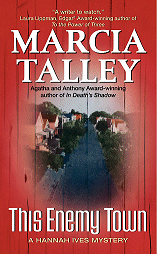 Married to a mathematics
professor at the
US Naval Academy, Hannah Ives has battled breast cancer throughout her
five-book career, and in This Enemy
Town (also from Shakespeare, I should point out) she has
become a survivor enough to lend a hand in the same battle to Dorothy
Hart, wife of a Navy admiral and mother of Kevin, a second classman at
the academy. Married to a mathematics
professor at the
US Naval Academy, Hannah Ives has battled breast cancer throughout her
five-book career, and in This Enemy
Town (also from Shakespeare, I should point out) she has
become a survivor enough to lend a hand in the same battle to Dorothy
Hart, wife of a Navy admiral and mother of Kevin, a second classman at
the academy.Most of the first 80 plus pages detail the efforts the two women make in building sets for the annual Glee Club musical, this year’s being Sweeney Todd, along with slowly introducing the cast of characters and their problems. This includes Emma Kirby, a young girl Hannah knows well, a midshipman whose sexual orientation and the “Don’t Ask, Don’t Tell” policy are finding difficulty adjusting to each other. The cast also includes Jennifer Goodall, now a navy lieutenant, but whose days in the Academy were marked by her accusations of sexual misconduct (false) against Hannah’s husband Paul. At least Hannah has always assumed they were false. But 80 pages is a lot of time to keep the plot boiling, especially when there’s barely a glimmer of which way the wind is blowing. When it starts, though, it’s batten down the hatches, and there she blows. (Sorry. That’s quite enough in terms of clichés for now.) However. Talley does a yeoman’s effort in maintaining authenticity throughout the book. She knows the Academy well, of that there is no doubt. Later on, a visit to the Pentagon makes it extremely clear that she’s also been there recently, a key moment being a passage through the security system set up since 9/11. But. While Hannah realizes that she is a suspect in the victim’s death, after two weeks and only a single interview has gone by, she thinks no more of it until the morning the FBI comes pounding on the door of her home, 6:30 in the morning, guns to the ready and handcuffs in the offing. A trip to the pokey ensues, her fingerprints are taken, and she just barely avoids a strip search before being arraigned. All before dinnertime. I’m sorry, but I don’t believe it. No warning, no followup interviews, no preliminary conferences with attorneys present, no nothing. Nor would I believe that the first thing Hannah does once freed is to go out and try to solve the case herself, but that of course is what amateur detectives do, and they do it all of the time. Of course, on the other hand, maybe I’ve been watching too much television, and I fully concede that I’m the amateur when it comes to FBI procedure and what they really do. So let’s lay that aside, if you will. It’s a book that’s pleasant enough to read, and even more so once it really gets going. It’s also one that’s difficult to recommend as a detective story, with the clues, for me, getting somewhat lost in the clutter. There’s too much going on, in other words, that’s peripheral to the mystery. Taking the book as a whole, you have to be more focused on the characters’ lives than I was for it to have the impact it needs and (to my mind) does not quite have. As always, however, your interpretation may vary. The
HANNAH IVES novels:
Sing It to Her Bones, Dell, pb, 1999. Unbreathed Memories, Dell, pb, 2000. Occasion of Revenge, Dell, pb, 2001. In Death’s Shadow, Avon, pb, 2004. This Enemy Town, Avon, pb, 2005. Comment: As I understand it, when an author’s series is dropped by one publisher, which may have been what happened, given the three year gap between books from Dell and Avon, it is extremely difficult to have it picked up by another. It would be interesting to learn whether it was Marcia Talley’s decision to make the switch, or if it was indeed because she beat the odds. October
2005
FOOTNOTE: In an
email reply to me, Ms. Talley tells how she did indeed beat the odds,
and it wasn’t easy. The Agatha and Anthony awards she won for
“Too many Cooks” were a large part of it. She also responds to
some of the points of the plot I brought up in the review above.
See the Readers
Forum
to read more.Books, Inc.; hardcover reprint, March 1944. First edition: Simon & Schuster / Inner Sanctum, 1941. Paperback reprint: Popular Library #47, ca. 1945. Serialized previously in The American Weekly as “The Green Diary.” I don’t know how long the website will stay up, but www.bpib.com/illustra2/various2.htm contains loads and loads of the beautiful (if not exquisite) artwork that filled the covers of The American Weekly in its heyday. While the examples are all from 1918-1943, the magazine, a Sunday newspaper supplement for the Hearst chain, continued on through the years until the title changed to Pictorial Living in 1963, then folded for good in 1966. (Information obtained from Phil Stephensen-Payne’s magnificent Magazine Data File website, located at http://www.philsp.com/data/data015.html.) 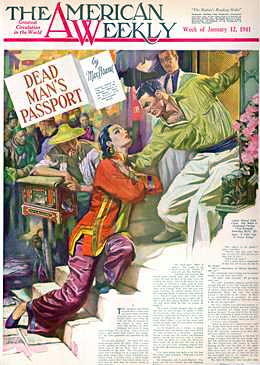 Which is not
relevant to anything more than the fact that this novel by Q. Patrick
first appeared there, nothing more, but you really ought to see those
covers. (I can’t resist. The one shown here is from 1941,
the artist Joe Little, and as you see, one of the authors who had a
story in that issue was Max Brand.) Which is not
relevant to anything more than the fact that this novel by Q. Patrick
first appeared there, nothing more, but you really ought to see those
covers. (I can’t resist. The one shown here is from 1941,
the artist Joe Little, and as you see, one of the authors who had a
story in that issue was Max Brand.)As for Q. Patrick, there is no way I am going to try to completely untangle the web of real names that lie behind that pen name and that of Patrick Quentin (and Jonathan Stagge). Suffice it to say that Return to the Scene was the result of the primary two collaborators who used that pseudonym, Richard Wilson Webb and Hugh Callingham Wheeler. On other Q. Patrick titles, Webb had as partners, at various times, Martha Mott Kelley and Mary Louise Aswell – pairwise, mind you, not in triple tandem. It is interesting to note that Aswell’s two efforts with Webb took place in 1933 (S. S. Murder) and 1935 (The Grindle Nightmare), and her single solo effort did not appear until 1957 (Far to Go). As for Patrick Quentin (and Jonathan Stagge), we’ll leave any discussion of who they were (and when) for another time, but as well known as practitioners of the Golden Age variety of detection, none of the various aliases, nor their books, are very well known today. Nor of course is Quentin/Patrick alone in this category. The rise and fall in popularity of various authors over the years is a subject that is likely to come up often in these pages in the days to come. Why, for example, are Agatha Christie’s books so timeless, and Borders has nothing on the shelves by Ellery Queen or Erle Stanley Gardner, and only a handful of titles by Rex Stout? John D. MacDonald’s books may be in print, but only from Amazon. I’ve not seen them on any actual bookstore shelves, new, in quite a while. Not that answers are likely to be very forthcoming and/or definitive, but the question at least will be something that will turn up in one of these review/commentaries every once in a while. Case in point. Return to the Scene, by Q. Patrick. Is it a book very likely to be published today? Answer, possibly, but not by a major publisher. Maybe by a small independent publisher like the Rue Morgue Press, which specializes in reprinting classic (and obscure) mysteries from the Golden Age, of which Return to the Scene is obviously one – and if you have gotten this far into this (which eventually will turn into a review), you really should be supporting them, and if you aren’t, then shame on you – or one of those publishers that specializes in large print editions for libraries, under the obvious assumption that only old people who can’t see so well any more will have any interest in reading them any more. 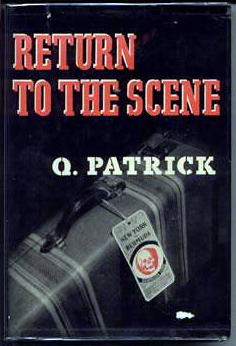 It starts out like a romance novel – this is now the review – with Kay Winyard rushing to back to Bermuda to stop her niece from marrying the man she once thought she was in love with, before she discovered what kind of man he was and walked out on him. And in her purse is her weapon, a diary. A very revealing diary written by the woman who did marry him, in spite of Kay’s warning, and who subsequently killed herself because of him. It very quickly becomes instead a murder mystery, however, and there is no surprise to learn who the victim is. The rich, the powerful Ivor Drake, and soon also very dead. And with a huge house of possible suspects, all of whom (it is also quickly discovered) had reasons to wish him that way. The police investigate, and for one reason or another, no one tells them the truth. Alibis are created out of happenstance and convenience. Every one has their own package of facts that they do not wish to be known, and webs of intrigue and would-be (and only reluctantly admitted) love affairs make learning the complete truth next to impossible even for Kay, who is an insider, much less Major Clifford, the ultimate outsider. Here’s a long quote from pages 116-117. It begins with Terry talking to his sister, Elaine. Elaine is the girl whose marriage Kay came back to Bermuda to stop: “And I’ll go on telling that story to the
police. You know I’ll do everything for you. But it can’t
be this way between us. I’ve got to know what you were doing
tonight.” He paused and then said in a tight, husky voice: “I
can’t go on like this, wondering if you killed Ivor, not being sure.”
“Killed Ivor!” Elaine have a sharp little laugh that was like a sob. “You and Kay! Why do you keep on saying that I killed him? Why would I have wanted to kill him? You don’t even know if he was murdered. It’s just Major Clifford, something crazy he said. It isn’t true. It’s all a terrible nightmare and we’re going to come out of it.” “It isn’t a nightmare, Elaine. It’s real. And there’s no hope for us unless we tell each other the truth.” “But what can I tell you when – when I don’t know anything?” Brother and sister were staring at each other with a cold, desperate intensity. Alliances are built, along with their stories they tell to the police, then collapse, and bit by bit the truth gets put together like a gigantic jigsaw puzzle. Delicious! There are clues aplenty, and the alibis so spontaneously constructed eventually cannot stand up under the pressure, and they begin to fall apart. Not one of the alibis, as it happens, is any good. The ending is disappointing, a little, but this (it seems to me) is what almost always happens. The explanation is so mundane, so unworthy of the mystery, so why-didn’t-I-think-of that, but only in comparison to the mystery itself. Another problem is that when the victim is so dastardly as this one is, one hates to see anything found guilty of the crime, although of course one must be, and in the end, all of the pieces fit together. (At least without a careful re-reading, all the way through, they do.) Not a classic, but in the Golden Age, even the non-classics came close. October 2005
PostScript: A preminary checklist
of titles in the Books, Inc., line of Midnite Mysteries, of which this
book is one, can be found by following the link provided.
JOHN CREASEY - Double for the Toff Popular Library, paperback reprint; no date stated, but circa 1972. Hardcover editions: Hodder & Stoughton (UK), 1959. Walker (US), 1965. UK paperback editions: Hodder/Coronet, 1963,1973; Sphere, 1967. Earlier US paperback edition: Pyramid R-1221, Aug 1965. 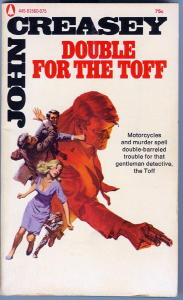 I’ll make no attempt here to do a general bibliographic discussion of John Creasey and the multitude of mysteries he produced. While that will have to wait for another time, this is certainly the place. (Hint.) As for the Toff, in real life Richard Rollison, I don’t believe it was ever a matter of a secret identity, only an honorific nomenclature. England seems to have had a long history of gentleman adventurers that did not seem to ever have been as popular in the United States as they were over there. The Toff, like Simon Templar, aka the Saint, before him (adventures recorded by Leslie Charteris), was merely another in a lengthy line of swashbucklers, figuratively speaking. And again, someone else may be better to write the history of such British adventurers, although again, this is certainly the place. In fact what I know about the Toff is minimal, but of course I will tell you what I know anyway. Let’s begin with a list of the books. These are in more or less the order in which they appeared in England. A hyphen (-) indicates the lack of an US edition. A star (*) means that there was one. A double star (**) indicates that the first US edition was a paperback. Alternate US titles are also included, if first appearances. (Thanks to Al Hubin’s Crime Fiction IV for most of this information.)
There was even a three-act play in which the Toff was a leading character: “The Toff.” UK, 1963. Creasey died in 1973, so the final three books had been written and were still awaiting publication when he passed away. The Toff was popular enough in England that when his publisher (Hodder & Stoughton) ran out of Toff books to sell, they hired William Vivian Butler to write a very last one: The Toff and the Dead Man’s Finger (1978; no US publication). Besides three books of his own, Butler also wrote the final five Commander George Gideon novels, Gideon being Creasey’s Scotland Yard detective whose adventures he wrote as J. J. Marric. In creating this list of Toff books, there are several things I discovered that I hadn’t known before. First, I didn’t realize how many of the books were published in the US. If that were the question, the answer would be “almost all of them.” I also didn’t realize that the Toff was introduced to American readers in paperback form when Pyramid published a number of them in 1964-65, even though I purchased my copies when they did. They must have done quite well, since Walker soon took over and all of the rest of them came out in hardcover first. (Paperback editions of the Toff stories that appeared from Lancer and Popular Library were all reprints, although occasionally they altered the titles to suit editorial or marketing whims. These are not noted in the list above.) I also suspect (but so far I have not investigated) that the early Toff books were revised and/or updated when published in this country. I understand that it was a common habit for Creasey to revise his books for whatever his current market might be, and I do not expect the Toff books to have been an exception to this general rule. A little googlizing on the Internet reveals that the Toff first appeared in the two-penny weekly The Thriller in 1933 (reference: www.tetheredcamel.com), so the gent with a bent for crime was really around for quite a long while. (As a useful frame of reference, the Saint first appeared in the novel Meet–The Tiger! in 1928, while several of his earliest short story cases were told in The Thriller in the years from 1929 to 1931. Simon Templar, once again, was there first, in other words.) On the same website, but on another page, is a description of the Toff’s first book-length adventure, Introducing the Toff:
A little road rage was not
unusual even in the 1940s, but the Toff was not expecting bullets to be
a part of the argument when his Allard blocked the path of an oncoming
Daimler in an English country lane.
What had been a pleasant day playing cricket became the start of a lethal fight against cocaine rings, gangsters and the criminal empire of The Black Circle. Introducing The Toff is a typical John Creasey mystery; a ripping yarn and a fascinating document of social history as it dances between high society and the East End of London. This seems to have come from the back cover of a recent British paperback edition, which perhaps explains the confusion over the date, but other than that, this blurb typifies exactly what I would have imagined the Toff’s early adventures to have been like. Returning to the book at hand, however, one can certainly read it without knowing all of the baggage that earlier stories might have brought along. One does get the sense that many of the secondary cast has been around for a while, but just as Della Street and Paul Drake were with Perry from the beginning, you can pick one of Erle Stanley Gardner’s books from the last 1960s as the first one in the series you read and not miss a beat. Creasey does not do a lot in terms of describing Richard Rollison. I made a few notes as I went along: he’s very handsome, a head taller than average, and in admirable physical condition. That’s about it. He’s on good terms with Scotland Yard, with Superintendent Bill Grice, apparently an old friend and only a semi-antagonist, willing to give the Toff a free hand whenever he sees a reason for it. 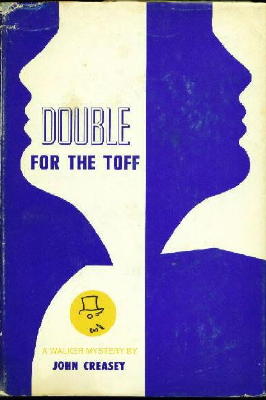 The title comes from the
fact that the Toff is handed two separate cases almost at one time, and
after mulling over the possibilities, he decides he can handle both of
them. Are they two separate cases? The reader knows better,
but only the better reader will figure out how they are related before
the Toff does. The title comes from the
fact that the Toff is handed two separate cases almost at one time, and
after mulling over the possibilities, he decides he can handle both of
them. Are they two separate cases? The reader knows better,
but only the better reader will figure out how they are related before
the Toff does.Which is due to two factors, the first being that even though this is a pretty good detective story, Creasey is determined to tell it as if it were a thriller, with lots of action and close calls for the Toff and his friends before it is over, and doing his best to keep the reader’s eyes away from the clues. The second factor is that the time table of events is wrong, or at least, let’s put it this way. The Toff’s reactions and apparent enlightenment on page 174 do not seem to match up with his deductions. In particular, please take note of his explanation to Grice on page 187 why he did something on page 168, well before he learned what he did that put the connections together on page, yes, 174. Inconsistencies are something you may have to learn to put up with when you read Creasey. On page 14 it is impossible to read the registration number on a motor-cycle, but on page 51 the Toff somehow knows that the motor-cycle had false number-plates. On pages 120-121 two men (bad guys) who have been gassed suddenly turn into three. Things like these used to drive me nutty when I was younger. I try not to let them any more. The book could have (and should have) been better. But taken as a given that you have to put your mind into a lower gear when you read his tales, Creasey was certainly a grand storyteller, with (as it turns out) a kind and sentimental streak in his books (or in this one, at least) a yard wide.
November 2005
MARGARET DUMAS - Speak Now: Married to Mystery Signet, reprint paperback; 1st printing, Nov 2005. Hardcover: Poisoned Pen Press, October 2004. This debut mystery by first-time author Margaret Dumas has some history behind it. On the basis of one chapter and a synopsis, the book was one of fourteen nominated for the British CWA “Debut Dagger Award” in 2003. The winner was The Cuckoo by Kirsty Evans, which I do not believe has seen publication, nor do I recognize any of the other nominees. The road to success is as always uneven, and at the moment, at least, Margaret Dumas seems to have been the winner that counts. The blurb on the front cover will attract a lot of attention, I’m sure: “A modern-day Nick and Nora Charles... witty, suspenseful.” But don’t they say that about every married couple who solve mysteries? Yes, and sometimes – do you know what? – it even applies. The husband and wife (wife and husband?) in this case, and presumably the first in a series, are Charley Van Leeuwen and Jack Fairfax, whom she met in London six weeks before they made it official. Returning to the US in Chapter One, the first thing they do is check into a $3000-a-night suite in a Nob Hill (San Francisco) hotel. Three thousand a night? Hold that thought. The second thing they do is to find a body in their bathtub. Female, nude, and dead. The hotel manager is appalled, and so is Charley. Jack, on the other hand, is calm, and admits to having seen dead bodies before. Charley, it seems, does not know everything she needs to know about Jack. 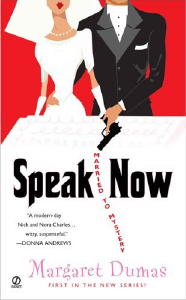 Nor do we know everything we (the reader) need to know about Charley, but the truth eventually comes out (page 27). Charley is heiress to at least a couple of million dollars, and her (eccentric) Uncle Harry believes it is his duty to keep fortune-hunters away from Charley’s door, even after the horse has been stolen, so to speak. Personally I think that Uncle Harry should have had a larger role to play in the book, but after a few skirmishes with Jack, Harry grudgingly begins to accept him, leaving Charley somewhat bewildered, because Jack’s past – as a “meteorologist” working for the Navy around the world in places where unusual events seem to have coincided with his travels – is full of gaps that Charley still finds herself trying to fill in. And it is Jack’s past that is causing a number of new unusual events in Charley’s life. Her flighty cousin Cece is kidnapped, first of all, and then bad things start happening to the theatre group that Charley sponsors, and whose new play she agrees to direct, the previous director having suddenly decamped for Broadway, never to be seen again. (Right.) As a result, most of the byplay and action in the second half of this rather lengthy novel (328 pages of small print) are intimately tied up with the members of the theatre group, along with several of Charley’s many other San Francisco friends. For my part, I’d rather have had that the villain come straight from this latter portion of the entourage, rather than having him (or her) being an old nemesis of Jack’s and doing the infiltration routine. That’s a bad word. The story itself is at least a notch above routine, and the characters even higher. The pacing is uneven, but enough things happen just often enough to keep spirits from flagging (or dragging, as the case may be). Nick and Nora, no, Charley and Jack are not, nor are they even Pam and Jerry. But if Margaret Dumas can keep a steadier hand on the melodrama throttle, their future adventures should be as much fun in the reading as this one, or more.
November 2005
CHRISTOPHER B. BOOTH - Mr. Clackworthy Chelsea House; hardcover; c.1926. FOOTNOTE. 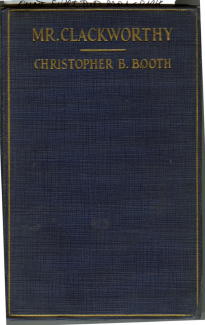 What I know about Booth
is that he was a prolific writer for the pulp magazines in the 1920s
and 30s, with just under three and a half pages of entries in Cook and
Miller’s Mystery, Detective, and
Espionage Fiction. These are only the detective
stories. On Bill Contento’s FictionMags
site, I also see a smattering of western stories for him, and these are
only the tip of the iceberg, as relatively few of the western magazines
have been indexed yet. What I know about Booth
is that he was a prolific writer for the pulp magazines in the 1920s
and 30s, with just under three and a half pages of entries in Cook and
Miller’s Mystery, Detective, and
Espionage Fiction. These are only the detective
stories. On Bill Contento’s FictionMags
site, I also see a smattering of western stories for him, and these are
only the tip of the iceberg, as relatively few of the western magazines
have been indexed yet.According to Al Hubin’s Crime Fiction IV, Booth wrote ten novels under his own name, all from Chelsea House, and eight more as by John Jay Chichester, also all from Cheslea House. Also to his credit is one book on which he shared the writing duties, and that was with Isabel Ostrander, another long-time writer for the pulps. To point out that you can not always trust the Internet for factual information, some sites suggest that Christopher B. Booth was a pseudonym for Isabel Ostrander. Not so, even though Ostrander (who died in 1924) really was the lady behind ‘Robert Orr Chipperfield,’ ‘David Fox,’ and ‘Douglas Grant.’ Chelsea House was the hardcover publishing arm of Street & Smith Publications, which also produced Detective Story Magazine, where most (all?) of the novels were serialized first. Or cobbled together out of short stories, as was Mr. Clackworthy. There are nine of them in this volume. Of the book which was the sequel to this one, Mr. Clackworthy, Con Man, I do not know if the same is true. Hubin in CF IV does not say yes, which may very well mean no. (I suspect the answer is yes, however.) Enough of the general background, I suppose. If you did not know before but if you were paying attention, you will know that Mr. Clackworthy was one of those protagonists so often on the wrong side of the law in the 1920s, a con man. I imagine someone could write a thesis if not a dissertation on such individuals in the world of crime fiction. Here is an off-the-wall question. What character in what novel(s) would qualify as the last in the line of con men, preying mostly on the rich and unscrupulous, but not necessarily giving to the poor, of which Mr. Clackworthy does not make a general practice? I am not an expert, so nor will I even attempt to list any of the other characters who would fall into the category. If you can help, please do, otherwise we shall leave the matter to someone who needs a thesis if not a dissertation on their academic record. (Of course such a someone then would be also obliged to put into perspective WHY con men who preyed mostly on the rich and unscrupulous were so prevalent in the 1920s. One can guess, though.) As a start to such a project, it belatedly occurs to me, if you will allow such an interjection such as this, may be Yesterday's Faces #3 : From the Dark Side, by Robert Sampson (Bowling Green Press, 1987), a rollicking account of all sorts of bad guys who inhabited the pages of the pulp magazines. 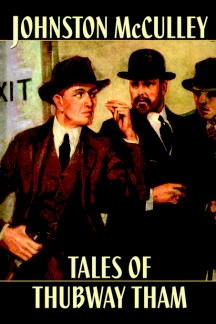 And by the way, before it
slips my mind and we head off into the review itself, I would like to
point out that in the pages of Detective
Story Magazine Mr. Clackworthy met another of that magazine’s
regular characters, Johnston McCulley’s lisping pickpocket, Thubway
Tham, on at least one occasion: “Mr. Clackworthy and Thubway Tham” (Detective Story Magazine, March 4,
1922). Even though Cook-Miller suggests that only Booth was the
author, this may be the first team-up on record between two characters
created by separate authors. (Does one count, however, Arsene Lupin Versus Holmlock Shears,
by Maurice LeBlanc, Richards, 1909? One must posit some ground
rules, one supposes.) And by the way, before it
slips my mind and we head off into the review itself, I would like to
point out that in the pages of Detective
Story Magazine Mr. Clackworthy met another of that magazine’s
regular characters, Johnston McCulley’s lisping pickpocket, Thubway
Tham, on at least one occasion: “Mr. Clackworthy and Thubway Tham” (Detective Story Magazine, March 4,
1922). Even though Cook-Miller suggests that only Booth was the
author, this may be the first team-up on record between two characters
created by separate authors. (Does one count, however, Arsene Lupin Versus Holmlock Shears,
by Maurice LeBlanc, Richards, 1909? One must posit some ground
rules, one supposes.)Further investigation into the subject reveals another story of interest: “Thubway Tham and Mr. Clackworthy,” by Johnston McCulley (Detective Story Magazine, February 18, 1922, or two issues earlier). You can read this story in the recent edition of Tham thtories from Wildside Press, Tales of Thubway Tham, although in that edition the story is called “Thubway Tham Meets Mr. Clackworthy.” One source does suggest that the team-up was a three-part serial. This may be so, but if indeed it is, I have not yet uncovered a third tale in the triptych, and to this date, the matter rests, for now. Let’s get on with the review. The best way to do that, I decided the moment I started reading it, is to quote the opening paragraphs, right from the beginning:
“The greed of the human heart!”
Mr. Amos Clackworthy, confidence man deluxe, sighed as he laid down his
newspaper, which was folded to the want ad pages. He had been for
some time engrossed in an analytical perusal of the “Business Chances”
column.
James Early, whose record at police headquarters credited him with the alias of “The Early Bird,” was standing at the window of Mr. Clackworthy’s [Chicago] Sheridan Road apartment, gazing glumly at the stream of traffic that flowed past in its usual Sunday afternoon flood. The Early Bird was a lost soul during those times when there was none of Mr. Clackworthy’s nefarious schemes under way to occupy his mind and to keep his wits sharpened. 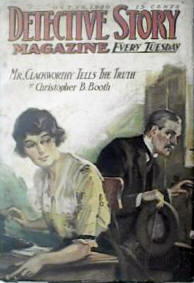 All con men naturally work on the concept of greed, as many a Nigerian knows full well today. Booth’s prose style is not all that dissimilar to that of his contemporary (at the time), Erle Stanley Gardner, whose Lester Leith stories for Detective Fiction Weekly started out in very much the same fashion. Most of Mr. Clackworthy’s victims well deserve it– greedy bankers, swindlers, unscrupulous investors, and so on – getting their comeuppance in a rough and tumble sort of justice, in a naive, twinkle-in-the-eye sort of way, but even innocent banks sometimes fell afoul of his various and sundry plots and plans. (But were banks truly innocent of wrongdoing in the 1920s? Perhaps Booth’s readers did not really think so.) In any case, these stories were written, read and enjoyed in a different time and place. If you’re read this far into the review and other commentary, however, I see no reason why you shouldn’t read and enjoy them, too, even if no one is writing them like this any more.
November 2005
FOOTNOTE. A copy of this book has been located at Ohio State University, where James M. Smith, the Assistant Curator for the Rare Books and Manuscripts section, has been so kind as to check the copyright date. Their copy is dated 1925, contrary to the one given in Crime Fiction IV. This information has been forwarded to Mr. Hubin. Mr. Smith also confirmed that the two Clackworthy books are not the same book published under two different titles, as was conjectured as a possibility by Jeff Falco as we were discussing the books a year or so ago. Not so, but OSU is one of only a few sources who could have told us this, being the only library, at least, whose holdings contain both books. UPDATE: Thanks to the eagle-eyed Monte Herridge, one of the nine stories has been identified so far. It is “Mr. Clackworthy Tells the Truth,” from the October 19, 1920, issue of Detective Story Magazine, the cover of which is shown to the right. If and when others are identified, you will read about it here first. This particular story, amazingly enough, can be read on-line. What is interesting is that some editing was done when the story appeared in book form. Small descriptive sentences and paragraphs were removed. If you want to read the complete text, in other words, you have to go back to the primary source. (I have short synopses available for the remaining eight stories, in case anyone has an extensive collection of DSM and is willing to check to see if any more matching up stories with titles can be done.) DAVID HEWSON - The Sacred Cut Delacorte Press; hardcover; December 2005. UK hardcover: Macmillan, April 2005. There are not many types of mysteries that I do not read, but there are a few. I remember once expressing my disinterest in detective stories with horses in them, which at the time caused a mini-uproar among Dick Francis fans, among others. Well, Dick Francis fans need no longer worry. I’ve read a couple of his books, and they were pretty good. Especially the parts that did not have horses in them. At one time I had no interest at all in historical mysteries. Now I read them all of the time. Except for those that take place in ancient Rome. I think that relates somehow to my distaste for Latin in high school. Ixnay, I say. I still do not read mysteries in which children are the victims. It’s bad enough to have to read about such incidents in the newspapers almost every day. Mind you that I am not saying that mysteries in which children are the victims should not be written, if they are written with the right motive in mind, but if children are hurt or killed in a work of fiction, it had damn well better be the right motive in mind. I seldom read books about serial killers, either, which gets us closer (finally) to the book at hand. The determining factor in this sub-genre is how much blood and gore gets splattered around. Generally speaking, my rule of thumb says to assume that when a book is about a serial killer, the author somehow is going to depend on blood and gore to get his (or her) point across, that this is one nasty guy and somehow he has to be caught. Well, sure. And I’ll pass on it and read something else. 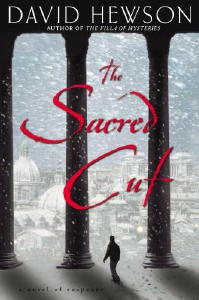 And so The Sacred Cut had a couple of
strikes against it, even before I began, given the front cover of the
Advance Reading Copy: And so The Sacred Cut had a couple of
strikes against it, even before I began, given the front cover of the
Advance Reading Copy: The snow is falling on the ancient
streets of Rome. And in the heart of the world’s most enigmatic
city, under the Pantheon’s great dome, a woman’s body lies on the
marble floor. Grotesquely carved on her back is ... THE SACRED
CUT.
You saw the bit about ancient Rome? Well, that’s not quite true. The setting is as contemporary as it can be, given that the various US invasions of Iraq are to blame for the events behind the scene described in the blurb above. But generally speaking, as the blurb suggests, history does play a big part of the story, with the multi-faceted city of Rome being one the most important players. There is, in fact, a large ensemble cast of players, and as long as the focus stays on police officers Nic Costa and his partner Gianni Peroni; their superior, Inspector Leo Falcone; the female pathologist Teresa Lupo; the female FBI agent-in-training Emily Deacon; and Laila, the youthful (female) waif refugee from Iraq who witnesses the scene in the blurb above, then all is well. Better than merely “well.” This is as intriguing a police procedural as I’ve read in a long time. (Even if you keep in mind that for some reason, I have not read a police procedural in a long time, this is still a true statement, and I stand behind it with no qualifiers at all. (I almost said with no qualification at all, but I thought better of it.)) I have to tell you, though. After reading page 116, when the killer snaps and his scalpel starts flying and he begins flaying away, along with a handy supply of meat saws and cleavers nearby, I very nearly did not read page 117. More of the same, I thought, and I have better things to do. My advice to you, however, is the same I gave myself. Keep on reading. You won’t regret it. The killer is largely known; his motives are not. Either way, he’s far from the most interesting factor of the novel. It’s Falcone’s superiors who are; Emily Deacon’s superior who is; it’s the relationship between Costa and Peroni and Lupo and Deacon and (surprisingly) Laila which is. Humorous when it needs to be, sad when it needs to be, philosophical when it needs to be, and real all of the time, this is a long novel which you will wish was even longer. What came as a surprise to me, when it was over, as I was happily sitting where I sat, doing my own wishing for more, was the discovery that this is the third in a series of Nic Costro novels, and that the fifth will be published next year. I knew that author David Hewson had written a quite a few other books I’ve seen at Borders, but they all looked like standalones to me. Filled with serial killers and/or grotesque killings. It looks like I’ll have to go looking for them. November 2005
UPDATE: In the Readers Forum is a reply from David Hewson in which he analyzes the nature of violence in crime fiction today, and why he believes it has increased. Belmont,
paperback reprint; July 1971. Hardcover edition: Charles
Scribner’s Sons, 1966; hardcover reprint: Detective Book Club, 3-in-1
volume, May 1967. British hardcover: Macdonald, 1967.
In the real life, Michael Delving was Jay Williams,
a name not in Al Hubin’s Crime
Fiction IV as having written any adult mystery fiction himself,
but to many kids growing up in the 1950s and 60s, Jay Williams was a
name widely known as the author of the Danny Dunn books, beginning with
Danny Dunn and the Anti-Gravity
Paint in 1956. He also wrote fairy tales (e.g.,
“Petronella”) and picture books (e.g., The Cookie Tree).
 But as
Michael Delving,
he wrote mysteries, and
biblio-mysteries at that. You probably thought that Belmont
published only schlock. Well, that’s not quite true. Once
in a while some good stuff crept in. But as
Michael Delving,
he wrote mysteries, and
biblio-mysteries at that. You probably thought that Belmont
published only schlock. Well, that’s not quite true. Once
in a while some good stuff crept in. Smiling the Boy Fell Dead was Delving’s first mystery, and it also introduced his primary series character, antiquarian book dealer, Dave Cannon, who later also branched out into antiques. Another individual who appeared in more than one Michael Delving book was Bob Eddison, Dave Cannon’s partner, who merits only a token mention in Smiling, first name only, as someone Dave has to check with before making a substantial bid for a manuscript (about which more later). As it happens, however, Bob Eddison became a co-lead in Delving’s second book, The Devil Finds Work, and later on he solves a case on his own, in A Shadow of Himself. (And during the course of this small investigation, I also discovered that Eddison is a full-blooded Okahoma Cherokee, something I did not know at the time of the first publication of my checklist of Native American detectives.) Using CF IV as a guide, here’s a complete list of the Delving books, as published in the US: Smiling the Boy Fell Dead. Scribner’s, 1966. Belmont, 1971. DC The Devil Finds Work. Scribner’s, 1969. Belmont, 1971; Leisure, 1977. DC/BE Die Like a Man. Scribner’s, 1970. Belmont, 1971. DC A Shadow of Himself. Scribner’s, 1972. No paperback edition. BE Bored to Death. Scribner’s, 1975. No paperback edition. DC The China Expert. Scribner’s, 1976. No paperback edition. No Sign of Life. Doubleday Crime Club, 1979. No paperback edition. DC The final book was published first in England (Collins Crime Club) in 1978, the year that Jay Williams died. It is too bad that his mysteries could not attract more attention from paperback publishers in this country. Mysteries involving book or antique dealers are very common today (and one assumes very popular), but in the 1970s, the kind of stories that Michael Delving was writing may simply have been going against the tide. Spy fiction was in; detective novels were in decline. And Smiling is a pretty good detective novel, and I’ll get to that soon. The story is Dave Cannon’s to tell, however, and as an American in England, he is both somewhat in awe at being there and lot more unruly, say, than I would have expected a dealer in rare books and manuscripts to be. For example, soon after his arrival he is involved in a fight outside a bar with a gang of “yobs,” one of whom later becomes the title character, and his choice of words at times, while never uncouth, is often slangy and argumentative. On the other hand, which almost every situation has, take the first few paragraphs, and you will have a clearer picture of who Dave Cannon is:
It was like being in a
dream. I suppose everyone who goes abroad for the first time has
this feeling, although when they get home, bing by then experienced old
hands, they can’t admit it. I knew all about England from novels
and travel books and movies, and of course my business kept me in touch
with the history of the land and, more directly, with English
dealers. Actually being there was quite another matter. So
different that nothing seemed real, and the unfamiliar speech of people
around me was like the speech of actors in a play. I had to keep
telling myself they weren’t just putting it on.
The color of the sky was different, the sunlight had another sort of gold, and the great massed clouds seemed to shape themselves according to patterns established long ago by painters of the Royal Academy. Even the smell of the air was different; coal fires and foreign earth. And nothing could be more different than the spot where I stood, between two stone gateposts topped by carved herons blackened with age, flanking a wide drive lined with ancient beeches. You never see beech trees like these in Connecticut, let alone a gate two hundred years old that is a mere afterthought to the house behind it. Oddly enough, it all made me feel more American than I ever had before. I wanted to drawl through my nose, hitch up my galluses, and spit.  Cannon
is about
to enter the home of an old woman
who owns a manuscript he has come to see. It is her gardener who
seems to take a dislike to him, who spies over him as he is examining
the letter, who jumps him later outside the pub as mentioned above, and
who is the victim of a falling-down-the-front-stairs sort of accident
(which it may not be) back at Mrs. Herne’s manor. Cannon
is about
to enter the home of an old woman
who owns a manuscript he has come to see. It is her gardener who
seems to take a dislike to him, who spies over him as he is examining
the letter, who jumps him later outside the pub as mentioned above, and
who is the victim of a falling-down-the-front-stairs sort of accident
(which it may not be) back at Mrs. Herne’s manor.And of course the pub incident puts Cannon in a bad light from the point of view of the local police, including Inspector Codd, with whom Cannon soon finds himself in a battle of wits. (Inspector Codd may also appear in later Cannon cases, as surprisingly enough, his name turns up in a google search for more information about Delving.) While the clues mount up, many discovered by Cannon, to Codd’s dismay, Cannon also learns how to play cricket (which is a sport I personally have never understood), finds a beautiful red-headed girl to spend time with (and surprisingly enough, he also gets along well her with father) and has many talks with the locals about England and England’s place in the world. But to get back to the clues, indeed there are, and a number of theories are proposed and discarded before the culprit is at length brought to justice, and Cannon’s search into historical records turns out to be one the keys in doing so. The plot is far from complicated. Don’t expect a Queen, Christie or a Carr when you read this one. Pretty good, I said earlier, and pretty good is what you get. And does Cannon get the girl? Bound by the rules of never revealing too much in a review, that is something I simply cannot tell you. Nor why the “boy” was smiling. (Hint: It has nothing to do with the poem.)
November 2005
JOHN DICKSON
CARR - The Man Who Could Not Shudder
Zebra, paperback; 1st printing, May 1986. Harper & Brothers, hardcover, 1940. UK hardcover: Hamish Hamilton, 1940. Other paperback reprints: Bantam #365, Aug 1949; Bantam 1504, 1956; F2837, 1964. Berkley S1941, Jan 1971. Hardcover reprints: P. F. Collier & Sons, no date; Books, Inc., 1944.  Unless a
reader is less
than 40 years old, roughly speaking, here is an author that needs no
introduction. If you’re a mystery reader who’s under 40 years old
and John Dickson Carr is an author who’s already familiar to you, I
have a feeling that you’re in a distinct (but very exclusive)
minority. Zebra (or Kensingston) did a series of paperback
reprints of many of Carr’s novels in the late 1980s – with very nice
covers – but that’s already 20 years ago, and like Ellery Queen, his
books are being slowly forgotten. Unless a
reader is less
than 40 years old, roughly speaking, here is an author that needs no
introduction. If you’re a mystery reader who’s under 40 years old
and John Dickson Carr is an author who’s already familiar to you, I
have a feeling that you’re in a distinct (but very exclusive)
minority. Zebra (or Kensingston) did a series of paperback
reprints of many of Carr’s novels in the late 1980s – with very nice
covers – but that’s already 20 years ago, and like Ellery Queen, his
books are being slowly forgotten.But for many of us over 40 (and then some), Carr’s books (and those he wrote as Carter Dickson, whom some believe are even better) are among the best detective stories ever written. Or, speaking personally now, that’s the way I remember them. Does the actuality measure up to the reality? I’m at an age now when I can go back and re-read a book that I first tackled when I was, say, 12 to 15 years old, and see it through completely different eyes. Or in other words, I didn’t remember this one at all. The detective who was on hand for most of Carr’s mysteries was Dr. Gideon Fell, a caricature whom some say was based on G. K. Chesterton. I didn’t know this when I was 12 or 15, and since no one knows who G. K. Chesterton is any more either, somehow I do not believe that it helps to point this out to today’s mystery readers, if in fact, any of them are still reading this short essay or long review. Suffice it to say that Fell was an unkempt, heavy-set fellow, prone to incisive thinking and frustratingly inclined to stay mum about his thoughts on matters of mystery, expect for the most cryptic utterances when pressed, but of course (I hasten to add) one of the world’s greatest experts on impossible crimes. The Man Who Could Not Shudder falls right in the middle of the list of Gideon Fell novels, but chronologically it’s much closer to the beginning of his (and Carr’s) career than to the end, which is all to the good – in one sense, and maybe not in others. More after the list: Hag’s Nook. Harper
& Brothers, 1933.
The Mad Hatter Mystery. Harper & Brothers, 1933. The Eight of Swords. Harper & Brothers, 1934. The Blind Barber. Harper & Brothers, 1934. Death-Watch. Harper & Brothers, 1935. The Three Coffins. Harper & Brothers, 1935. The Arabian Nights Murder. Harper & Brothers, 1936. To Wake the Dead. Harper & Brothers, 1938. The Crooked Hinge. Harper & Brothers, 1938. The Problem of the Green Capsule. Harper & Brothers, 1939. The Problem of the Wire Cage. Harper & Brothers, 1939. The Man Who Could Not Shudder. Harper & Brothers, 1940. The Case of the Constant Suicides. Harper & Brothers, 1941. Death Turns the Tables. Harper & Brothers, 1941. Till Death Do Us Part. Harper & Brothers, 1944. He Who Whispers. Harper & Brothers, 1946. The Sleeping Sphinx. Harper & Brothers, 1947. Below Suspicion. Harper & Brothers, 1949. The Dead Man’s Knock. Harper & Brothers, 1958. In Spite of Thunder. Harper & Brothers, 1960. The House at Satan’s Elbow. Harper & Row, 1965. Panic in Box C. Harper & Row, 1966. Dark of the Moon. Harper & Row, 1967.  Do you know, I’m not even sure that I’ve read the last three. I was in grad school at the time, and it looks like things may have gotten away from me. I don’t know what the general consensus is – whether Carr’s later 50s and 60s efforts are as well-regarded as his “Golden Age” books, or not. As for my own opinion, there’s only one way to find out, isn’t there? And that’s to read them. Not a very difficult task at all. And so The Man Who Could Not Shudder just happens to have been the one I picked up first, for no particular reason. It just happened to be the handiest one to hand. I’ll get to the others soon enough. If you are anything like me, though, the thing that will strike you the most if you were to read Shudder is what a game Carr delighted in when he was telling a mystery. Well along in his writing career and knowing exactly what he was doing, he demonstrates the sheer fun of telling a detective story and daring the reader to play along and to see who gets to the ending first. It begins in a bar in a gentleman’s club with a number of participants jovially telling each other ghost stories. Only two of people in the bar appear in any of the later chapters: the narrator, Bob Morrison, and his guest at the time, Martin Clarke, who in spite of the story told about Longwood House (or perhaps even because of it) buys it, renovates it, and invites a gaggle of guests down for a weekend. What was the story? That twenty or so years ago a butler was found dead in the house, crushed beneath a chandelier that he had (terrified?) jumped up to hold onto and – this is the only explanation possible – swung back and forth on it until it came loose and fell down upon him. A ghost story of some magnitude, in other words, and apparently the ghost is still there, in spite of the renovations. A small, mild incident occurs first, that of a mysterious clutching hand that disappears as quickly as it appears. It is not until later that one of the guests, the man who could not shudder, is shot by a pistol which had been set up for display upon some pegs in the wall – but which “jumped off the wall” and was somehow fired while still in the air, with nary a human hand anywhere about. Rather fantastic, you may think, but is the atmosphere that Carr creates beforehand that makes this work. Here’s a long quote that will demonstrate, from pages 61-62, on the night previous. Morrison is in bed, trying to fall asleep:
I put on my slippers and
dressing gown. I lit a cigarette, was annoyed at the absence of
an ash tray, wondered what to use for an ash tray, and compromised (as
we usually do) by dropping the burned match into the soap dish.
In the raw reaction of seeing light, nerves crawled. I would have given five pounds for A strong whisky and soda, to send me to sleep. There was no reason why I should not go downstairs and get myself one, except that it would be an admission of weakness if anybody saw me, and it seems the height of something-or-other to creep out and take whisky in another man’s house in the middle of the night. No: no whisky. Reading might do it. The cigarette smoke rose up blue, tasting thin and bitter. I was going over to the mantel to get a book when I heard, from somewhere down in the house, a heavy thud as though a sofa had been lifted and dropped. Then silence. Though that noise was not loud, the whole house seemed to vibrate to it; the tingle of the window frames, the jar of the electric bulb, the fancied shift of a plaster ceiling, for the thud had been in my chest as well. And here I made a discovery. In the shock of that noise, I think I discovered what is at the root of all the psychology of fear. The hot-and-cold feeling I experienced was one of pure relief. Something had happened: it could be investigated. It was no longer a question of lying supine, between starchy sheets, without shoes or the moral armor of a dressing gown, waiting in the dark for something to come to you. You could go to it. You could face it. And it was thereby shorn of half its terrors. We are frightened of ghosts because, in the literal sense, we take them lying down.  If preparation
is one
weapon in Carr’s arsenal of writing tools, misdirection is
another. Quite a bit is made of hidden passages (none found),
sliding panels (no) and long poles with or without fishing hooks on a
line (the opportunity is there, but neither poles nor hooks are to be
found). Alibis are questioned, identities are mistaken, people
make up tales to protect themselves, but in case you are wondering, as
Fell tells Morrison on page 267, “...this is not Roger Ackroyd all over
again.” If preparation
is one
weapon in Carr’s arsenal of writing tools, misdirection is
another. Quite a bit is made of hidden passages (none found),
sliding panels (no) and long poles with or without fishing hooks on a
line (the opportunity is there, but neither poles nor hooks are to be
found). Alibis are questioned, identities are mistaken, people
make up tales to protect themselves, but in case you are wondering, as
Fell tells Morrison on page 267, “...this is not Roger Ackroyd all over
again.”Characterization is minimal. I would certainly have to concede that. The plot is everything, and if you don’t pick up on the clues that Dr. Fell spots and bases his solution to the matter upon, then you have no one to blame but yourself. They’re there; there are no two ways about it. If you were to persist in pointing out, however, that some of the characters’ actions are doubtful, designed only to further the plot as part of the massive authorial misdirection, I would have to confess that I could not disagree. I also confess that when the final denouement finally arrived, I was – not disappointed, but – let down. I was hoping for better – but of course there could be no other explanation, even though (in retrospect) it makes the chances of the events happening that led to the title character’s death slim and (dare I say it?) far-fetched, if not worse. Would the book make for a decent movie? Yes, in the 1930s. No, not today. To explain more would mean to explain too much. I’m tempted, but no, I simply can’t do it. There are some very nice twists in the tale, both beforehand and afterward, but I think the audiences of today are too well sophisticated for this particular explanation to have a snowball’s chance of going over and being accepted. This is not to say that I did not enjoy the book, for indeed I did. It is a marvelous game that Carr was playing here, and if this particular effort is not up to his best, which was the best there ever was – my memories cannot all be wrong, can they? – then so be it. The enjoyment that arises from reading a purely puzzle story like this one, whether it’s successful or not, can come from observing an expert who enjoys what he’s doing and who is careful and methodical about doing it. Even if Carr doesn’t manage to pull this one off, and I don’t think he does, there’s still plenty of pleasure to be found in simply sitting back, watching closely and seeing just what it is that he’s trying to do. There are not many other authors who’d even make the attempt, then or now. DON
BREDES - The Fifth Season
Three Rivers Press/Random House; trade paperback; First Edition, 2005.  Don Bredes is not a very prolific author, but if The Fifth Season is any example of his work, the four-year wait between his first mystery novel, Cold Comfort (Harmony, 2001), this one is, as the cliché goes, was well worth it. Bredes is also the author of Hard Feelings (Macmillan, 1977) and Muldoon (Holt Rinehart & Winston, 1982), neither of which qualify as crime fiction, but if you look at the dates when they came out, all they do is to back up what I said about him not being prolific. As for the completists among us, who want to know everything about every author we read and every book they wrote, Hard Feelings was made into a movie of the same name, a joint Canadian-US production, in 1982. Bredes was also the screenwriter for the films WHERE THE RIVERS FLOW NORTH (1994) and A STRANGER IN THE KINGDOM (1998). But it is The Fifth Season which is of interest here, the second case tackled by Hector Bellevance, the town constable of Tipton, Vermont, a town so far north it may as well be in Canada, and a good place for a former member of the Boston PD to go into what could easily be thought of as seclusion. (We learn more about that from the back cover than we seem to obtain from anything read anywhere in the book. We also could, I imagine, have read the first book first, but things do not always work out the way they should.) There is not much of a hint as to what the title refers to, only a reference on page six to the following:
With all of the spring rain on
top of the winter’s burden of snow, we were in the middle of a brutal
mud season ...
And with the mud comes a dead hand a dog has found in the woods, a complaint from the former son-in-law of the town’s road commissioner that the mile of road leading to his home has not been taken care of all winter, and a court order against Marcel Boisvert, that same previously mentioned town road commissioner, has been issued to remove him from his home. Reason: spousal abuse. All on the same morning. This series of events does not include local ace reporter Wilma Strong’s two things to talk about just before they snuggle down to sleep. I was going to tell you what each of them was, but in honor of the fact that the day is also Hector’s birthday, I will let you be as surprised as he is. (You are entitled to guess, however.) The following day, everything that went badly the day before gets worse. Sheriff Pete Mueller is found gunned down outside the Boisvert place, Marcel Boisvert has disappeared, and who knows who his next target may be. Even worse, if possible, the state troopers think Hector may be way too personally involved. What makes this book work, even more than the complicated plot that you have to keep a sharp eye on every minute that you’re reading it, is the small New England home town atmosphere that is in every pore, nook and cranny of the story, which is jam-packed with personal background on everyone in town, going back to when Hector was a kid, if not before. And Hector is a man on the move, every mile of the way, and even though he tells the story, he doesn’t reveal everything that he’s thinking, leaving the reader to do so some thinking along with him. In a tough and craggy way, however, it is author Don Bredes whose hands are firmly on the story, guiding it his way and no one else’s, false trails and all, and there are dozens of them, figuratively speaking. Once you enter Bredes’s realm, he’ll have you hooked, every twist, turn and bend of the way. One thing that is for certain is that it had better not take another four years for a return visit. Personally, between you and me, there are people in this story I would like to see again. MAUREEN SARSFIELD - Murder at Beechlands The Rue Morgue Press; trade paperback; 2003. Originally published in the UK as Dinner for None, Nicholson & Watson, 1948. Published in the US as A Party for Lawty, Coward-McCann, 1948. If you are fan of the “Golden Age of Detection,” and you don’t know about the proliferation of mystery novels that Rue Morgue Press has published, it is about time you did. They don’t go for the big names – the big publishers have them all tied up and could publish them if they wanted to. Tom and Enid Schantz, the folks behind Rue Morgue Press, have instead carved a niche for themselves in the world of detective fiction by publishing the works of such lesser known authors as Frances Crane, Norbert Davis, Gladys Mitchell, Kelley Roos, Clyde B. Clason, Juanita Sheridan, and – Maureen Sarsfield. Among others. Check out their website. How many of the names I just mentioned do you know? Of those of you still standing, how many of you have ever heard of Maureen Sarsfield before starting to read this review? Not many, I don’t imagine, and yet (on the basis of my reading this one just now) perhaps you should have. Not much is known of the author. She wrote two mysteries and one mainstream novel, Gloriana, the latter never published in the US and good luck on finding a copy. For the sake of completeness, her other mystery is: Green December Fills the Graveyard. Pilot Press (UK), 1945; Coward-McCann (US), 1946. Reprinted in Two Complete Detective Books, January 1950 (pulp magazine).  Both mysteries feature the
same detective, Inspector Lane Perry, but I’m getting ahead of
myself. When the Schantzes publish a book, their introductions
always provide in-depth looks not only at the book itself but also at
the author, chatty and informative. Maureen Sarsfield has
them stumped, this time. The lady seems to have disappeared
without a trace, leaving behind her all sorts of questions, such as,
why only the two detective novels and no more? Both mysteries feature the
same detective, Inspector Lane Perry, but I’m getting ahead of
myself. When the Schantzes publish a book, their introductions
always provide in-depth looks not only at the book itself but also at
the author, chatty and informative. Maureen Sarsfield has
them stumped, this time. The lady seems to have disappeared
without a trace, leaving behind her all sorts of questions, such as,
why only the two detective novels and no more?Al Hubin’s Crime Fiction IV happens to have a piece of data the Schantzes don’t include in their introduction to Murder at Beechlands, and that is that the author’s real name was Maureen Pretyman. (On the Rue Morgue website, aha, they do mention that she wrote children’s books under that name, so it isn’t something they don’t know about. No big clue there, dash the luck.) One of the grandest means of coming up with a detective novel is to reinvigorate the well-used idea of the isolated mansion house where murder has occurred, with any one of the people in the house capable of being the guilty party. Beechlands is such a mansion, or rather a drab but dowdy hotel in Sussex, as a matter of fact. The blizzard that snows in all of the guests (some paying, some not), staff and servants is the same storm that forces Inspector Parry’s car off the road, just in time to have him witness the discovery of a body during an outdoor snowball party. Soon enough the phone lines are cut, dismissing all chance that the dead man either fell or jumped out of the window on his own, but the burglar alarms are left on, making sure that no one can escape without being noticed. Every so often a recap (of who may have done what to whom, and who was where when) is offered, which was not a bad idea on the author’s part, because that is 99% of what this detective novel is about. You may after a while get the idea, if this is your kind of story to begin with, that too much of a good thing is not so good after all. But the author’s sure hand on keeping the reader’s eye away from what is essential is also a key ingredient, which is an inside joke, because as soon as the key to the hotel safe is found, all of the mystery begins to unravel almost immediately. The characters themselves are minor beings, Lane Perry included, but some of them readers of this story may eventually find themselves becoming wistful about. The England in this story is past, and so is the type of mystery this is. One certainly may wonder why Maureen Sarsfield never wrote another detective novel, but on the other hand, the day for detective novels like this one was waning even as it was first written. If this is the kind of mystery story you like, however, you will really like this one. GEORGE BAGBY - Another Day–Another Death Curtis; reprint paperback; no date stated, but circa 1969-70. Hardcover edition: Doubleday Crime Club, 1968. UK hardcover: Robert Hale, 1968. The real life author of the “George Bagby” books was Aaron Marc Stein (1906-85), about whom I wish I knew more. Concentrating only on his mystery and detective fiction, there were 51 George Bagby books; 42 under his own name (split between two different series: the first 18 were Tim Mulligan and Elsa Mae Hunt books, followed by 23 Matt Erridge adventures, plus one standalone); and then as Hampton Stone, he wrote 18 “Gibby & Mac” mysteries, Gibby being Jeremiah X. Gibson, an Assistant DA in New York City, Mac being the person who tells the tale.  Which is a
ton of books,
and who remembers him today? Besides me, that is. I’ve said
it before, and let me say it again, no matter what name he wrote under,
Aaron Marc Stein was a man who could write. He could write
circles around anybody. He could take a scene of a man getting up
in the morning and searching for a button on the floor and expand into
three pages worth of writing, and every word would be interesting and
essential. What the man was thinking, what the man had for dinner
the night before, who the man was planning on meeting as soon as he got
dressed, having found the missing button first, and which way his
shoelaces were tied, left over right or right over left. Which is a
ton of books,
and who remembers him today? Besides me, that is. I’ve said
it before, and let me say it again, no matter what name he wrote under,
Aaron Marc Stein was a man who could write. He could write
circles around anybody. He could take a scene of a man getting up
in the morning and searching for a button on the floor and expand into
three pages worth of writing, and every word would be interesting and
essential. What the man was thinking, what the man had for dinner
the night before, who the man was planning on meeting as soon as he got
dressed, having found the missing button first, and which way his
shoelaces were tied, left over right or right over left. You get the idea, but just in case you don’t, since there are some of you, I am sure, who might not, I will demonstrate with a quote, as you might expect, as soon as I can fit it in. The gimmick in the Bagby books is that George Bagby is both the author of the Inspector Schmidt stories and a character in the stories who trails along with the inspector on his investigations and writes them up afterward. And sometimes the case begins with Bagby, as it does in this one. (Or for that matter, maybe most of them do. I never thought of wondering about it before, or I would have taken notes. Of course I’ve read but only a few of them, and none for say 20 years.) Here comes the quote. Bagby is in his apartment, complaining mildly about the new office building that’s been put up to spoil his view of the park. (Which would be Central Park, I imagine, but you wouldn’t know that, since I see I have neglected to tell you that the scene of all of Inspector Schmidt’s cases is New York City.) Of course, that gives himself something else to look at while putting off going to work for a while in the morning. From page six:
But I was wrong again. I
still have a view. It’s not the park. It’s different.
I watch the secretary across the way. She’s at the window often
looking after her pots of herbs. I also watch the window
cleaners. They’re over there all the time, hanging from their
belts, sluicing and squeegeeing, working at one floor or another, and I
can hardly keep my eyes off them. They are especially good
watching when they swing from a finished one to the next one they are
going to tackle. They detach their safety belts from the bolts
either side of the window, just as they in preparation for going
inside, but they don’t go in. Instead they take the left-hand end
of the belt and hook it to the right-hand bolt. Then, secured at
only the one point, they swing themselves to the next window.
They pull that window up from the outside, shove their legs in so
they’re securely seated on the windowsill, and then reach over to
detach the belt and haul it in. At that point they’re all
set. The right-hand end of the belt hooks onto the new right-hand
bolt. The left-hand end of the belt is attached to the new
left-hand bolt, and they’re sluicing and squeegeeing on the new window.
This is important, mind you, because on page nine the window-washer Bagby is watching suddenly falls, as if somehow taken ill, and while he dangles in midair hanging by only one end of his safety belt, Bagby rushes to the phone. When he returns, there is no one there, and the window-washer’s body is on the ground far below. If I were in as many detective story novels as Bagby, I would suspect foul play somehow, but neither he nor the police investigating seem to. Nor does Bagby connect the incident in the morning with his shooting scrape later that evening – as he comes home from a party he finds an intruder in his apartment, under his bed, with a gun. You and I know the two incidents are connected, or you would if you were reading this book along with me, so it’s with some amusement that we watch both him and Inspector Schmidt go through the routine of investigating, connecting the second incident with a similar shooting elsewhere in the city a few weeks earlier, and then eventually suddenly realizing that just maybe the window-washer incident was somehow connected to both of the other two. While Aaron Marc Stein was a writer without equal, at least to my way of thinking, plotting was not always one of his strongest points – unless this book is an anomaly that should be disregarded, with an ending (or an explanation coming at the end) that simply does not hold water. Any way you look at it, it does not fit. As I mentioned earlier, this is the first of Stein/Bagby/Stone’s books that I have read in a while, so I’m not sure how strong an emphasis you (or I) should place on that last paragraph. I enjoyed this one, but I surely wish I could recommend more highly than I am. PostScript. One thing that I am wondering about is why Aaron Marc Stein, in all of his various guises, in spite of all the books he wrote, is all but forgotten today. (Correct me if I’m wrong about that, but I don’t believe I am.) I even wonder if he was ever as popular as the number of books he wrote would indicate, even when he was writing them. All of his books came out in hardcover. I imagine most of them were sold directly to libraries. Did his readers ever buy his books themselves? Not many of his books ever came out in paperback – or so I believe – I’d have to check to be sure – if that’s a gauge of some kind, and when they did, they often came out from small, badly distributed companies like Curtis. Or maybe not. I’ll look into it sometime. The underlying theory here is that the really popular authors invariably ended up in paperback and sold millions of copies that way – with Erle Stanley Gardner, Mickey Spillane and Agatha Christie coming immediately to mind, not that they had very much else in common – but I don’t think the Lockridges’ books were widely published in paperback form either, and I’m sure they were popular, having both radio and TV shows made of their adventures. This theory I’m working on may be nothing more than a wisp of a hypothesis. And you know how solid that is. BERNARD MARA - A Bullet for My Lady Gold Medal 472; paperback original, March 1955. I didn’t buy my copy of this book when it first came out, although I might have and I lost or misplaced it later on. But I have had this particular copy for probably just under 35 years. How do I know? (You ask.) Inside the front cover it has the stamp of a used bookstore I used to go to, a place called Tessman’s, and that’s where I spent all of my spare change when we first moved to Connecticut. All told, I must have stopped in on the average of once a week. The price is stamped in, too. All of the paperbacks they had were 20 cents each. Gee, how I’d love to back there today. But I digress. Bernard Mara was one of two pseudonyms used by the rather famous Irish-born Canadian author Brian Moore. You might recognize him as the author of such novels as The Luck of Ginger Coffey, I Am Mary Dunne, The Magician’s Wife and others. He was nominated for the Booker award three times, and none other than Graham Greene called him “my favorite living novelist.” (Taken from his 1999 obituary in the LA Times.) Not bad for someone who started out by writing paperback originals for Harlequin-Canada, Gold Medal and Dell: as Brian Moore
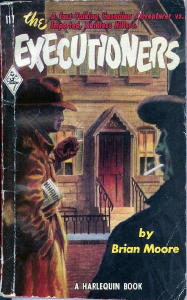 Wreath for a Redhead. Harlequin #102, Canadian pb original, 1951. = Reprinted as Sailor’s Leave, Pyramid #94, 1953. The Executioners. Harlequin #117, Canadian pb original, 1951. = No US edition; reprinted in Australia by Phantom Books (paperback). as Bernard Mara
French for Murder. Gold Medal #402, pb original, May 1954. A Bullet for My Lady. Gold Medal #472, pb original, Mar 1955. This Gun for Gloria. Gold Medal #562, pb original, Mar 1956. = Reprinted as Wild as by Edwin West in a pirated edition (Zodiac pb, 1963). as Michael Bryan
Intent to Kill. Dell First Edition #88, pb original, 1956. Murder in Majorca. Dell First Edition A145, pb original, Aug 1957. You might find this interesting. Here is how one Internet source describes his early work:
... Following a tentative
start as a short-story writer, he began trying his hand at hack
thrillers in the Chandler-Hammett mode, under the name of Brian Mara,
before taking off into serious fiction in 1955 with The Lonely
Passion of Judith Hearne.
Other than the books above, only a few of his later books could be described as being mystery-related. Using Al Hubin’s Crime Fiction IV as a source, they are: The Revolution Script. Holt Rinehart & Winston, 1971. The Color of Blood. E. P. Dutton, 1987. Lies of Silence. Doubleday & Co., 1990. The Statement. E. P. Dutton, 1996. Copies of A Bullet for a Lady, in about the same condition as the one I have, are offered on ABE at $30.00 and up. Not bad for a 20¢ investment, and now I really wish I could go back. (And take a look at the prices wanted for the Harlequin editions. They don’t seem to be scarce, but my oh my.) What I do not think is precisely true is that Moore was writing in “the Chandler-Hammett” mode. I think someone was stretching there, using the only names the writer could think of (or thought his readers could identify with). Hammett and Chandler are always used as a crutch by (and for) people not so familiar with the field, when they cannot come up with names on their own. I’m reminded a little of Eric Ambler myself, but with a hero a little more knowledgeable and capable than some of the innocents (more or less) in Ambler’s work, guys here and there overseas, mostly postwar Europe, who fall into trouble and struggle to get out, and trouble not of their own doing. The adventuresome kind of guy, scraping by, doing this and that, independent and on his own. Jack Higgins’ earlier heroes fall into this category, people like Jack Nelson in The Khufra Run. But since he came along later, then how about Harry Bannock in Edward S. Aarons’ Girl on the Run? 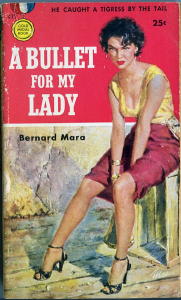 It is no coincidence, I do
not believe, that the Aarons book was also published by Gold Medal, nor
that later on many of Higgins’ earlier books first appeared in
paperback in this country as Gold Medal’s. It is no coincidence, I do
not believe, that the Aarons book was also published by Gold Medal, nor
that later on many of Higgins’ earlier books first appeared in
paperback in this country as Gold Medal’s.The hero in Bernard Mara’s book is Josh Camp, and he is a partner in a small (two person) aviation company based in France, specializing in small jobs that take them all over the world. In 1955, when this book was written, the world was huge, and men who flew around it on their own were greatly to be admired. When Camp’s partner goes missing in Spain, Josh does not hesitate. He immediately goes to find out what went wrong. And as soon as he lands in Barcelona, he is met by a beautiful woman who tells him that Harry is dead. This is on page 7, and this is where the story begins. Mara [aka Brian Moore] had a way with words, even at this early stage of his career. Josh checks into the hotel where Harry stayed in Barcelona, and the elderly bellhop leads the way to up to his room. From page 22:
We went up. My room had a
thirty-watt light bulb, a bathroom so small you could shave and shower
at the same time, and a small balcony looking down at a street as
narrow as an alley. A sign on the back of a door said it cost the
equivalent of seventy-five cents a night. I gave Grandfather a
bill and he left. The place was clean, but being in it made you
feel dirty. I took my jacket and shirt off and began to
wash. Harry must have been pretty broke to stay here. Not
that we hadn’t stayed in worse places when the going was rough.
But Spain is the cheapest country in Europe and Harry was on
expenses. Still, if he was running from something, the Strasbourg
was an ask-no-questions joint.
The language is picturesque, and for readers never more than 200 miles from home, Mara/Moore makes them feel as if they were. I must have led a sheltered life myself. Look at the lady on the cover. If I ever met a lady like that, I know that I wouldn’t be able to say a word. I wouldn’t even begin to know what to say. In the first 50 or so pages, Josh meets: three women, all enigmatic but beautiful in varying ways; one tough guy; one second- or third-rate toreador; a dwarf; miscellaneous (but not very friendly) cops; and assorted cab drivers and hotel staff. They all have different agendas, especially the three women and the second- or third-rate toreador. All the cops care about is getting Josh out of the country, and they give him only 24 hours to do so. And therefore only 24 hours to discover how Harry’s death happened and who was responsible. When I got to page 57, I made myself a note. It says, “Do you know what? None of this makes any sense.” On page 67, Mara/Moore rightly decides that a sort of a recap is in order, and by page 84, the true story starts to come out. What it is that the bad guys want and at the same time, to some extent, at least, an idea of who the good guys are. As you may know, Gold Medal paperbacks in the 1950s were usually only 160 pages long. They could almost be read in a day, and this book is no exception. It may surprise you if I were to tell you that it is the first half which is the more interesting – the half in which confusion is king – but it is so. Once the story rights itself around and heads off in the right direction, it is as if the mystery is gone, as if the story from that point on is a mere formality, as though (but not quite) it’s only going through the motions. Go figure. An “A minus” perhaps for the first half, and a “C plus” for the second. The works out to a solid “B,” doesn’t it? That’s just about what I would have called it, anyway. If I were still using letter grades. MARK MIANO - Dead of Summer Worldwide; paperback reprint, Nov 2005. Hardcover edition: Kensington, April 1999 (copyright date, 1998). Hardcover reprint: Detective Book Club, circa 1999. There is something going on here that I do not understand. There is what is nearly a “phantom” entry on Amazon for a Kensington paperback edition of this book which was to have come out in March of 2002. There are no copies of the book for sale on ABE, and the only used copy on Amazon has an asking price of $30.68. What gives? The book itself was the third detective novel written by Mark Miano, who is obviously making much more money by working as a producer for the Discovery channel, his current full-time job. Not so incidentally, in this book is an account of the third case tackled and solved by Michael Carpo, a television news writer based in Manhattan. The three books are: Flesh and Stone. Kensington, hc, Feb 1997; pb, Feb 1998. The Street Where She Lived. Kensington, hc, Feb 1998; pb, Feb 2000. Dead of Summer. Kensington, hc, Apr 1999. Worldwide, pb, Nov 2005. Puzzling over this just now, it appears – and please do not take this as fact – that as time went on, sales were low or even only so-so, and Kensington began to drag their feet on the series. After three tries, it looks as though Michael Carpo’s shot at mystery fiction fame and fortune was over and out. Kensington cancelled the series, and they never published the third one in paperback, although (from the Amazon listing) everything was set and ready to go. If so, and things like this certainly do occur, then how did it happen that Worldwide picked the book up after such a long time, more than six years later? Hardcover orphans like these (last books in a series that aren’t published in paperback) almost never have any second wind to speak of, and even more unlikely is a sudden appearance out of the blue after a long delay like this. Here’s a hint. Miano is still listed as an author on the Kensington website, where it’s mentioned that he has a new series in the works, one with a new leading character called Martin Ripley. The series is said to focus on the art and museum world, but the important aspect of this is that he’s still in their good graces. I’m not enough in the know to do more than ask questions, although I do seem to remember Kensington cancelling several other mystery series, even with books delivered but which ended up never being published altogether. Something like this may have happened at the time. If you happen to have more details, I’d be pleased if you’d let me know, and thanks in advance. 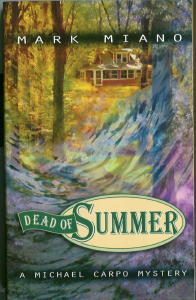 To the book, though. (And at last, you say.) Intending to spend some of his vacation watching over writer Jack Crawford’s cottage overlooking Lake Lillinonah in Bridgewater, Connecticut, Michael is shocked to find the old man dead, an apparent suicide, closed up in his bathroom with his dog. The local state trooper and the county coroner say it is suicide, but the inveterate mystery reader (that’s both you and I, right?) will know otherwise, even before it dawns on Michael. Who would commit suicide, say I, shut up in a bathroom with a pet? On the other hand, who would commit a murder shut up in the same bathroom with a pet? And of course murder it is, not that we ever had any doubt, but the question is never answered nor the circumstances explained. I do not even believe it ever comes up, but I may be in error on that point. What this means though, is that although the book has some good moments, it’s also undone by the weakness of the plotting. (There are other questionable moments, but the word “weakness” was deliberately used, not to imply “bad,” but only to suggest that the reader is sometimes ahead of the protagonist, and definitely not always.) Let me run through some of the good moments. Michael is assisted in doing some digging into local history by a neat lady librarian in New Milford who ought to be a detective herself. And the friendship between Michael and the dead man, in many ways his mentor, is extremely well depicted, even though it is, of necessity, brought out after the fact, with Michael staying on in Jack Crawford’s house, with his books and mementos, and with all of the sadness and memories they bring. One last note. I mentioned local history in the last paragraph – we are speaking of Connecticut here – and this involves a town called Southville I had never heard of before. I checked it out on Google, and yes, the event that’s the basis for this present-day mystery actually happened, and I learned something. I’m usually better at history than this, but I didn’t move to Connecticut until 1969, which was 14 years later, so that’s my excuse. If it matters at all, and I’m sure it doesn’t. December 2005
UPDATE: The author Mark Miano has replied with some inside information as to how and why Worldwide ended up publishing this book, and not Kensington. He also talks about the portions of the book that he thinks worked best. Go to the Readers Forum to read more. CAROLINE ROE - Consolation for an Exile Berkley; paperback reprint, December 2005. Hardcover edition: Berkley, November 2004. It is better, it is safe to say, to come into a series eight books late than not at all. There are one heck of a lot of series about which I can say the latter, unfortunately, but not now about Caroline Roe’s series of historical mysteries featuring the blind Jewish physician Isaac in Girona, Spain. The year: 1355. Here is the list of the books that I’ve missed. Well, all but the last one: Remedy for Treason. Berkley pb, May 1998. ● Barry award for Best Paperback Original. ● Anthony nominee for Best Paperback Original. ● Nominee for the Canadian Arthur Ellis award for Best Novel. Cure for a Charlatan. Berkley pb, Feb 1999. An Antidote for Avarice. Berkley pb, Dec 1999. ● Anthony nominee for Best Paperback Original. Solace for a Sinner. Berkley pb, Dec 2000. A Potion for a Widow. Berkley pb, Dec 2001. A Draught for a Dead Man. Berkley hc, Nov 2002. A Poultice for a Healer. Berkley hc, Nov 2003. Consolation for an Exile. Berkley hc, Nov 2004. Perhaps you already knew, without my telling you, but I’ve only now discovered that Caroline Roe is a pen-name for Melora Sale, another mystery writer whose books I have not yet read. (I did tell you that there is one heck of a lot of them.) The detective in the set of six books by Melora Sale (1986-1994) is Inspector John Sanders, a Canadian homicide detective who teams up in solving crimes with Harriet Jeffries, an architectural photographer in Toronto. Slow sales was more than likely the cause for the end of the series. Mystery novels with British detectives usually sell well in the US. Canadian detectives usually don’t. This is pure conjecture, of course, and as such, it’s worth about as much as your saying otherwise, and maybe less. 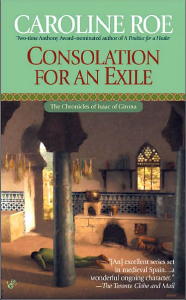 Returning to Caroline Roe,
though, and this has absolutely nothing to do with that, I have
begun to wonder where the ninth book in her series is. I’ve not
been able to find out anything about it, and the Internet usually knows
all. This time it doesn’t. Returning to Caroline Roe,
though, and this has absolutely nothing to do with that, I have
begun to wonder where the ninth book in her series is. I’ve not
been able to find out anything about it, and the Internet usually knows
all. This time it doesn’t.As for Consolation for an Exile itself, there is at least one long loose end not tied up at the end of this book – and it is not one that has anything to do with the mystery, I hasten to add – and I shouldn’t be surprised if fans who have been paying attention all along might be getting a little restless and being concerned about it themselves. The particular loose end I am referring to has to do with Isaac’s 13-year-old pupil, Yusuf Ibn Hasan, a Muslim lad from Grenada who, it learned, has connections with the royal family (or families) there. His return is requested, but once it is discovered that his life is in danger, he is required to make his way back to Girona, not by ship, which is how he was taken to Grenada, but overland, a trip fraught with thieves, conspirators and others of that ilk, about which he knows nothing. As I mentioned earlier, this long interlude has nothing to do with the mystery. But in fact, if a mystery needs a murder to be solved before the mystery begins, the mystery does not begin in this book until page 183. Much of the early going consists of slowing piecing together the relationship between the characters, many of them known to earlier readers of the series, but perhaps as many not. In any case, if the reader slips up and does not recognize a name of a character when he or she comes upon him or her, there is a handy three page list of those involved in this story, who they are, and who they are related to. Perhaps I make that sound like a bad thing, and I do not mean to. It is helpful, and perhaps other authors should use the device more often. Girona in the 14th century is a pleasant enough place to visit, and a leisurely stay, with attendant sights, sounds and smells, is not altogether unwelcome. Although, there is this itch that keeps recurring, one that keeps whispering “If this is a mystery, why is there no mystery yet?” It is a patient of Isaac’s who dies, a death by poisoning foreshadowed by his nightmares and an long-extended visit from a man who had claimed to be the dead man’s half-brother, a man no one much liked, but a man who could not be asked to leave. The story is told in soft, understated tones, which also is enjoyable, but – and I’ve been putting this off for as long as I can – but as pleasant and enjoyable the telling, by the time the story ends, one does wonder why this was marketed as a mystery, the detective portion being so minor – and so indifferently solved. Reading is a funny thing. It’s a cooperative effort between the author and the reader, and sometimes there are problems. Sometimes they are significant, sometimes they are only niggling, and sometimes it is the reader who is not giving the author his full attention. So it could have been me, but in this case, I think not. Let me tell you precisely when I had the feeling that the author and I were no longer in touch with each other. Not completely, but it was a bump big enough, and noticeable enough, that it jarred me out of the story, and I never quite returned. It has to do with Yusuf’s remarkably miraculous journey back to Girona. I am reluctant to say more, but when you reach page 167, tell me if you do not react the same way I did. You may also read what I just said very carefully. December 2005
_____________________________________ YOUR COMMENTS ARE WELCOME. |

 courtesy
of
courtesy
of