Return to
the Main Page.
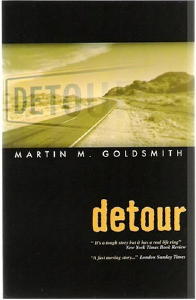 MARTIN M. GOLDSMITH -
Detour: An Extraordinary Tale MARTIN M. GOLDSMITH -
Detour: An Extraordinary TaleO’Bryan House, Publishers; trade paperback, 2005. Hardcover edition: Macauley Co., 1939. The people behind O’Bryan House, and that includes Richard Doody who wrote the introduction, have done the fans of noir fiction a tremendous favor in reprinting this book. If you are thinking, “What book?” and I imagine many of you are, you are in exactly the same position I was when I first heard about it. Now of course there is The Movie Version, which perhaps you have heard of. If there ever were a poll of noir film fans, the film that is based on this book would have to rank in the top two or three of all time. Forgive me, though, if I don’t review the movie, although I will have to admit that it was the rhinoceros in my head when I was reading the book. I’ll review the book, though, if you so allow, and whatever movie you’re thinking of, I never heard of it. Let me get back to the “favor” that I mentioned in the first paragraph. There are two copies of the First Edition on ABE, neither of which has a dust jacket. The asking price for the first is $2500, and no, I did not loose the decimal point, so you can get up off your hands and knees and stop looking for it. The second copy is a mere $3500, but that one is signed by Mr. Goldsmith, who died in 1994, with a long inscription, so it is probably worth the money. There may be other ways to obtain the paperback edition, but one good way may be to order it from Amazon, and at an even more reasonable $14.95. If Mr. Doody has any alternative means to get a book into your hands, I will have him tell you later. To get started on the review, however, I hope that you don’t mind if I simply start off by quoting to you the first four paragraphs or so. Once again, if you are a fan of noir fiction, and if you were to tell me that you could put the book down after reading this, most of the first page, frankly, I wouldn’t believe you. One way or another, you’d be lying to me. Either you’re no fan of noir fiction, or you’re picking the book back up again when I’m not looking.
The big grey roadster streaked
by me and came to a halt fifty yards down the highway with screaming
tires. I got my lungs full of the smell of hot oil and burning
rubber. It choked me so that for a full minute I couldn’t
breathe. Neither could I move; I just stood there staring
stupidly at it and at the two black skid-marks the wheels left on the
concrete. I was heading west, via the thumb-route, and had been
waiting over three hours for a lift. I can’t remember exactly
where I was at the time, but it was somewhere in New Mexico, between
Las Cruces and Lordsburg.
It seemed kind of crazy, that car stopping. I had begun to believe that only old jalopies and trucks picked up hikers any more. Bums are generally pretty dirty and good cars have nice seats. Then, too, it was a lonesome stretch in there and plenty can happen on a lonesome stretch. The guy driving the car yelled at me over his shoulder. “Hey, you! Are you coming?” He acted as though he was in a great hurry, for he goosed his engine impatiently so I’d shake a leg. I snapped out of it. It was hot as a bastard and I guess the sun was getting me. Somewhere back along the line I had lost my hat and the top of my head seemed to be on fire. Anyway, the last two hours I had been waving at cars more or less mechanically, not expecting anyone to stop. A few hundred of them must have whizzed by without even slowing down a little to give me the once-over. You know, hitch-hiking isn’t as popular out west as it used to be. I suppose that is why the real bums stick to the rails. Telling this first part of the story is a down-on-his-luck jazz musician named Alex Roth. He is heading for California, and Hollywood in particular, since that is where his former live-in girl friend, Sue Harvey, has headed before him, only a week or ten days before they were to have gotten married. (She is the impulsive type, Alex tells the reader.) Picking him up in the grey roadster is Charles Haskell, who has a wad of money in his billfold and who is not long for this world. It is an accident, but Alex knows that no one will believe him, given that small incident (thirty days) in Dallas, and given that he and Haskell do look alike... Well, you get the picture. Backing up just a little, from page 32:
All right. Now you’ve
reached the part where all the mess begins. You’ll probably take
the rest of the story with a grain of salt or maybe just come right out
and call me seven different brands of liar. It sounds fishy – but
I can’t help that, any more than I could have helped what
happened. Up to then I did things my way; but from then on
something else stepped in and shunted me off to a different destination
than the one I had planned for myself. And there was nothing in
the world I could do to prevent it. The things I did were the
only things left open for me to do. I had to take and like
whatever came along.
For when I pulled open that door, Mr. Haskell fell and cracked his skull on the running-board. He went out like a light. In the meantime, Sue herself is not doing so well. From pages 47-48, she expresses to the reader her distinctly discouraged view of Hollywood, where she is getting by (barely) as a waitress, and not as the star she had thought she was destined to be. Or if so, not yet. It scarcely seemed believable, but only a
few months before I too had thought Hollywood a glamorous place.
I had arrived so thoroughly read-up on the misinformation of the fan
magazines that it took me a full week before I realized that the
“Mecca” was no more than a jerkwater suburb which publicity had sliced
from Los Angeles – a suburb peopled chiefly by out and out hicks (the
kind of dumbbells who think they are being wild and sophisticated if
they stay up all night) or by Minnesota farmers and Brooklyn smart
alecks who think they know it all. I soon saw that here were only
two classes of society: the suckers, like myself, who had come to take
the town; and the slickers who had come to take the suckers. Both
groups were plotters and schemers and both on the verge of starvation.
Goldsmith is less convincing as the voice of Sue Harvey than is as Alex Roth, but his portrayal of her is solidly etched in weariness and desire, and if one of the two of his two leading characters were to be considered hard-boiled, you have to know that it is not Alex. And returning to that half of the story, the reader’s brain will start to scream vicariously in warning when Alex, in turn, picks up a hitch-hiker, female, a woman named Vera, and man, does the story explode from there, eventually taking a leap with one staggering coincidence that exceeds even the often crazy incoherence of a Cornell Woolrich short story or novel, but in this kind of story, the stops are usually pulled all of the way out, and if they weren’t, you’d complain. Backing up one more time, from page 84, after Vera has agreed to the lift, saying as she gets in, “Los Angeles is good enough for me, mister.”
I kept looking at her out of
the corner of my eye for a long time, wondering who she was, why she
was going to Los Angeles and where she had come from in the first
place. I has asked her all of those questions when she first got
in the car, but her answers had all been vague. Her name was
Vera, though. I didn’t quite catch the last part. Vera’s
manner puzzled me in a way. She didn’t seem at all grateful for
the lift I was giving her. She acted as though it were only
natural, that it was coming to her. I had half-expected her to go
into ecstasies when I told her I was going all the way to the
coast. However, when I said I’d take her to Los Angeles, she
wasn’t at all surprised or pleased. She merely nodded her head
and shot me a look I couldn’t understand. It was a funny look,
shrewd and calculating, and a couple of times I turned my head and
caught it again. That gave me the notion that this dame was a
little simple upstairs.
These are the players. What you have just read includes considerably more quoting than I usually do, but there is little here, I guarantee you, that you will not glean from reading the few sentences of descriptive material on the back cover. There is plenty of story left, and on very nearly every one of the 158 pages in this book, there is another passage as quotable as any one of these. To my mind, this is the great undiscovered American novel, told from the underside, and somehow in its understated raciness, marvelously reminiscent of those rather notorious pre-Code days at the movies. Which brings us back around to one of my opening comments. They did make a movie out of this book, did you know?
January 2006
PostScript. In his introduction, Richard Doody mentions Goldsmith’s first book, Double Jeopardy (Macauley, 1938), but he doesn’t describe it at all, except to say that it is a crime novel. There are three copies on ABE, ranging in price asked from $175 to $275. That’s also beyond my price range, unfortunately, but (Richard?) I really would like to know more. Update. Richard has responded to the questions I asked, including how to obtain copies and to tell us what he knows about Goldsmith’s first book. You will find his reply in the Readers Forum. Second Update. Follow the link to a brief summary by Bill Pronzini of the author’s other two books. Bill also provides cover scans of all three in jacket.  CARA BLACK
- Murder in the Marais CARA BLACK
- Murder in the MaraisSoho Crime; trade paperback, October 2000. Hardcover edition: Soho Press, 1998. The publication date for the hardcover edition of this book is generally accepted to be 1998, but I’m a little puzzled by it. In the paperback edition I have, the copyright date is given as 1999. On the other hand, the book was an Anthony (and Macavity) nominee for Best First Mystery in 1999, so 1998 it has to be. (Until or unless I learn otherwise.) Since the obvious success of this, her first book, Cara Black (who is not the young tennis player from Zimbabwe, if you try Googling her) has written several more in the series, to whit: Murder in Belleville. Soho Press, 2000; trade paperback: April 2002. Murder in the Sentier. Soho Press, 2002; trade paperback: April 2003. Murder in the Bastille. Soho Press, 2003; trade paperback: April 2004. Murder in Clichy. Soho Press, 2005; trade paperback: March 2006. Murder in Montmarte. Soho Press, March 2006. All of these are cases of one species or another for Parisian private eye Aimée Leduc, a specialist in computer penetration, and her partner, René Friant, a “handsome dwarf with green eyes and a goatee.” Either the author or her character has struck quite a chord with her readers, as witness the almost yearly addition to the saga, and all in multiple printings. The books themselves are handsomely made as well, solid and somehow daring you not to pick them up. In Marais, the first of the six, Aimée is hired by an aged French Nazi-hunter to take a digitalized photo (converted from computer code) to an elderly woman still living in the Jewish section of Paris. Aimée arrives too late, finding Lili Stein murdered soon before her arrival; and her employer, Soli Hecht, is hospitalized soon thereafter in what is called a horrrific pedestrian accident. (We know better.) In France and apparently Paris in particular, life has gone on since World War II, but the days of Nazi control are never too far away from many inhabitants’ memories, both victims and collaborators. One such sad story is what Aimée finds herself up to her neck into. Aimée herself reminded me of Emma Peel and a not-so-voluptuous Honey West, mixed in with a dash of Sydney Bristow (of TV’s Alias) with her penchant for disguise and undercover work, slinking across Parisian rooftops in high-heeled pumps. And a form-fitting tight black skirt. (I can picture that.) Her partner René does not have much of a role in this one, content to opening password-locked computer accounts with an ease and nonchalance that makes it seem all too easy, with his one big scene consisting of being hung by his suspenders by one of the villains on a peg on the wall. It would seem churlish to suggest that passwords are not discovered as easily as they are in this book, but perhaps the author was just trying to keep the pace of the book moving, which is constant, fierce and filled with action upon demand. A large portion of Aimeé’s background is described in broad outlines, but some of her past is only hinted at. The part that is hidden may be part of what it is that has had readers coming back for more. That, and of course, the independent and free spirit that is Aimée herself, living as she wants, and being attracted to and sleeping with whomever she wants. Life in Paris is always an attraction to people in the United States, and whether her depiction is authentic or not, Cara Black makes the city come to life, the non-touristy part, made even more real by the inclusion of more than occasional phrases in French, in my mind just the right dosage. (Some of the reviewers of this book online have taken issue with the authenticity, which I noted but did not want to know about. If it was an illusion, I did not want the illusion broken. So I am pointing this out but stepping back, and with a double grain of salt, allowing you to be the judge.) I am therefore disappointed in myself for having to tell you my other impressions. The book is not meant for speed-reading. The prose, while not clumsy, is often as disjointed as the plot, jumping here and there and sticking in good scenes when a good scene is called for, whether it is always that particular scene or not. Here is one example of the author’s carelessness in the details. On page 217, the dying Soli Hecht’s last words are related as having been “Don’t ... let ... him ...,” then “Lo ... ” On page 251, the man’s last utterance, as Aimée is puzzling over the case to that point, she remembers as “Ka ... za.” Faulty details like this are deadly in a detective story, even if both versions could have been true. To my knowledge the point was never addressed, just another indication that in the world of detective fiction today, atmosphere and eye-catching characters can often carry the day, even if the puzzle of the plot is present but passed aside as if it doesn’t really matter. But here’s what is really funny, not in the sense of “ha-ha” funny, unless the joke is on me, but funny in the sense of “I can’t explain it either.” I enjoyed the book, and if you were to ask me if I am going to read another of Aimée’s adventures, the answer would definitely be yes. January
2006
COLIN ROBERTSON - A Lonely Place to Die Robert Hale (UK); hardcover, 1969. No US edition. You can sometimes buy the darnedest things on eBay, which is what happened not too long ago, when I picked up a small collection (seven) of Colin Robertson’s hardcover mysteries from a seller in Canada. And even though seven sounds like a sizable amount, it is indeed small when you compare it to the author’s total output, which runs to something like 57 novels and collections under his own name, not including a Sexton Blake adventure that came out under the house name of Desmond Reid. 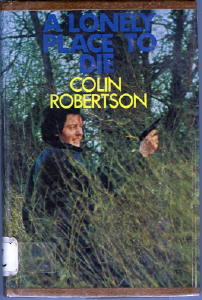 The book I happened to pick, more or less at random out of the stack, is an adventure of Peter Gayleigh, a name I confess I did not know ahead of time, and whom I will get back to in a minute. First, though, here’s a list of all of the series characters that originated from the typewriter of Mr. Robertson. See how many of these fellows (and one gal, I believe) you recognize. In chronological order of their first appearances: Inspector John Martin (1935-39; three books.) Inspector Robert Strong (1935-40; four books) Victor Raiefield (1938-40; two books, both in tandem with Strong) Peter Gayleigh (1939-69; fifteen books) Edward North (1950-53; four books) Vicky McBain (1951-61; nine books) Supt. Bradley (1957-70; eleven books) Alan Steel (1965-68; three books) There were some stand-alone’s as well, in case you were trying to make the total come out right. And to tell you the truth, as I hinted at above, I am only assuming that Vicky McBain is female. Googling did not help. I found only one semi-useful reference, and it did not say either way, only that Vicky was a private investigator. And if you were wondering, no, none of the other six Robertson’s I obtained via eBay are Vicky McBain thrillers either, so there is no assistance gained from that quarter. But a few of the ones I have are affairs that it was up to James Bond knockoff Alan Steel to handle. I use the term “knockoff” deliberately and in similar fashion to Peter Gayleigh, who seems to have followed (gaily? sorry) in the footsteps of one Simon Templar, gentleman adventurer, rather closely. Or perhaps, if one to were to analyze the matter even more in depth, it might be possible to conclude that John Creasey’s Richard Rollinson (aka The Toff) was also a likely model. It is difficult, you see, to make generalizations when you’ve only read one or two books recently from any of the three authors, but I see in the notes I wrote to myself while reading the book in hand that at one point I was definitely reminded off The Toff, so I’ve changed my mind, and The Toff it is, at least for now. Well, I’ll give you the same paragraph I was reading when I made the quote, and you can judge for yourself. From page 62:
As Diana [Caryll,
Gayleigh’s close lady companion] had
found, he [Gayleigh] effected
the privileged few who worked for him in that way. There was
something in his vital personality that bound his subordinates to him
with enduring loyalties. It was partly the buccaneering
recklessness in those cool blue eyes; partly his inherent capacity for
overcoming any obstacle; but in the main that indefinable attribute of
the born leader.
On page 70, Gayleigh is referred to as “a notorious character, an insolent buccaneer,” so maybe the Simon Templar comparison is not so far off either, since that is exactly how I remember The Saint as being described in Mr. Charteris’s books. You decide. I had no idea while I was reading this book that it was to be Gayleigh’s last (recorded) adventure, a spy caper involving a deadly virus designed for germ warfare, although I doubt that it would have changed my opinion of it very greatly. He and Diana (see above) live apart, and they seem to have a rather chaste relationship, for all of the companionship there exists between them. What is rather remarkable – or let’s make that “who” – is a femme fatale who nearly comes between them. At the least, there are strong hints (see page 89) that Gayleigh is strongly attracted to Corinne Raeburn, a madcap heiress or jet-set socialite not akin to an early Paris Hilton, but with a gun. And she is also a woman who knows how to use it. The plot is strictly a paint-by-numbers sort of affair, brightly colored in spots and not making a lot of sense in others if you were to take the time to look at them up close. While the book kept me reading for the requisite amount of time, I see the other six books sitting there, and I say to myself, probably not next. Sometime soon, perhaps, but not next.
January 2006
J. P. HAILEY - The Anonymous Client Tor, paperback reprint; 1st printing, August 1993. Hardcover edition: Donald I. Fine, 1989. In the real world, the pseudonymous J. P. Hailey is known as Parnell Hall, as you may have already known o your own. Over the course of his writing career Hall has come up with three rather distinct series characters, two under his own name and one as by Hailey. First by a year was Stanley Hastings, who first appeared in Detective (Donald I. Fine, 1987) as by Hall. Hastings is an outwardly inept and reluctant private eye who does small-time jobs for ambulance-chasing attorneys. He is also still around, or so it seems, last appearing not so very long ago in Manslaughter (Carroll & Graf, 2003). Attorney Steve Winslow, to whom I’ll return in a moment, is the detective of record in the Hailey books, beginning the year after Hastings’ debut with The Baxter Trust (Donald I. Fine, 1988). He seems to have run out of cases to solve, though, since he hasn’t made an appearance in over 13 years now. Picking up the slack has been crossword puzzle constructor Cora Felton, who beginning with A Clue for the Puzzle Lady (Bantam, hc, 1999), again as by Hall, has proven to be very popular, solving a long line of detective novels that come out on a regular basis ever since. I’ve not (yet) read any of them, but the way the elderly Cora Felton has been described, she seems to be a deliberate reverse take-off of Agatha Christie’s Miss Marple: crusty, promiscuous, and a lush. (If I have that wrong, please let me know. I’d hate to be sued for defamation of character.) Let’s get back to J. P. Hailey, shall we? Here’s the list of the books in which Steve Winslow is the sleuth of distinction: 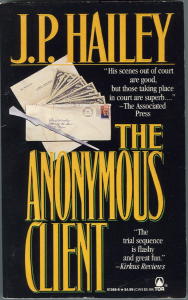 The Baxter Trust. Fine, 1988. Lynx, pb, 1989. The Anonymous Client. Fine, 1989. Tor, pb, 1993. The Underground Man. Fine, 1990. Forge, pb, 1994. The Naked Typist. Fine, 1990. No paperback edition. The Wrong Gun. Fine, 1992. No paperback edition. Something is entirely wrong here. If a book with a title like The Naked Typist can’t get reprinted in a paperback edition, something is wrong with the world of publishing, totally. In any case, after two hardcovers for which the softcover rights were not sold, that was it, no more, the end of the series. Now obviously after reading only the one book, and the second one in the series at that, I can’t possibly tell you what did go wrong. But will you allow me to guess? Ah, well no. On second thought, I won’t guess. Let me just tell you about the book I did read, and not the ones I didn’t, which is where the problem(s), if any – whatever they were – may actually be. Steve Winslow is a lawyer with only one client, a wealthy woman (heiress?) a carry-over from the previous book. I’m not sure how correct I’d be if you were to try to pin me down about the details, but I think I have the wealthy part right. As a result of whatever it was that happened in the previous book, Winslow is now Sheila Benton’s personal attorney. Although as a result he has a steady income, which is of course a good thing, he is also essentially only on call when needed. His secretary Tracy Garvin is so bored with nothing to do that at the beginning of this, the second book, she has just given him two weeks notice. She reads mysteries, you see, and working for Steve Winslow is nothing like what happens to Della Street in the Perry Mason books. Not until, that is, the morning mail brings an envelope containing ten thousand-dollar bills as a retainer from a client who deliberately has not signed the note that comes with it. It may be difficult to believe, but this creates a big problem. Winslow already has a client, and he cannot act on behalf of this new one in case there is a conflict of interest with the old one. He also cannot return the money, because he does not know to whom to give it back. Luckily Winslow knows a private detective whose offices are in the same building, an old buddy named Mark Taylor, and if he doesn’t remind you of Paul Drake, you certainly don’t get out and read those old Erle Stanley Gardner books very often, do you? Many complications ensue, and I won’t go into all of them – or any of them, for that matter – but if you were thinking that there’s got to be some really unusual courtroom shenanigans that occur, then you are thinking along exactly the same line that you should be. Here is a lengthy quote that I liked, lifted from page 129. It is in one of the aforementioned courtroom scenes, and Winslow is on the stand. (I wonder if Perry ever was, in one of his books – on the stand, I mean.)
“Mr. Winslow, I hand you a
piece of paper and ask
you if you have ever seen it before.”
“Yes I have.” “What do you recognize it to be?” “It is the list of serial numbers off of ten one thousand dollar bills.” “Where did you get that list?” “You just handed it to me.” And later on, from page 228:
As [prosecutor] Dirkson began citing cases into the
record, [co-defense attorney] Fitzpatrick
turned to Steve
Winslow. “We’re going to lose.”
“I know,” Steve said. “We’re just laying the groundwork for an appeal.” “I know, but I hate to lose.” “Stick with me. You’ll get good at it.” So there you have it. I enjoyed the jokes, and I enjoyed the complicated plot. Make that “really enjoyed” and “really complicated.” But I have a couple of comments to make – not guesses, you understand – but just an observation or two. Parodies are fine – can this be anything else? – but some people may not like the razzing of their heroes. The F-word was never heard in any of Erle Stanley Gardner’s novels, but it is in this one, and several times over. Parodies can also fizzle, and badly, when the subject of the parody is no longer very popular or perhaps not even remembered. By the time Steve Winslow’s run of adventures was over, Perry Mason had long since vanished from the bookstore shelves and the TV screen, or very nearly so. I have an uneasy feeling, and maybe you realize it too, that these are the guesses I was going to make, after all. Here are some more: Maybe Parnell Hall got tired of the series himself, or maybe even a little more likelier, became weary of thinking up really complicated mysteries for a really quick-witted attorney, dedicated (sort of) and (in this case) underappreciated secretary, and long-suffering private investigator to solve. I guess I could ask, and I think I will.
January
2006
ROBERT LEE HALL - Murder on Drury LaneSt. Martin’s, paperback reprint; October 1993. Hardcover edition: St. Martin’s, November 1992. 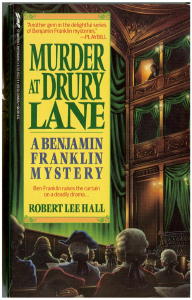 Checking back on
Hall’s career, he seems to have
worked exclusively in the historical mystery subgenre. In doing
so, he has also been no slouch at all in choosing either characters or
period settings. Here’s what I found, in terms of his
crime-oriented fiction: Checking back on
Hall’s career, he seems to have
worked exclusively in the historical mystery subgenre. In doing
so, he has also been no slouch at all in choosing either characters or
period settings. Here’s what I found, in terms of his
crime-oriented fiction:Exit Sherlock Holmes. Scribner’s, hc, 1977. Playboy Press, pb, 1979. The King Edward Plot. McGraw-Hill, hc, 1980. Critics Choice, pb, 1987. * Benjamin Franklin Takes the Case. St. Martin’s, hc, 1988; pb, 1993. Murder at Saint Simeon. St. Martin’s, hc, 1988. No paperback edition. * Benjamin Franklin and a Case of Christmas Murder. St. Martin’s, hc, 1991; pb, 1992. * Murder on Drury Lane. St. Martin’s, hc, 1992, pb, 1993 * Benjamin Franklin and the Case of the Artful Murder. St. Martin’s, hc, 1994; pb, 1995. * Murder by the Waters. St. Martin’s, hc, 1995; trade pb, 2001. * London Blood. St. Martin’s, hc, 1997. No paperback edition. The Ben Franklin cases of detection, of which Murder on Drury Lane is one, are marked with an asterisk. Sherlock Holmes made an appearance only in Hall’s first mystery. Murder at Saint Simeon takes place at the California mansion of William Randolph Hearst, with Marion Davies, Louella Parsons, Jean Harlow and Charlie Chaplin all making at least cameo appearances. That leaves The King Edward Plot, which takes place in England in 1906, during the reign of Edward VII, and one online source describes it as “the first novel-length story to feature Holmes as a character.” This does not appear to be so. Holmes’s appearance is not mentioned in a Kirkus review of the book, and the statement seems in itself to contradict the existence of Exit Sherlock Holmes. Other mystery novels that Holmes had a role in and which also came before Hall’s first book are: Ellery Queen [Paul W. Fairman], A Study in Terror, Lancer, 1966. Michael & Mollie Hardwick, The Private Life of Sherlock Holmes, Mayflower (UK), 1970. Nicholas Meyer, The Seven-Per-Cent Solution, Dutton, 1974. Philip José Farmer, The Adventure of the Peerless Peer, Aspen, 1974. Frank Thomas, Sherlock Holmes Bridge Detective Returns, Thomas, 1975. Don R. Bensen, Sherlock Holmes in New York, Ballantine, 1976. Richard L. Boyer, The Giant Rat of Sumatra, Warner, 1976. Nicholas Meyer, The West End Horror, Dutton, 1976. Austin Mitchelson & Nicholas Utechin, The Earthquake Machine, Belmont, 1976 – Hellbirds, Belmont, 1976. I may have missed one or two, but I don’t believe many more than that. Keep in mind that this is a list of novels only, and that I deliberately attempted to avoid self-published works. Ever since 1977 (what happened then, timewise?) the dam has burst, and Sherlock Holmes has unquestionably become the one single fictional character, detective genre or not, who has appeared in the works of more novels by other authors than any other. (You can question the statement, if you like, as long as you can come up with an alternative.) I seem to have gone off on a tangent here. The Sherlockian connection that exists in The King Edward Plot, and strongly so, is that two of the four amateur detectives who uncover the plot reside at 221A Baker Street. One of them nicknamed “Wiggins.” I will have to read it. Mr. Benjamin Franklin is getting restless, I am sorry to day. The book I have just read is about him, and he is being neglected. Here is a quote from page two. Franklin’s son William, a law student while in London, has just walked into the home where the Franklin entourage is staying, but he is unable to talk about the experience he has just had: Mr. Franklin wore his
customary brown worsted suit and black, buckled shoes. He
sighed. “As my son’s voice appears disarmed, mine must
slay the silence; viz.: he set by the law for the Theatre Royal in
Drury Lane, where he saw the play. Some soubrette has stole his
heart – and his tongue with it.”
He lifted an inquiring brow. “Did I hit the mark?
Did your enchantress dance in the pantomime?”
“Desdemona,” breathed William Franklin. “She played Desdemona.” He blinked, as if waking. “But, Father, I did not tell you that I went to the theatre. Indeed I have not been in my chamber since midmorning.” If Mr. Franklin’s explanation behind his deductive reasoning processes does not match that of the master, the attempt is well taken, at least by me, and the language is well appropriate for the tale that follows. Telling the story is Nick Handy, a twelve-year old lad who is Mr. Franklin’s illegitimate son. (Franklin made more than one trip to London, and there is a story behind this, one that was told in the first installment of the series. See above.) Actually the language, the vocabulary and the insight of the narrator is far beyond those of a twelve-year-old boy, but if you assume that Nick is rather precocious and add some sense of wonder, you will soon not notice. The year, lest I forget to mention it, is 1758, and Drury Lane (as the title aptly suggests) is the center of the mysterious misadventures taking place. David Garrick hires Ben Franklin to investigate, who obligingly allows young Nick to tag along, making sketches of the various places they go and the people they meet. It also turns out that Mr. Franklin is a pioneer in the field of fingerprints and handwriting analysis, but it is the later – with regard to the threatening notes that Garrick has been receiving – that is the more important of the two this time around. The pace of the tale is leisurely, to say the least. Perhaps more important to the mystery, until the end, of course, are the sights and sounds of the theater itself, as well as the area surrounding, bit players included. Other famous personages have roles as well: Sir John Fielding, Dr. Samuel Johnson. Horace Walpole attends a play, as does Tobias Smollett. A tremendously well-manufactured atmosphere is present, in other words, with a melodramatic ending that fits the mood perfectly. If the detection takes second place, it is only a minor quibble on my part to say so.
January 2006
LESLIE CAINE - Manor of Death 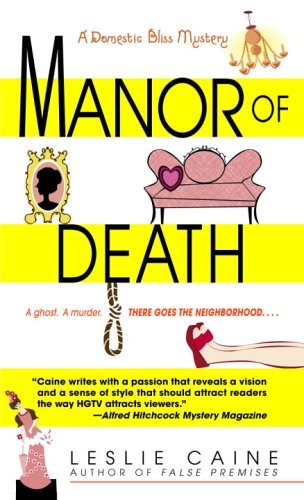 Dell, paperback original; 1st printing,
February 2006. Dell, paperback original; 1st printing,
February 2006.I do my best to keep up to date with all of the mysteries that come out every month, or at least those that come out in paperback. Honest, I do. I buy almost all of them, but I have to confess, at 30 or so a month, that averages out to a book a day, and in my reclining years it takes me two or three days to read a detective novel, and those are on the good days. You do the math. And there are all of the older books in this house to be read. This book by Leslie Caine came out in February, and it’s being reviewed in February. Did that happen last month? No. Will it happen in March? We will have to see. I’ll give it my best shot, but I will also promise you this: No promises. There are two previous books in Caine’s “Domestic Bliss” series, namely: Death by Inferior Design.
Dell, pbo, October 2004.
False Premises. Dell, pbo, June 2005. Take a look at the short amount of time between these books. No wonder I feel so bad. And do you know what else? All of the books are nearly 400 pages long. The lady writes faster than I can read, and I’m not kidding. Here’s a quick recap of the series, using Amazon.com as a guide. In Inferior Design, in trying to determine which of three couples are her real parents, two sets of which end up being killed – can that be right? – home decorator/designer (and primary series character) Erin Gilbert ends up nearly being murdered herself. In Premises, Erin finds that the antiques that she has used to decorate a wealthy client’s home have all been replaced by fakes. Her “nemesis” in these three books, if you care to call him that, segueing into Manor of Death now as well, is her primary competitor in Crestwood CO, Steve Sullivan. (If you don’t get the play on names, let me be blatant about it.) Sullivan is, of course, also a strong quasi-romantic interest in the stories as well. The major events in Manor occur in the house next door to the one where Erin is currently renting space for her and her cat to live. It seems as though the ghost of a young girl who fell, committed suicide, or was murdered forty years ago has now come back and is haunting the present inhabitants. Erin’s involvement is guaranteed since she has been hired to remodel the house, including the girl’s former room and the upstairs tower from which she met her death. Erin, who tells the story in first person singular, is appropriately smart and sassy, but the pacing is oddly off. The opening premise runs on to great length, with only the ghostly happenings (supposedly) and a seance to keep one’s interest alive. Or as you very well may be thinking, my interest, at least. With home decorating such a powerfully significant part of Erin’s life, you might question whether or not I am among the intended readership for this book, and that would probably be a fair inquiry to make, if you were to make it. (Not that home decorating is not a manly pursuit, you understand, don’t you?) On page 106, there is at last a death to investigate. By this time in the series Erin has become a good friend with the primary investigating officer (female and in no way competition for Sullivan), and as good friends do, the police politely make themselves (relatively) scarce. This allows Gilbert and Sullivan to combine forces and dig up the necessary clues from the past – high school yearbooks and the like – on their own. By page 273 the story has finally started to move into higher gear. I went along for the ride, but to tell you the truth, by that time all of the squabbling neighbors and their ofttimes trifling concerns had largely taken their toll on me. The mystery is not bad. The problem is that it’s too small for the book. I’ll take that back. That was my problem, possibly gender based, and it may not necessarily be yours.
February 2006
Charles Scribner’s Son; hardcover; First Edition, 1940. Even though there is a hint in the last paragraph that Inspector Steve Hamilton of the Bermuda Police Department may at some later date have another case to solve, it didn’t happen. This is it, the only case he ever had (one that was recorded for posterity, that is) but nonetheless, it’s a good one. Better than good, as a matter of fact. Something occurred to me while reading this book, though, and I’m not exactly sure why it’s never occurred to me so strongly before, since I’ve known it all along, but this is what it was. That the settings of the mysteries that are part of the period that’s commonly known as the Golden Age of Detection – and 1940 is almost exactly in the center of the time frame, or just afterwards – that the setting and people involved were almost always of the upper crust, the jet set (before there were jets) the rich or the artsy or both. The private eyes hung out in the gutters of society. The socialites had their world, and a certain segment of the population liked their detective work to take place in that world, not that they were part of that world, but that they enjoyed the opportunity to take a peek into that world and (perhaps) to see segments of that society broken down, just a little. As you must have gathered by now, that’s the kind of mystery this one is. And with the youngish Inspector Hamilton’s kid sister Joan romantically involved with the owner of the estate on the island just off Bermuda, he’s also there on the scene before the crime of murder is committed. What this book is also about, and once again something which is also very common in books taking place in the Golden Age of Detection, is a murder that takes place in a somehow isolated locale, in this case an island, and therefore resulting in only a limited number of suspects to be concerned about. (Well, almost.) Which includes the following: an young actor and a young actress, a man-about-town and his wife, a famous director’s wife and a famous artist, female. Not to mention the host and one mystery guest, whom everyone seems to know and seems to have seen even before the surprise is announced. Besides being involved with the host, Tony Bound, and not necessarily to Inspector Hamilton’s pleasure, his sister Joan is also his “Watson,” as she amusingly discovers that a murder investigation is something very much to her liking, eavesdropping in on the questioning of the suspects, making timetables, and all of the other accouterments and other apparatus of solving a crime. Either you like timetables in your detective fiction, or you don’t, but I do, even though I also like a private eye novel that dwells down in the lower echelons of society as much as anyone else. The detective work in this book I thought was excellent. Worthy of a Queen? Yes, even so, and once again, even with the cliched situations and settings that make themselves so noticeable that you cannot help but stumble over them, all I can say it that is it a shame that Joan never had the chance to help her big brother out like this again. UPDATE: This was the only work of crime fiction that David Burnham (1907-1974) produced, but Bill Pronzini, who provided the scan of the dust jacket above, suggests that he perhaps was also the author of Winter in the Sun (Scribner’s, 1937), a book about ranch life in the Arizona desert. The name’s the same, and the publisher’s the same, so the chances are better than good that it’s a match. February 2006
HILARY BURLEIGH - Murder at Maison Manche Hurst & Blackett Ltd., British hardcover. First Edition; date not stated but in fact 1948. 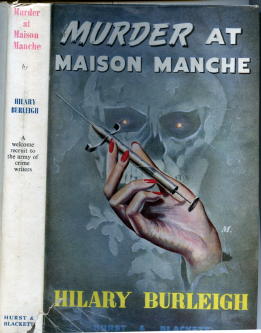 Another one-shot detective novel from an all-but-unknown author today, but not one, in my opinion, that is nearly as successful as the entry above. To begin with, to set the scene, so to speak, let me quote from early on in the affair, from page 13:
The salon at Pierre Manche’s was never crowded. His
clientèle was too carefully chosen for that. One could say
with truth that it was chosen, for in these days the distinction of
being dressed by Mache is so eagerly sought that it is more often the
case of Manche choosing whom he would dress than of Manche seeking
clients. To have admission to his dress parades was a
distinction. Tickets took the form of invitations to an exclusive
function, and men and women came as guests to that beautiful room,
where they were personally welcomed by the little fat man at the head
of the stairs and regaled with cocktails or sherry of undoubted
vintage, as a prelude to the display of fashion.
So all right, then. Both of the ingredients for a successful Golden Age Mystery are present, as touched upon in my comments on the Burnham book. Essential setting ingredient number one: A house (or even better, a manor) full of glitzy people, or an exclusive business establishment of some sort, or some other meeting place of the rich and famous. Essential setting ingredient number two: When Gleba, Mache’s most beautiful mannequin (model) is found murdered immediately after a showing of a wedding dress (page 18) there has been only limited access to the salon and the dressing rooms behind. Only the people on the premises can be presumed to have been the killer. One difference between this book and the previous one is how early on the victim’s death occurs. Here it seems almost too soon, only eighteen pages in, and there has been no time to know anything about the girl, except that she wears clothes well, and thus there has been no time for the reader to react properly and have any feeling about such minor matters such as rationale, reason and motive. In this book, matters like these are left to be revealed only gradually, but the major one as far as I will reveal to you is that the wedding dress Gleba had been wearing just before she was killed was that of a woman in the audience with whose fiancé she (Gleba) recently had had an affair. The detective from Scotland Yard who is quickly called to scene is Chief Inspector Tellit. He is described in detail on page 74 as a thick-set man dressed in well-cut and utterly uninspired clothes, ugly hands, far from good-looking but with an often kindly look in his deep blue eyes. In general, however, “he was considered a hard man” as far as crime and criminals are concerned. This is far from his first brush with a mysterious death, you may also be interested in knowing, since on page 48, his assistant, Det. Sgt. Fry feels “content that he was once again with Tellit on a murder case.” Tellit is a man for keeping track of details, gathering together scraps of information and putting them together like pieces of a jigsaw, as we are told on page 101. Every so often the author (in the guise of Inspector Tellit) feels the need for a recap and a provisional summing up, a device that seems worn-out today, but it is one which this reader, at least, almost always finds welcome. If this is not as gripping a detective yarn as David Burnham’s one was, it is for two reasons, the first being the huge amount of coincidence that is involved to put all of the actors on the scene at precisely the right moment, with the right means (a mysterious snake venom manufactured only in one lab in South America), the right motive and the right opportunity. Secondly the pacing is oddly off. In particular, the book also seems to “end” at page 180, with 27 more pages to go, and another character, previously relegated to the background is needed to emerge to set up the “real” solution. One more coincidence, and usually for a suspension of disbelief, all that an author is usually allowed is one, or no more than two. The right ingredients are present, in other words, but they get themselves muddled up a bit at the hands of an author whom I will call an amateur – without knowing anything else about her – in the finest sense of the word. February 2006
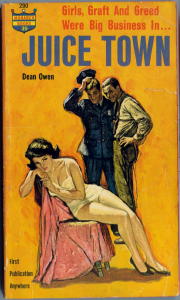 DEAN OWEN - Juice
Town DEAN OWEN - Juice
TownMonarch 290; paperback original. First printing, December 1962. (Cover art by Rafael M. deSoto.) As an author, Dean Owen (born Dudley Dean McGaughey, 1909-1986) is perhaps better recognized for his westerns than for his crime fiction, but today I don’t imagine he’s a well-known name in either field. If you follow the link, however, you’ll find a fairly lengthy and what I hope is a complete checklist of the fiction he wrote, starting out in the pulps, then almost exclusively paperback originals. Of the books listed in Al Hubin’s Crime Fiction IV, I found two errors. First of all, Juice Town is listed as only a marginal entry. Not so, as you will see in a minute. And A Killer’s Bargain (Hillman, pbo, 1960) is included, and I don’t believe it should be. From all I can tell without having it in hand, it’s a western, with no more crime elements than almost any other western has. And of the “sleaze” books Dean wrote, some may have definite crime elements, but while they’re included in the checklist, I don’t own any of them, so someone else will have to report in on those. (And in fact, two of the hard-to-find digests Owen wrote as Hodge Evens have since been confirmed as having substantial crime content.) It’s been a long time since I’ve read a book like this one. It starts out really, really tough and doesn’t let up until it’s over. It doesn’t matter too much if it’s also only a song with only one note. The one note is like a small incessant drumming in the background that just doesn’t go away until the book is over. In a sense (speaking of westerns) this is a western in theme, at least, if not in reality. One guy in a white hat comes to town and cleans it up, one guy against the mob, one guy who’s left himself vulnerable with a wife and kids, but he does his job anyway. The guy in this book is Del Painter. Out of a job and looking for work – there’s a story behind that as well – he is persuaded to return to his home town of Southbay, California, and to join the same police department that he was so proud his Uncle Ray, now deceased, was a member of for so long. Little does Del know that his uncle was a crook, that the entire police department is crooked (and rather openly so), and that he on his first day on the job is expected to be a crook as well. Juice, in the sense of the title, means protection, as it is carefully explained to Del on page 34, and the police in Southbay make out very well, including the use of the services of the local ladies of the evening whenever they feel they have a need for them. Del has a hard head, though, and hard heads make for harder enemies in towns like this. He does make a few friends, however, although it difficult to tell at times – well, most of the time – on which side some of the friends are. At only 144 pages in length, this book can be read in only one evening, and probably in only one sitting. And even though several weeks later you are probably not very likely to remember much of the details of what is admittedly a rather minor effort, this vividly jagged portrayal of a town with such a blatant disregard of the law may stick with you a whole lot longer than you think it will, when you’re done with it.
February 2006
OCTAVUS ROY COHEN - Romance in the First Degree Popular Library 88; no date stated [1946]. Hardcover edition: Macmillan, 1944. The copyright date is 1943, which led me to a quick investigation and the discovery that this very enjoyable detective novel first appeared in several installments as a four-part serial in Collier’s in December of that year. I don’t collect Collier’s, even though I’m often tempted to, as there’s quite a bit of genre fiction to be found in the magazine, including both mysteries and westerns. But just as it is with The Saturday Evening Post, the oversized format makes it both awkward to read and to store, and so (so far) I’ve been able to resist. At any rate (sometimes I do digress) this book would come in Cohen’s later period, if he had periods, but if he did, his early period has been covered by Jon Breen in a short article he did a year or so ago. If you follow the link, you will also find a comprehensive bibliography of Cohen’s crime fiction. As far as when one period ends and another begins, your guess is as good as mine. This may be the first book by Octavus Roy Cohen I’ve read, but you can believe me when I say that it won’t be my last. The opening premise is rather strange. Straight out of the army with a now-healed war wound (but with several missing toes), Jerry Anthony is hired by Warren Cameron, the man he used to work for, but as an unofficial investigator to find out what kind of trouble his (Cameron’s) son and new wife have somehow gotten themselves into. Since Jerry needs a place to stay, there is no better place than the Cameron apartment, where Alan, Linda and their baby are also living. That’s not the unusual part. Cameron is also the father of Rita, the girl Jerry was supposed to marry, but who jilted him while he was overseas. Now engaged to someone else, she still lives at home, as does Sandy, the youngest daughter, who has been in love with Jerry since she was 16. (She is only a few years older than that now.) It’s quite an arrangement. You might think that this is going to be one of those upper class mysteries I was talking about a while before, one involving the Park Avenue set, but No Sir or Ma’am, this is something else altogether. Following Alan and Linda one night to a desolate road house on Long Island, Jerry enters after they have left to find a dead man inside, at which moment he (Jerry) is clunked on the head. From which point on, when he wakes up, the mob is involved – the dead man being a close associate of head mobster Leo North – and so is the dead man’s girl friend; another mobster in love with the girl friend; a somewhat unsavory private eye named Dave Larric who somehow seems to know too much and somehow not enough; and a vivacious young Broadway star named Holly Hamilton. While Jerry knows he did not do the killing, he is not too sure about Alan and Linda, but even though they are not talking, he figures that it is part of his job to protect them. How everyone else fits in, he has no idea. This is one of those cases that gets screwier and screwier one 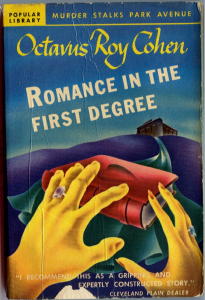 chapter to the next, nor in the meantime is
there any shortage of death and skullduggery at almost any level you
can think of. chapter to the next, nor in the meantime is
there any shortage of death and skullduggery at almost any level you
can think of.Assisting Jerry in sorting through the facts and the clues is Rita’s younger sister Sandy, and if you don’t grasp onto the fact that some romantic (and only slightly sappy) fireworks are going to go off in that regard, you simply have not read enough fiction, young sir or lady. As for Rita, she is sort of steamed about this, and before I forget, here is Jerry’s description of the older sister when he first sees her for the first time in this country after their broken engagement (from page 21): She was a full two inches taller than
Sandy which made her tall enough to be called statuesque. She had
a figure which couldn’t miss the same description What every
woman wants, she had. If you were inclined to think along certain
lines, you could call her voluptuous. I called her
voluptuous. It was a nice thing to call her, and it fitted.
She had provocative gray-green eyes and the richest golden hair that I
ever saw.
She was in a dinner dress. She wore dinner dress every chance she got. She had at least two good reasons. [...] She said, “Jerry! It’s good to see you again.” She said it in a deep, throaty voice that sent tingles up and down my spine. She put both hands in mine. I almost upset my cocktail putting it down to make the most of this opportunity. [...] Already I felt myself looping, just as I had in the old days. I even said “Nuts” to the still small voice that was warning me to watch my step. Besides doing descriptions very well, Cohen has a good hand with dialogue as well, not only here, but throughout the book. Eventually, after Jerry has filled his eyes to the brim, a paragraph or two later his brain seems to take over again. “Magnificent,” I said. “And it all
belongs to someone else.”
I heard a chuckle. I couldn’t tell where it came from, but I suspected Sandy. This hasn’t anything to do with the mystery, but byplay like this surely makes the tale Cohen tells go down more smoothly, not that it needs a whole lot of help. Surprisingly enough, all of the clues eventually fit and make a coherent whole out of what seemed to have been an impossible tangled mass of events and unknown motives and relationships. It is all choreographed so beautifully that – Um. I should not get carried away so dramatically. This is all relatively speaking, you understand. It is not Tchaikovsky I am talking about here, but perhaps you know what I mean without forcing me to finish the sentence above. And let me not forget the private eye whose presence is both peripheral and essential to the story, Dave Larric. In terms of doing down-to-earth detective work, Jerry Anthony is only an amateur. Larric is the professional, straight from the pulp magazines. Although he may as a result be somewhat stereotypical in being so, I wonder (and would really like to know) if he ever appeared in any other of Cohen’s novels.
February 2006
BRUCE ALEXANDER - Rules of Engagement Berkley, paperback; 1st printing, February 2006. Hardcover edition: G. P. Putnam’s Sons, March 2005. This is the first of Bruce Alexander’s “Sir John Fielding” detective novels that I’ve read, and no, I did not realize it until after I’d picked it out to read that this is also the last one that Alexander ever wrote. Bruce Alexander was not his real name – you probably knew that, and so did I. Bruce Cook (1932-2003) wrote eleven mysteries as “Alexander.” Under his own name he had five earlier ones, four of them with Antonio “Chico” Cervantes as the leading character. Now it gets interesting. (I will get back to Antonio “Chico” Cervantes in a minute.) Cook also was at least in part responsible for writing William J. Coughlin’s last book after he (Coughlin) died, The Judgment (St. Martin’s, 1997). I’m quoting from Al Hubin in Crime Fiction IV now: “Apparently written by Bruce Cook from a beginning by Coughlin, then finished and polished by widow Ruth Coughlin.” The reason is that this is interesting, is that this is also exactly how Rules of Engagement got written. From the back cover, and quoting again: “He (Bruce Cook) died in 2003, having completed most of Rules of Engagement, and left notes on how the rest of the story unfolded. John Shannon, author of the highly praised Jack Liffey series, most recently Dangerous Games, completed the novel with Bruce’s wife, Joan Alexander.” As coincidences go, it would be rather minor, but was it a coincidence? Probably not. The idea was there, and the Bruce Cook and his wife simply carried it out in the same way it had been done before. And as you can easily imagine, there are both pluses and minuses in doing so. Before getting into that, and to Sir John Fielding and what the book (and the series) is about, I promised to tell you something about Chico Cervantes. The Thrilling Detective link will tell you more, but perhaps it suffices to say that Cervantes was a Mexican-American ex-LA cop turned private eye whose stomping grounds were (as you probably already guessed) Southern California. His four recorded cases (1988-94) did not seem to turn the mystery fiction world on fire, and in fact, only one of the four, the first, Mexican Standoff, was ever published in paperback, the other three only in hardcover. For whatever that tells you. In any case (no pun intended) the year the last Cervantes book came out, 1994, was the same year that Blind Justice, the first Sir John Fielding novel appeared. Cook, as Alexander, at the age of 62, had hit the equivalent of pay dirt. Here is the complete list of the highly popular Fielding books. (I have them all. They are still in the TBR (To Be Read) portion of the basement. Unfortunately.) All were published in hardcover by Putnam and in paperback by Berkley. The dates are of the hardcover editions; the paperback generally appeared a year later. 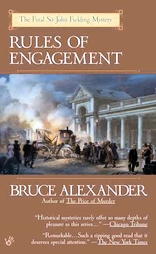
Sir John Fielding, as I’d better make sure I tell you, was the blind English magistrate who was the real-life founder of London’s first true police force, the Bow Street Runners, in the mid-to-late 1700s. What is interesting about one of the books above, An Experiment in Treason, Benjamin Franklin makes an appearance, although unlike in Robert Lee Hall’s series of books, in Alexander’s novel he (Franklin) is a suspect, not the detective, while Fielding is only a (relatively) minor character. In the books by Bruce Alexander, Fielding’s household and close-knit circle of friends and close acquaintances takes center stage, filled to abundance with family, servants, many of which (if not most) are fictional. Especial note should be made of the narrator of the tales, one Jeremy Proctor, Fielding’s protege with him throughout the series, an orphan taken under his wing as a dogsbody, now all of eighteen and Sir John’s clerk at the Bow Street Court. The title comes in part from the fact that Jeremy is engaged to be married to Clarissa Roundtree, the other orphan taken in by the Fieldings, Clarissa as Lady Fielding’s general factotum, and as the book begins, he (Jeremy) is beginning to wonder greatly about his future. (On page 241 there is another context in which “rules of engagement” come into play.) The mystery, which is extremely slight, but of course it needs to be mentioned, is that of the strange death of Lord Lammermoor, who has recently jumped to his death from a bridge while crossing the Thames alone. Several chapters later (or to be precise, in Chapter Three) the case is all but solved when Fielding and his entourage are entertained at the theater by a practitioner of “animal magnetism” and/or “mesmerism.” The only question that remains (to the reader, that is) is who is responsible, and while I cannot reveal his/her name, you will know as soon as he/she enters the story. (Ventriloquy is also an important factor, but my telling you that will neither enlighten you further, or less.) One hopes for more, but more there is not, save 200 pages in which a great happens, but very little of any consequence. All in all, what the authors in consultation have provided is nothing less than a worthy attempt to tie up some loose ends for the readers who have followed the series from early on, but not all of them (the loose ends, that is). Life happens, and that is what is left for the reader to contemplate. This is one of the aforementioned pluses. For someone expecting a detective story with some solid, down-to-earth detective work going on, either Mr. Alexander did not have one in mind, or if he did, neither his wife nor John Shannon were able to build one out of the notes that he left them. This is one of the aforementioned minuses. For the record, the pluses outweigh the minuses, but personally, coming in at the end as I did, I left with a feeling of disappointment that, strangely enough, I sincerely wished I didn’t. If you’d like to call my verdict “mixed,” you’d certainly be right. I wouldn’t deny it at all.
March 2006
DAVID DODGE - Shear the Black Sheep Popular Library 202; paperback reprint; no date stated, but circa 1949. Hardcover edition: The Macmillan Co., 1942. Magazine appearance: Cosmopolitan, July 1942. After I finished reading this, the second murder mystery adventure of accountant detective Jim “Whit” Whitney, I went researching as I usually do, and it didn’t come as any surprise to learn (from a website devoted to David Dodge) that Dodge was also a CPA by profession, and that he started writing mystery fiction only on a dare from his wife. Although Dodge went on to another series (one with private eye Al Colby) and after that several standalones, there were only four books in the Whit Whitney series, to wit: 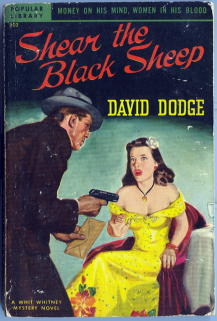 Death and Taxes. Macmilllan, hc, 1941. Popular Library 168, pb, 1949. Shear the Black Sheep. Macmillan, hc, 1942. Popular Library 202, pb, 1949. Bullets for the Bridegroom. Macmillan, hc, 1944. Popular Library 252, pb, 1950. It Ain’t Hay. Simon & Schuster, hc, 1946. Dell 270, pb, 1949 [mapback]. Sorry. I couldn’t resist. You can find much more detailed entries for each of these books at the David Dodge website, which includes a complete bibliography of all of his other books, both fiction and non-fiction. Not to mention his plays, his magazine stories, the articles he wrote and all of the radio, TV and movie adaptations of his work, the most well-known of which is TO CATCH A THIEF, the Cary Grant and Grace Kelly film from 1955. Comprehensive is an understatement, and it’s definitely worth looking into, just to see a bibliography done right. As for Whit Whitney, his home base is San Francisco, but in Shear the Black Sheep he is talked into taking a case in Los Angeles over the New Year’s Eve holiday weekend. Against his better judgment, he agrees to check into the activities of a client’s son, who seems to be spending too much of his father’s money in the business they’re in. They’re a wool brokerage firm – hence the title. The son has also left his wife and new-born baby. Is there another woman? Assisting Whitney – or making her way down to LA on her own to spend the holiday with him, or as much of it as there is left after Whit’s investigative duties are over – is Kitty MacLeod, “the best-looking girl in San Francisco, and pretty clever as well,” as she’s described on page 12. I’ve not read the first book in the series, and make no doubt about it, I will, but in that book (according the short recap on just about the same page) Whit’s former partner was murdered and at the time, Kitty was his wife. It’s now six month’s later, and Whit and Kitty are very close. Whit is beginning to worry that some of his colleagues are starting to talk. There had even been some talk at the time that Whit had had something to do with Kitty’s ex’s departure from life, and getting out of the jam at the time seems to be the gist of the story in Death and Taxes. But that was then, and this is now. There is indeed a woman involved, as suspected – getting back to the case that Whit was hired to do – and the woman leads to a hotel room, and in the hotel room are ... gamblers. A crooked card game, and the black sheep is getting sheared. It is all sort of a light-hearted tale, in a way, but then a murder occurs, and a screwy case gets even screwier – in a hard-boiled kind of fashion. Let me quote from page 160. Whit is talking to his client, who speaks first:
“I don’t think it’s wise to
interfere with the police, Whitney.”
“I won’t interfere with them. I’d cooperate with them except that they’ve told me to keep out of it. I want you to know how I feel, Mr. Clayton. You hired me to find out what Bob was doing with your money, and to stop it. I found out what was going on, but I thought the best way to stop it was to let these crooks get out on a limb, and then saw it off behind them. I thought I could protect your money and show Bob what was happening at the same time. I guessed wrong. I don’t know who killed [...] or why he was killed, and I don’t think I’m responsible for his death, but I’m in a bad spot and I’d like to bail out of it by myself – for my own satisfaction. The police needn’t know what I’m doing. I don’t have to tell you that I don’t want to be paid for it, but if you haven’t any objection, I’ll try to find out who killed [...] and get your money back.” 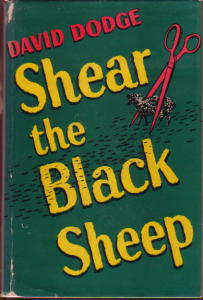 Here are a few lines from page 170, at which point things are not going so well:
He got off the bed and prowled
thoughtfully around the room in his stocking feet, still holding the
beer glass. What would Sherlock Holmes do with a case like
this? Probably give himself a needleful in the arm – Whit drained
his beer glass – and deduce the hell out of the case.
Whit tried deduction. These were the days when mystery thrillers were also detective novels. After a long paragraph in which Whit tries out his best logic on the tangled threads of the plot, and who was where and when and why: It was a pretty wormy syllogism. As
a deducer Whit knew he was a lemon when it came to logic, and he was an
extra-sour lemon because he didn’t know enough about Bob Clayton to
figure out what he might do in a given set of circumstances. Such
as having a pair of football tickets to dispose of, for example.
Ruth Martin might have known where they went, but didn’t, ditto Mrs.
Clayton, ditto John Clayton. Jack Morgan was the next one to try.
What’s interesting is that Kitty has more to do with solving the case than Whit does. Things happen rather quickly at the end, and if all of the loose ends are (or are not) all tied up, no one other than I seems to think it matters, as long as the killer is caught – who was not someone I suspected, or did I? I probably suspected everyone at one point or another. I also wonder if what happens on the last page has anything to do with the title of Whit Whitney’s next adventure in crime-solving. Read it, I must. And I will.
March
2006.
FRANK G. PRESNELL - No Mourners Present 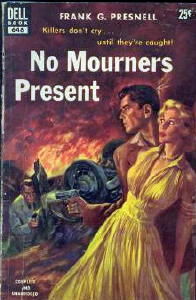 Dell 646, paperback reprint; no date stated,
but circa 1953.
(Cover by Robert Stanley.) Hardcover edition: William Morrow
& Co., 1940. Dell 646, paperback reprint; no date stated,
but circa 1953.
(Cover by Robert Stanley.) Hardcover edition: William Morrow
& Co., 1940.The jacket of the hardcover edition suggests that the book may have been published as by “F. G. Presnell,” but any final judgment on that would have to wait until the title page has been examined, the final and only arbitrator on matters of bibliographic significance like this. There is nothing on the Internet that discusses Frank G. Presnell (1906-1967) nor his three mysteries in any significant way. At the moment, all I have to tell you about him personally is what Al Hubin says in Crime Fiction IV: “Born in Mexico; educated at Antioch College and Ohio State Univ.; designer and engineer; lived in Ohio for 40 years, then in Los Angeles.” Which is a start, but what it doesn’t say is why Mr. Presnell wrote two good books in 1939 and 1940, both with high-powered (and hard-boiled) practicing attorney John Webb, then not another novel until 1951, and Webb is not in it. For the record, here is a list of Presnell’s only contributions to the world of crime fiction: Send Another Coffin. Morrow, hc, 1939. Detective Book Magazine, Winter 1939-40. Handi-Book #39, pb, 1945. No Mourners Present. Morrow, hc, 1940. Dell 646, pb, 1953. Too Hot to Handle. M. S. Mill / Morrow, hc, 1951. Dell 593, pb, 1952. I had not known until I looked it up, but a movie was made of Send Another Coffin, one I’ve never seen, but I believe I shall have to purchase it. The title of the movie is SLIGHTLY DISHONORABLE (United Artists, 1940), and besides Pat O’Brien and Ruth Terry as the two leading characters – I’ll get to that in the next paragraph – also in the film are Edward Arnold and Broderick Crawford.
In the movie, Ruth Terry is credited only as “Night Club Singer,” but in the book she has a name: Anne Seymour. In the followup book, the one at hand, she has another name: Anne Webb. A substantial part of No Mourners Present is the mystery novel, of course – and I’ll get to that in moment too – but another significant portion of it, one mixed up one with the other, concerns the domestic life of the two newlyweds. The tough attorney John Webb is deeply in love with his wife. That much is apparent right away. He also seems to wonder how it is that he is so lucky to have her in love with him. Her background as a singer seems to be a concern to him as well: how well will she fit in with the wealthy set that he sometimes hangs around with? Without revealing too much, I think Anne Webb is smarter in many ways than he thinks she is, and that she can hold her own in his world very well indeed, and maybe even better. John has nothing to worry about. Of course there is no way of knowing. Two books with the Webbs, and that was all there was. If I had known while I was reading this, the second one, it might have influenced the way that I read it, but of course we will never know that, either. For Mr. Presnell, we must assume that the war intervened, and life and a family and earning a living. The town in which John Webb is a man with considerable political clout is not named, I don’t believe, and since Hubin doesn’t suggest a setting (I just checked) neither do I believe it is a matter of my missing it. With very few preliminaries, the mystery gets into action right away, with Jake Barman’s murder taking place on page 15, one page after Webb very nearly slugs a radio news commentator for a remark he makes about Anne. Anne takes him to task reproachfully afterward. “Listen,” she says. “You’ve got to stop hitting people.” Barman is a partner in a building firm, or he was, and he also had ambitions of being elected governor. He is on the outs with his wife, however, which is a liability, especially since everyone knows that Julie Gilson, his secretary, is also his mistress. She is also the leading suspect as well, especially after she disappears completely from sight after Barman’s death. Without a client, Webb is only incidentally involved until Julie’s brother comes to town are hires him to help protect her name. Once hired, Webb goes immediately into Perry Mason mode. See page 40, and you will see exactly what I mean. 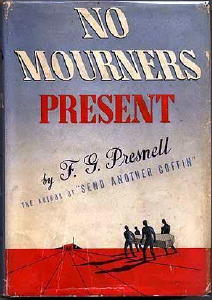 If you’re only in your 30s
or 40s, it may not seem like it – it’s too long ago – but 1940 was
still a time in this country’s history when if your company bucked
either the gangs or the unions, people were maimed for life. This
is the sort of thing that gets Webb’s blood boiling as well.
Here’s a long quote from page 45. He’s talking to the man he’s
working for who’s in charge of operations at a chain of cleaning
establishments. If you’re only in your 30s
or 40s, it may not seem like it – it’s too long ago – but 1940 was
still a time in this country’s history when if your company bucked
either the gangs or the unions, people were maimed for life. This
is the sort of thing that gets Webb’s blood boiling as well.
Here’s a long quote from page 45. He’s talking to the man he’s
working for who’s in charge of operations at a chain of cleaning
establishments. “... In the second place, even if I
didn’t give a good Goddamn whether Acme ever makes another nickel or
not, I’ve got a front to keep up. Why do you think people pay me
fancy prices to do things for them? Because they think I’m going
to lie down and let myself be walked on? Like hell they do!
They hire me because they know they’ll get grade-A effort,
anyhow. And how come I usually give them results besides?
Because the other side knows they’ll sweat for anything they get. [...]
If anybody from this damn
cleaning-and-dyeing-trades racket comes around here, you tell ’em to
talk to me.”
I mentioned Perry Mason a short while back. Perry was tough in his early days, but not as tough as John Webb. Here is a portions of his thoughts, his philosophy of action, you might say, taken from page 61:
Cabash was tough and vicious,
but he wasn’t smart. He’d start trying to bluff us, and when he
did, it was up to me to give him a chance to do nothing but wonder what
hit him. I didn’t know how I was going to work it, but you can
always figure out ways if you’re willing to use them.
As a word of warning, the book is a little too talky to be this tough all the way through, but when it is, it is. It earns high points as a detective novel as well, or at least it did with me, with plenty of twists and turns in the plot to keep Webb’s brain (and mine) working in as finely-tuned fashion as his brawn. The solution is not nearly as finely worked out as one of Perry Mason’s, however, containing as it does one small gap I haven’t quite yet figured out. Nonetheless, even if the mystery itself is not a classic that anyone will remember for very long, if there’s any in mourning at the moment, it’s me, wishing that there were a next one to read, and as much for the characters, I would advise you, as for anything else. Sadly to say, one more time, there wasn’t a next one to read at the time, and there isn’t now.
March 2006.
GEORGE HARMON COXE - Focus on Murder 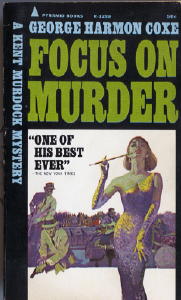 Pyramid R-1259; reprint paperback, January
1966. Cover by Frank Kalan. Hardcover edition: Alfred A.
Knopf, March 1954. Hardcover reprint: Dollar Mystery Guild, June
1954. Previous paperback reprint: Dell 970, 1958. Pyramid R-1259; reprint paperback, January
1966. Cover by Frank Kalan. Hardcover edition: Alfred A.
Knopf, March 1954. Hardcover reprint: Dollar Mystery Guild, June
1954. Previous paperback reprint: Dell 970, 1958.What with two paperback editions and (more importantly) a book club edition, this should not be a difficult book to come across, if you all you want to do is to find one to read. In his prime, Coxe was not a bestselling author like Gardner and Christie, but if longevity has anything to say about it, his sales must have been steady if not spectacular. Coxe’s career in hardcover fiction began in 1935, with Murder with Pictures, also with Kent Murdock, the crime-solving news photographer who has the starring role in Focus on Murder, and it did not end until No Place for Murder. Kent Murdoch does not appear in this latter book, but private eye Jack Fenner does, and he also appeared in Murder with Pictures, his career in hardcover therefore lasting exactly as long as Coxe’s did. And here’s something interesting. While Jack Fenner appeared in 12 cases chronicled by Coxe, his only solo shot was that final one, and it did not appear until the author was 74. (After retiring from writing, Coxe himself lived another nine years, until 1984.) Coxe is probably best known for his series character “Flash” or “Flashgun” Casey, a tough Boston-based news photographer who began his crime-solving in the pages of Black Mask magazine, circa 1934, but (after a quick double-check to confirm this) Coxe wrote far many more novels in which Boston-based news photographer Kent Murdock appeared (23) than those in which Casey was the detective of record (only five). The difference in fame, such as it may be, is probably due to the fact that Casey had a long-running radio show named after him, and two movies based on his exploits, while Murdock had neither. Kevin Burton Smith over at www.thrillingdetective.com suggests that Murdock is Casey with the rough edges smoothed off. Given Casey’s early pulp fiction days, Kevin is probably quite correct in that assessment. The paths of Murdock and Casey also seem to have never crossed, and this only adds more credence that they were in fact one and the same person, only under different names. Although his roots were in the pulps, I would definitely consider Coxe as an author solidly in the Golden Age of Detection story-telling tradition, but if you do indeed come across a copy of this book, and if my review and other chatter convinces you to read it as well – which I certainly am going to do my best to do – be sure to strap yourself in for a fast-paced mixture of action and clues you have to keep your eyes on every minute of the way. Let’s get the basic plot out of the way first – or at last, depending on your point of view. Ralph Stacy, a colleague of Murdock’s at the Courier is found murdered shortly in his apartment after his (Murdock’s) departure, said colleague (as it turns out) having been a blackmailer in his spare time. That Murdock happened to have been in Stacy’s place of residence is important but not significant in the sense that he becomes one of the suspects – Lt. Bacon has worked with Casey before, and I’ll get back to this in a moment – but (as it turns out) an entire parade of suspects just happens to have been in and out of the apartment and/or lurking around the building both before and after Murdock comes on the scene, not all of them totally coincidentally. There is nothing like good old-fashioned (and dirty) blackmail to create a long list of suspects in the death of a blackmailer, not to mention a wife who has just moved out, a current girl friend, and a close boy friend of said girl friend, who just happens to be the jazz singer shown on the cover. Murdock is also personally offended in a personal sense, he being a true-blood newspaperman through and through, nor can the reader help be offended as well. Coxe also has (had) an excellent insight into the way people in the real world (mostly male, I concede, but far from entirely) react to tragedy and other things, which includes matters of right versus wrong, in a strangely tweedy sort of way. He also seems to have been quite the jazz aficionado. I won’t quote Murdock’s conversation with pianist Jack Frost about Art Tatum on page 80 – it’s rather long – but there is nothing said here about Tatum that anyone could possibly dispute. It’s dead on, in other words. By page 116, Lt. Bacon has (figuratively) thrown up his hands and asks Murdock, quite unofficially of course, to give him (Bacon) whatever assistance he (Murdock) can. And of course he (Murdock) does, again with neither the final flourish of a Christie or a Gardner – to pick a couple of prime examples out of the air – but with the somewhat subdued manner of a magician whose apparent casualness may catch you blinking, and with a slowly comprehending grasp of just how easily the unwary reader can be taken in.
March
2006
WILLIAM MURRAY - I’m Getting Killed Right Here Bantam; reprint paperback, July 1992. Hardcover edition: Doubleday, November 1991. You very well may know this, but the bad news is that William Murray, author of the Shifty Lou Anderson books, of which this is one, died last year (2005) at the age of 78. He wrote nine in the series, of which this is the first one I’ve read, and no, it will not be my last. Shifty, who tells the stories himself, is what you might call a “close up magician” by vocation and a steady habitue or patron of the racetracks by avocation. Here is a list – you were waiting for this, right? – of the nine Shifty Lou Anderson novels: Tip on a Dead Crab.
Viking Press, hc, April 1984.
Penguin, pb, 1985. The Hard Knocker’s Luck. Viking Press, hc, October 1985. Penguin, pb, July 1986. When the Fat Man Sings. Bantam, hc, September 1987. Bantam, pb, June 1988. Bantam, pb, June 1990. The King of the Nightcap. Bantam, hc, July 1989. Bantam, pb, July 1990. The Getaway Blues. Bantam, hc, August 1990. Bantam, pb, May 1991. I’m Getting Killed Right Here. Doubleday, hc, November 1991. Bantam, pb, July 1992. We’re Off to See the Killer. Doubleday, hc, September 1993. No paperback edition. Now You See Her, Now You Don’t. Henry Holt & Co., hc, October 1994. No paperback edition. A Fine Italian Hand. M. Evans & Co., hc, May 1996. No paperback edition. This list does not constitute all of his mystery fiction. Here are the others, all but the last appearing before the first Shifty Lou book: Passport to Terror.
Avon T-423, pbo, 1960, as by Max
Daniels.
The Sweet Ride. New American Library, 1967. Signet, pb, 1967. A novel of the restless generation, the young people who are rebels against authority and accepted conventions – a new breed of youth, the rootless, purposeless ones who want nothing more than a "sweet ride" on drinks, drugs, and sex – but mostly on the ever pounding beckoning surf. (Stated as marginal crime fiction in Crime Fiction IV.) The Killing Touch. Dutton, hc, 1974. [No paperback edition.] This taut, fast paced novel is not just about an isolated killing, but, more important, about some of the many ways man and women kill each other – through illusion, deceit, even simple neglect. The Mouth of the Wolf. Little Brown, hc,1977. [No paperback edition.] A millionaire's grandson brutally snatched from the streets of Rome. The Myrimidon Project. Coward, McCann & Geoghegan, hc, 1981, with Chuck Scarborough. Ace, pb, 1982. A highly rated TV newsman about to retire is hit by a series of personal tragedies, perhaps at the instigation of the chairman of his network. Dead Heat. Eclipse Press, hc, Sept 2005. [Published posthumously.] A female jockey searches out a crusty old trainer to help take her to the top. This does not include any non-crime-related fiction, if any, nor have I attempted to list his non-fiction. Among the latter, however, and not surprisingly, is one entitled The Right Horse: Winning More, Losing Less, and Having a Great Time at the Racetrack. (Never having been to a racetrack, I assume that I am correct in assuming that this is non-fiction.) That’s my theory, and of course there are always individual circumstances that can’t possibly be worked into an overall generalization. In this case, for example, Murray would have been 69 when the final one appeared, and the decision to stop writing them may have been his and nobody else’s. The fact remains that while keeping a good series going has probably never been easy, it has to have become more and more difficult in the last ten years or more. Lengthy careers like those of a George Harmon Coxe, to pick an author not so totally at random, while not so remarkable at the time, seem less and less common today. On the other hand, perhaps if we were to wait twenty years and look back, we might see some of the writers starting out today still around and adding to their list of credits. And if I knew how to stop this small digression, other than just by stopping, I would. From an online tribute to Murray by Robert Cancel comes the following information: For many years he taught writing as a
visiting lecturer at both the University of California, San Diego, and
at San Diego State, mostly in the 1980s. His broad interests
included opera and Italian literature, resulting in (among other work)
two volumes of translations of Pirandello’s work. (In the late
1980s, Murray also wrote the “Letter From Italy” column for The
New Yorker magazine.)
Many of the Shifty Lou Anderson characters and venues were based around tracks in southern California, particularly Del Mar, often framed “in imagery reminiscent of Damon Runyon.” One mystery novel managed to combine two of Murray’s passions, When Fat Man Sings, which is “set in the worlds of horse-racing and opera, with a protagonist reminiscent of Pavarotti, but with a gambling problem.” 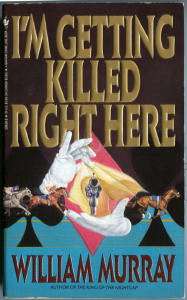 What’s at the center of I’m Getting Killed Right Here – which is also the punch line of a joke told on page 166, sort of – is that for the first time, Shifty is an insider at the racetrack. He owns a horse, one that is possibly going to be a very good race horse, and suddenly he’s very much aware of the fact that there is ten thousand ways to lose a race. Or if he wasn’t aware, that’s the unwelcome but wholly undeniable fact that Charlie Pickard, Mad Margaret’s trainer, reminds him of very early on, no later than page 3. Unable on a magician’s less-than-reliable salary to feed and maintain a horse on his own, Shifty needs to take on a partner, and this case it is a guy who turns out to have made millions in the construction business and who also has a wife who is a looker (the general consensus) and who is also much younger than he is. It may not take more than a nudge from me for you to know where this is going right now. It certainly didn’t take very long for me. One brief motel scene later – well, OK, I guess that was more than a nudge, wasn’t it? – Shifty’s new partner knows what has transpires, and he, Shifty, not to mention Linda, is in a good deal of trouble. Here’s a quickie description of the sort of business problems Shifty’s new partner is having, quoting from page 55: “... something along the lines of bidding
on a job, corrupting the officials in charge of awarding the contracts,
kicking back under the table, greasing politicians and bureaucrats,
socking the city on cost overruns, padding payrolls, working sweetheart
deals with building unions, buying off inspectors, that sort of thing.”
“Nothing major,” Arnie added, “just the healthy American pursuit of a buck. I love free enterprise, don’t you? I wonder when somebody’s going to try it.” Shifty is in over his head, and he damned well knows it. And yet, while this particular escapade on Shifty’s part starts out in rip-roaring old-fashioned Gold Medal fashion, Murray erringly allows the overwhelming sense of impending disaster flit strangely away, and the story heads off instead in a modified, somewhat more dignified, and unfortunately far more predictable fashion – which is not to say that the Gold Medal type of story was not predictable: the one in which the guy gets caught making love to another’s guy younger and good-looking wife, when the second guy belongs to the mob and has connections. Mr. Cameron, that’s the partner, is a villain through and through, of that there is no doubt, so don’t get me wrong, but there is another villain behind him and while attempts are made along these lines to keep his role secret, there simply are no doubts at any time along the way about who he is. (This is one of those books in which as soon as the Bad Guy makes his appearance, you know, somehow deep inside, that he is the Bad Guy.) A detective story this is not, in other words, which to some minds (mine) may leave the ending in something of an anti-climactic nature, but on occasion I am of a forgiving nature, and this is one of them. Shifty’s buddies (Damon Runyonesque, the lot of them) will be around in his next adventure, as will (I imagine) Mad Margaret. Whether his new lady friend appears again is another question altogether. It is to wonder, but my cap is off to Shifty Lou Anderson – there are simply no two ways about it.
March
2006
_____________________________________ HAL GLATZER -
The Last Full Measure HAL GLATZER -
The Last Full MeasurePerseverance Press; trade paperback original; April 2006 Number three in the continuing mystery-solving adventures of itinerant 1940s swing band musician Katy Green turns out to be measurably better than number two, A Fugue in Hell’s Kitchen (2004), in my opinion, but still not nearly as fine as number one, Too Dead to Swing (2002), which is still the best of the three so far. The primary setting for Katy’s latest adventure is an ocean liner that is headed for Hawaii in December, 1941. “Ah, ha!” you say. Yes. It is one of those novels in which the reader knows exactly what is in store, but for the passengers and crew, all they are aware of are rumbling war clouds somewhere off in the distance (but getting closer and closer as time goes on). Katy is part of an all-girl group hired to entertain the passengers, and while you might think impending events would be trouble enough, it is not so. There is a murder on board, but as it is also one with no real suspects, once the ship arrives in Hawai’i, there is (strangely) nothing to forestall a side journey by a subgroup of the all-girl orchestra and various other passengers to locate a treasure buried by native Hawai’ians during a failed insurrection against the haoles in control of the islands many years before. Of course this recitation of historical events requires a couple of short lectures, but while necessary, they also slow the action to a temporary crawl. Soon enough, however, it is back to the still unsolved murder, committed by one of the dumbest villains in print, magnified by two events having probabilities of say, one in a million each. (Since the events are not likely to be independent, the overall combined probability of the two events both happening is NOT found by multiplying the two individual probabilities together.) Other than that, the travelogue and on the on-board camaraderie are nicely done and may be in themselves worth the price of admission. The author certainly knows his music, and it shows.
March 2006
Note:
A
shorter version
of this review appeared in Historical Novels Review. ELIZABETH GUNN - Crazy Eights Worldwide, paperback reprint; March 2006. Hardcover edition: Forge, February 2005. This isn’t his first appearance, by any means, and I’ll get back to that in a minute. But this is the first case that Jake Hines has been involved with that I’ve read, so I’ll start out with some small bits (or bytes) of information. Hines, who tells the story, is the chief of detectives in Rutherford, Minnesota, and the woman who is living with him is Trudy Hanson, a forensic scientist at the Bureau of Criminal Apprehension in St. Paul, about eighty miles away. They must have gotten together earlier in the series, as the story begins with them well-ensconced on their farm halfway between their two jobs. They get along well, and as you probably have realized without my telling you, a certain amount of shop talk takes place at home – or in other words, all the crime news in the area seemingly filters one way or another through one of them. FOOTNOTE 1. Here’s a long sort of quote to help further the introduction along, from page 10, about where the story itself begins, with Jake being woken up at four in the morning: Coming out of the shower five minutes
later, I stood by the bed, looking down at the sweet curve of her
shoulder while I buttoned my shirt, thinking how it would feel to wake
up and find her gone from there. I never quite get over the luck
of it; I was rescued as a foundling from a Dumpster, an ugly duckling
that grew into an ugly duck, with indeterminate brown skin and a
mixed-race face that looks like it was made by a committee. But
this smart, beautiful blonde likes me. Go figure.
Here are the earlier entries in the series, as promised:  Triple Play. Walker, hc, September 1997. Dell, pb, November 1998. Par Four. Walker, hc, December 1998. Dell, pb, December 2000. Five Card Stud. Walker, hc, May 2000. Worldwide, pb, July 2001. Six-Pound Walleye. Walker, hc, June 2001. Worldwide, pb, July 2002. Seventh-Inning Stretch. Walker, hc, June 2002. Worldwide, pb, June 2003. “Too Many Santas” A short novel (or long novella) contained in How Still We See Thee Lie, no editor stated, Worldwide, November 2002. Crazy Eights. Forge, hc, February 2005. Worldwide, pb, March 2006. Some questions remain to be answered. For example, what happened to the first two books in the series? Will they ever be told? Also notice the short hiatus and the save by Forge Books when Walker (I believe) cancelled all of their genre fiction categories, including mysteries, or is there more of a story there? Gunn’s paperback publisher at the time, Worldwide, an imprint of Harlequin, must have helped the cause in the interim, publishing a non-numerical shorter entry in the series as they did. In any case, there is some history behind the characters, and when you come in late, you have to get used to dealing with it really quickly. But the author does it right, and the paragraph quoted above is a good part of what does it. What is unusual – I can’t think of another instance – is that the story that follows – the one about the case that Jake is called out on (at four in the morning) – jumps from Chapter One and right into Chapter Two and the trial of the second of two small-time hoodlums who kidnaped and killed Shelley Gleason. Time elapsed: a year and a half later. What happened in the meantime? In a very interesting way of telling the story, Gunn lets the reader sort it all out through the ensuing testimony. It is not all that is unique, but when the trial is over and the defendant is found – well, no, I can’t tell you that, but what I can tell you that there is a confrontation between the accused Benny Niemeyer and one of the prosecuting attorneys that has never happened in a work of fiction before, ever. FOOTNOTE 2. This is on page 102, and there are over160 pages to go. Perhaps it suffices to say that medium-sized towns like Rutherford MN have a lot of secrets on both sides of the track, and on occasion there are oodles of opportunity for crossover. Most of the rest of the book plays itself out with relatively straight-forward plotting and story-telling. Unless, of course, you consider a relatively innocent skateboard as being a relatively unique clue in the annals of detective fiction, as I do. FOOTNOTE 1. I was curious about Rutherford, so I looked up the town on Google. No such place. The first two references to Rutherford MN were directly related to Elizabeth Gunn’s series of books, which may give Ms. Gunn her own two moments of fame right then and there (or here and now). FOOTNOTE 2. What I said I couldn’t tell you is the first thing out of the mouth of the blurb-writer responsible for describing the book on the back cover. Do I feel dumb, or what?
March 2006
 MICHAEL KURLAND
- The Empress of India MICHAEL KURLAND
- The Empress of IndiaSt. Martin’s Minotaur; hardcover. First Edition: February 2006. On and off over the period of nearly 30 years, Kurland has been chronicling the adventures of Sherlock Holmes’ most notorious nemesis, James Moriarty. In the process his primary intents seems to have been to clean some of the tarnish off the good (or not so good) professor’s reputation. . Not that Holmes was entirely mistaken about him, but could it just possibly be that Moriarty was NOT responsible for all of the crimes Holmes suspected him of committing? Take this latest case, for example. When a fortune in gold is known to be on its way to the Bank of England from India, and Moriarty is known to be on the way to Calcutta, what other reason could he have other than the most obvious one? Wrong. Admittedly he has nefarious intent, but the gold is not why he is there. While Holmes himself has mysteriously disappeared, swept away in a London sewer, Thuggees seem to have re-emerged as an evil force in India, and Dr. Pin Dok Low and his gang of unsavory associates really do have gold on their minds. While Kurland is not terribly convincing when writing in the mode of Doyle, when he is left to tell his own rollicking story, what a glorious romp of a tale it is! His quick breezy style, interspersed with small jabs of wry humor, makes this particular caper move along in fine smile-provoking fashion . That there is also a locked room mystery to be solved is only the frosting on the cake.
March 2006
FOLLOWUP: Rather than expand upon my (of necessity) shorter than usual review, which first appeared in the Historical Novels Review, I’ve decided to take a look instead at the complete list of Michael Kurland’s mystery and detective fiction, as much (as always) for my own benefit as yours, as many of these books I’d never been fully aware of until now. I’ll be working in somewhat chronological order, but also grouping the novels by theme and series character, with some comments or two scattered between. Not included are Kurland’s science fiction and fantasy novels with no criminous connection, but perhaps The Unicorn Girl (Pyramid, pbo, 1974) deserves a mention, as it partially takes place in the same alternative universe as Lord Darcy, about whom, keep reading.  +++++ +++++Mission: Third Force. Pyramid R-1578, pbo, 1967. Mission: Tank War. Pyramid X-1876, pbo, 1968. Mission: Police Action. Pyramid, pbo, 1969. [Does not exist. According to Mr. Kurland, the book became A Plague of Spies. See below.] I have a copy of the second of these, but as usual, I don’t have it at hand and available for inspection. Here is a description taken from a biblio.com listing, however, one that will give you the essence of what kind of spy thrillers all three books are likely to be:
Are you a little country with BIG trouble? WAR, Inc. will –
develop your weapons – train your troops – plan your strategy –
and even fight your wars! Peter Carthage of WAR, Inc. races to
Asia on a crash-priority mission – find a way to stop a guerrilla
army terrorizing a tiny, independent kingdom. But there’s a joker
in the contract – a hidden party to the conflict – and Carthage and his
WAR, Inc. team are in the fight of their lives against the mysterious,
deadly Third Force.
A Plague of Spies. Pyramid X2098, pbo, 1969. Finalist for Edgar award. Described by one bookseller as a “sexy spy thriller.” Once again according to Mr. Kurland, Peter Carthage, the “Man from WAR,” is in all three of these books, a series character not previously known to Al Hubin.  +++++ +++++The Professor Moriarty / Sherlock Holmes novels: The Infernal Device. Signet J8492, pbo, January 1979. [Finalist for an Edgar and nominated for an American Book Award.] Death by Gaslight. Signet AE1915, pbo, December 1982. The Great Game. St. Martin’s, hc, August 2001. St. Martin’s, trade pb, February 2003. Publisher’s
info on the latter:
In March 1891, an unknown caller arrives at Moriarty's door on a matter of great urgency. But before Moriarty can be summoned to speak with him, he is shot by a crossbow bolt loosed by unseen hands. While a lesser man might be daunted, Moriarty is merely intrigued and begins to investigate. What Moriarty discovers is that a cabal is attempting to use assassination to destablize the rule of the crowned heads of Europe. But he also senses that there is more than this operating--a conspiracy within a conspiracy--and detects the workings of a mind possibly more clever than his own. Using his agents around the world, Moriarty must outwit his most clever opponent ever while the fate of the world hangs in the balance. The Infernal Device and Others. St. Martin’s, trade pb, August 2001.  Publisher’s
info on the contents:
The Infernal Device - A dangerous adversary seeking to topple the British monarchy places Moriarty in mortal jeopardy, forcing him to collaborate with his nemesis Sherlock Holmes. Death by Gaslight - A serial killer is stalking the cream of England's aristocracy, baffling both the police and Sherlock Holmes and leaving the powers in charge to play one last desperate card: Professor Moriarty. “The Paradol Paradox” - The first new Moriarty story in almost twenty years, it has never before appeared in print. The Empress of India. St. Martin’s, hc, February 2006. +++++ The Last President, with S. W. Barton. William Morrow, hc, 1980. Critics Choice Paperbacks/Lorevan Publishing, pb, June 1988.  +++++ Psi Hunt. Berkley 04664, pbo, September 1980. Star Griffin. Doubleday, hc, March 1987. Science-fiction crime novels both, taking place in the future as constituted at the time of their writing. +++++ Ten Little Wizards. Ace 80057,.pbo, March 1988. A Study in Sorcery. Ace 79092, pbo, May 1989. The detective of record in both of these novels is Lord Darcy, a character created by SF author Randall Garrett. Darcy is a private security expert and chief investigator for Richard, Duke of Normandy, in an alternate world from ours in which magic takes the role of science. Garrett wrote one novel and several short stories about Lord Darcy, and after Garrett’s death, Kurland wrote the final two adventures. +++++ Too Soon Dead. St. Martin’s Press, hc, March 1997.  The Girls in the High-Heeled Shoes.
St. Martin’s Press, hc, August 1998 The Girls in the High-Heeled Shoes.
St. Martin’s Press, hc, August 1998St. Martin’s Press, trade pb, August 2001. A traditional mystery series set in New York City in 1935, featuring New York World columnist Alexander Brass. +++++ And I’d certainly be remiss if I failed to include the Holmes-related anthologies edited by Kurland: My Sherlock Holmes: Untold Stories of the Great Detective. St. Martin’s Press, hc, February 2003. Stories about Holmes but told by characters from the canon other than Dr. Watson. St. Martin’s Minotaur, trade pb, November 2004. Sherlock Holmes: The Hidden Years. St. Martin’s Minotaur, hc, November 2004. An anthology of original stories taking place while Holmes was believed dead after Reichenbach Falls. St. Martin’s Griffin, trade pb, January 2006. FRANK RAWLINGS - The Lisping Man Atlas Mystery/Hercules Publishing Corp.; digest-sized paperback; first printing, 1944; abridged. Hardcover edition: Gateway, 1942. Based on the short novel “Calling the Ghost,” the first appearance of the Ghost/Green Ghost pulp hero character, magician-sleuth George Chance, in The Ghost, Super-Detective, January 1940, as by G. T. Fleming-Roberts.  For a longer and much
more comprehensive look at the complicated background behind this
story, go to Monte Herridge’s excellent article “Chance Without a
Ghost,” located here.
Monte goes into a considerable amount of detail in pointing out all of
the changes that were made by Fleming-Roberts between the pulp story
and the digest paperback, with a hardcover appearance in between. For a longer and much
more comprehensive look at the complicated background behind this
story, go to Monte Herridge’s excellent article “Chance Without a
Ghost,” located here.
Monte goes into a considerable amount of detail in pointing out all of
the changes that were made by Fleming-Roberts between the pulp story
and the digest paperback, with a hardcover appearance in between.
The most significant of these alterations turned out to have been all of the pulp hero apparatus that was abandoned for the novel – no secret identity nor hidden hideaway nor so on – leaving George Chance as only a magician by profession and a crime-solving sleuth as a sideline, only one step up from being a hobby, you might say. Monte did not believe that the story was very good. I agree. In fact, I thought it was quite bad, but with reservations. Working pretty much in the dark, I’m inclined to lay a good chunk of the blame on the second set of changes – on the editorial staff whose responsibility it was for trimming a standard-sized hardcover down to a fairly slim paperback. The latter is the only version I have, and just as it was for Monte, that’s all that I can basing my comments on. So how much was cut, or whether it was done crudely or with any amount of skill, I do not know. The fact is that when a book is cut and trimmed and comes out as, well, ineptly as this one, it’s awfully difficult to give the full responsibility to the author for how the final version reads, especially as in this case, when it does not turn out well. [FOLLOWUP: It’s not exactly a
footnote, but Bill Pronzini, a fellow pulp fiction afficionado, will
have more to say about this when I’m finished with the rest of the
review, which follows. Keep reading.]
I mentioned that crime-solving was an avocational passion for George Chance. A good example that I can use to demonstrate just exactly how obsessive and attracted Chance is to strange murder cases comes only one or two chapters into the book, as he leaves his new wife Merry on their wedding night to help Inspector Ames investigate the suicide of one Leonard Van Sickle, who apparently jumped (or was pushed) from a hotel room twenty floors above the pavement. What makes this a strange case is that Leonard Van Sickle had telephoned Chance only hours before, with no indication in the call that he was planning on ending his life. What is also strange is that he talked with a lisp. Hence the title. It also turns out (page 67) that the dead man had recently had all of his teeth extracted. Explains the dentist: “I wouldn’t have complied with the
patient’s request to extract healthy teeth had it not been for the fact
that I needed money badly,” Dr. Chambers confided. “I thought
there was something suspicious about the whole setup. ...”
 As you have probably
suspected, there is something funny about it, all right, and you also
would probably not be astonished to learn that there is a lot of fuss
made about life insurance policies and who collects and who
doesn’t. There is some intelligence behind the plot, but it is
seemingly indifferently and/or non-skillfully told most of the way
through, culminating in a “gather all of the suspects together” scene
that does not depend on more than a modicum of a magician’s
sleight-of-hand in any substantial manner, shape or form. What it does
rely even more upon is the answer to the question, “Whose hands will
show up like phosphorus under an ultra-violet light?” As you have probably
suspected, there is something funny about it, all right, and you also
would probably not be astonished to learn that there is a lot of fuss
made about life insurance policies and who collects and who
doesn’t. There is some intelligence behind the plot, but it is
seemingly indifferently and/or non-skillfully told most of the way
through, culminating in a “gather all of the suspects together” scene
that does not depend on more than a modicum of a magician’s
sleight-of-hand in any substantial manner, shape or form. What it does
rely even more upon is the answer to the question, “Whose hands will
show up like phosphorus under an ultra-violet light?”It didn’t take a magician to think of this. I think that if a magician is a sleuth, he ought to do more with his prestidigitation and legerdemain than pull cigarettes out of the air or coins out of people’s ears. (I’m speaking figuratively here, as what is up George Chance’s sleeve at a crucial moment is, well, crucial.) There is a decent detective novel hidden in the depths of this one, perhaps. I just didn’t happen to read it, or I was too lazily intent at the time on reading the one that was there, not the one it could have been. FOLLOWUP: After finishing my review above, and telling Bill Pronzini only the gist of it, I asked him about the differences between the hardcover and the paperback version of the novel. (I could think of no one else who might possibly have read both.) Here’s his reply: “The uncut
hardcover edition of The Limping Man
is marginally better than the abridged paper one, which eliminates a
fair amount of descriptive material that fleshes out the story and some
connective material whose absence makes for choppy reading. It’s
still not a very good novel, though, particularly when compared
to the pulp version – no doubt the reason Fleming-Roberts didn’t want
his own name on it and why it didn’t find a better publisher than Leo
Margulies’ Gateway.”
April 2006
JESSICA FLETCHER & DONALD BAIN - Murder She Wrote: A Palette for Murder Signet, paperback original. First printing, October 1996. The first question that occurs to me as I sit down to write this review, and it hadn’t occurred to me before now, except in a nebulous sort of way, is just how many of these “Jessica Fletcher” books are there? They’ve seemed sort of generic and ubiquitous at the same time, and I never stopped to get them listed and enumerated. Until now: Gin and Daggers. McGraw-Hill, hc, June 1989 Avon, pb, October 1990 Signet, pb, April 2000. Manhattans and Murder. Signet, pb, December 1994.  Brandy and Bullets. Signet, pb, August 1995. Martinis and Mayhem. Signet, pb, December 1995. Rum and Razors. Signet, pb, April 1995. A Deadly Judgment. Signet, pb, April 1996. A Palette for Murder. Signet, pb, October 1996. The Highland Fling Murders. Signet, pb, April 1997. Murder on the QE2. Signet, pb, October 1997. Murder in Moscow. Signet, pb, May 1998. A Little Yuletide Murder. Signet, pb, October 1998. Murder at the Powderhorn Ranch. Signet, pb, May 1999. Knock ’Em Dead. Signet, pb, October 1999. Trick or Treachery. Signet, pb, October 2000.  Blood on the Vine. Signet, pb, April 2001. Murder in a Minor Key. Signet, pb, October 2001. Provence to Die For. Signet, pb, April 2002. You Bet Your Life. Signet, pb, October 2002. Majoring in Murder. Signet, pb, April 2003. Destination Murder. New American Library (NAL), hc, October 2003 Signet, pb, September 2004. Dying to Retire By. Signet, pb, April 2004. A Vote for Murder. NAL, hc, October 2004 Signet, pb, September 2005. The Maine Mutiny. Signet, pb, April 2005. Margaritas and Murder. NAL, hc, October 2005 Signet, pb, September 2006. A Question of Murder. Signet, pb, April 2006. Three Strikes and You’re Dead. NAL, hc, October 2006. First of all, to get some historical perspective out of the way first, the TV show itself, the one starring Angela Lansbury, was on the air for twelve seasons, from 1984 to 1986. The first book came out in hardcover first, three years AFTER the televison series had ended. I did not know that, nor did I remember that the first paperback was done by Avon. Not until a gap of more than five years had passed did books in the series start appearing again, this time from Signet, and until recently, all of them were paperback originals, at a consistent rate of either one or two a year. For the past three years, the fall entries in the series have first come out in hardcover again, but the spring books have remained paperback originals. It is a strange publishing schedule, to say the least, and it is one that I do not pretend to understand. In any case there have now been 25 of them, with the 26th scheduled for this coming fall. Even ignoring the first book, separated from the others by that aforementioned three year gap, the books have appeared over a span of 13 years, which is a longer time than the TV program stayed on the air. It’s quite a track record, and it certainly goes a long way in explaining the ubiquitousness I mentioned above. Which of course got me to thinking. What other series of TV tie-ins has consisted of more books than these with Mrs. Fletcher have? To set some parameters, let’s restrict this question to detective novels. Otherwise in the field of science fiction, there is Star Trek, and we do not want to even begin to go there. In the field of gothics, and books that are actually included in Al Hubin’s Crime Fiction IV, there are the Dark Shadows books, of which there 32 (at a quick, rough count). If anyone can come up with a series I’m simply not thinking of – and, no, I don’t consider the Perry Mason paperbacks with photos of Raymond Burr on the back cover true TV tie-ins, or should I? – drop me an email. As for the author, Donald Bain, he has his own website (and photo), and by following the correct followu link, you can find a complete list of all of the books he admits that he has written, are not all of them have been crime fiction, by any means. His bibliography pointedly omits 24 books he wrote under another’s name but which he can not contractually reveal. Most of these books are (in all likelihood) the Margaret Truman books, of which Al Hubin says, again in Crime Fiction IV: TRUMAN,
(Mary) MARGARET (1924- ). Despite the strenuous denial of
Donald Bain, 1935- , q.v., the strong belief persists that he has
ghost-written all the titles below....
 Back up when I starting
this review, which seems a long time ago already – you don’t know it,
but it is now several days later, real time – I also called the books
“generic” as well as ubiquitous, and perhaps I should apologize for
that, even though I said “they’ve seemed,” since of course and/or as
usual, this is the first one that I’ve read. Back up when I starting
this review, which seems a long time ago already – you don’t know it,
but it is now several days later, real time – I also called the books
“generic” as well as ubiquitous, and perhaps I should apologize for
that, even though I said “they’ve seemed,” since of course and/or as
usual, this is the first one that I’ve read.“Ubiquitous” I think I may have proven, but the case is far less solid when it comes to generic, unless of course you think that the TV show was generic, and maybe it was, but what TV show today exerts as much effort into actual deduction in terms of its detective work than Murder, She Wrote? Numb3rs, perhaps? Any others? I’ll get back to this. To tell you something about the book I have just read, in it Jessica Fletcher is visiting the Hamptons (on Long Island), trying to get away from the hustle and bustle of the big city and secretly to try her hand at oil painting. The latter effort fails – well, in fact both objectives fail – if getting away from the big city means staying away from murder cases – when the young model posing nude for Jessica’s class is found dead while taking a short break. (With careful camera angles, most of the activity immediately preceding could have been shown on television.) But in any case it is thus that Mrs. Fletcher is introduced to world of modern art, including thefts (her own sketch of the dead girl included), forgeries and high finance, Long Island style. She also tells the story in her own words, and what is quite remarkable is that Donald Bain as the author has her voice down cold. Perfect. To a T. From page 58: ... One minute Miss Dorsey was very much
alive and posing for fifteen fledgling artists. The next minute
she was dead.
I knew I could justify looking into her death based upon the theft of my sketch. Maybe I could find out who took it. Even more important, the sketch was now floating around the Hamptons. Where was it? And who had it now? I stopped going through my internal justification process, and decided to take a walk. It was sunny and warm outside, the sort of pretty day I’d counted on when deciding to vacation in the Hamptons. And then a second death occurs, suggesting that the first one was not a simple accident of some kind, as if we (the reader) did not know that already. Perhaps innate in the world of “cozy” detective novels, the death may have affected me more than it did anyone in the story, including Mrs. Fletcher, who had begun to know the second victim well. (Shouldn’t she have at least been angry?) What I said about Donald Bain’s having his “co-author’s” voice down pat, he – at this relatively early point in the series – it does not seem to me that he has the mystery-telling (and solving) pattern of television series very well in mind at all. Instead of calling the suspects together and recreating the crime scene (in flashbacks) and naming the killer as a result, we have Jessica going here and there on her own and in exceedingly dangerous places, not realizing as she should that a two-time killer is on the loose. The ending is rather muddled altogether, in fact, and that I ending up skimming through it, rather than being transfixed with the unraveling, may tell you more about the mystery than anything else, I regret to say. I may read another, but without a push from some other direction, all things considered, it’s not as likely as it should be.
April
2006
MAY
MACKINTOSH - Balloon GirlPopular Library; paperback reprint; no date stated. US hardcover edition: St. Martin’s, 1977. Previous UK hardcover edition: Collins, 1976, as Roman Adventure. If you seek a book that has all but dropped out of sight, you need not look very much further than this one. There is only one copy of the paperback listed on ABE, and five copies of the hardcover, and for the completists among you who may be asking, there is a single copy of the British hardcover. Others might also ask, after taking note of the publication information above, if it were indeed the case that the British title Roman Adventure was not considered by the US publisher to be too provocative (or evocative) for a book of gentle romantic suspense – which of course it most definitely is – why was that of Balloon Girl considered a more likely candidate to sell the book, which again of course was the goal, was it not? I happen to prefer the US title myself, so I confess that it’s largely a rhetorical question only. I’ll return to the story itself in a minute or so, but in the meantime, here’s what I have discovered about the other mystery fiction that May Mackintosh wrote, using Hubin’s Crime Fiction IV as a guide, ably assisted by www.abebooks.com: Appointment in Andalusia. Collins, UK, hc, 1972. [Laurie Grant; Stewart Noble] Delacorte, hc, 1972. Dell, pb, 1973. Pan 23817, pb, UK, 1974. A King and Two Queens. Collins, UK, hc, 1973. [Laurie Grant; Stewart Noble] Delacorte, hc, 1973, as Assignment in Andorra. Pan 24325, pb, UK, –, as Assignment in Andorra. The Sicilian Affair. Collins, UK, hc, 1974. [Laurie Grant; Stewart Noble] Delacorte, hc, 1974. Dell, pb, 1978, as Dark Paradise. The Double Dealers. Collins, UK, hc, 1975. Delacorte, hc, 1975, as Highland Fling. Dell, pb, 1978, as Highland Fling. Roman Adventure. Collins, UK, hc,1976. St. Martin’s, hc, 1977, as Balloon Girl. Pop. Library 04384, pb, n.d., as Balloon Girl. And as by REGINA ROSS: Falls the Shadow. Arthur Barker, hc, UK, 1974. [British Intelligence agent Charles Forsyth] Delacorte, hc, 1974. Futura/Troubadour, pb, UK, 1977. Dell, pb, –. The Devil Dances for Gold. Macdonald & Janes, hc, UK, 1976. Futura / Troubadour, UK, pb, 1977. Ballantine, pb, 1977. The Face of Danger. Avon, pb, 1982.  There are no birth or death dates for May Mackintosh in Crime Fiction IV, but there is found the only biographical information I have discovered so far: born in Scotland, later living in Spain. I do not know who series characters Laurie Grant and Stewart Noble are (nothing on Google), but I plan (eventually) on finding out. Some day! Well, OK. I mentioned “gentle romantic suspense” somewhere above, around the second paragraph or so, and now that all of the hard-boiled detective fans have stepped off the bus, so to speak, let’s get down to cases. This is one of those books which never quite manages to get down to details – any questions that plain flat out need to be asked are never quite asked – leaving them off in the distance, somehow clouds on the horizon with a procrastinator’s unsurpassed flair for putting off the unpleasant things in life for tomorrow. Take Kati Nickleby, for example, for indeed she is the primary and main character in the tale. Kati works for the restoration department at the European and American Museum in London, and when she awakes on the morning that dawns in Chapter One, she spots her flatmate Ann, her immediate supervisor at the museum, driving off in the street below with a strange man, taking all of her clothes and possessions with her. Later that morning it is discovered that a valuable Van Gogh is missing. While there is no proof, the conclusion is obvious. Or is it? On page 29 Ann returns, blissfully unaware that the police have been looking for her. End of Chapter Two. In Chapter Three, Kati is in Italy, ready for her pre-arranged stay with Signor Turo, for whom she is to work in his private gallery. What had happened to Ann is a question that Kati ponders but does not know the answer to, and life in sunny Italy quickly begins to shoo away the clouds that had formed back in England. Until, shockingly, Ann appears again in a villa Kati is visiting in Tuscany. Ann is the niece of the owner, one Conte Pietro di Tiepolo, and not too coincidentally, of a chain of antique shops, each called The Balloon Girl. And also not too coincidentally, Kati’s one assured friend, Dr. Sam Frame, a Canadian museum director who also happens to have been on the scene in London when the Van Gogh disappeared and now also in Italy, suspects that forged paintings have surfaced through The Balloon Girl shops. Ah, sorry. This is getting (a) too complicated, while at the same time (b) I am oversimplifying things. I will skip further details, as I am sure you have gotten the picture by now. There is an abundance of atmosphere, with long passages in which little happens but sudden chills in the warm Italian sun, hinting ever so slightly that some insidious evil is at work, and then of a sudden, evil is at work. Shots ring out in an open square. Kati is attacked while touring the Tomb of St. Cecelia. Someone wants her dead; someone else – or it is the same person? – intends to use her to take a fall. For what, it is not quite known, but nevertheless managing to steer suspicion by the spadeful in her direction Please do not get me wrong. There are flashes of brilliance in the plotting, just enough to keep the reader wondering, and just often enough to keep the aforesaid reader from putting the book down for good – precisely when the tale begins to falter, crumble and fall apart – which it verges upon but, if you stay with it, never quite does.
April 2006
ROGER L. SIMON - California Roll Warner, paperback reprint; 1st pr., June 1986. Hardcover edition: Villard, March 1985. Trade paperback: I Books, Jan 2001. I think what I shall do is to quote private eye Moses Wine in his own words. The first three paragraphs of California Roll will do as much to set the stage as anything that I could say:  I never sold out before because nobody
ever asked me. In all it took around twenty minutes. It
would have taken around three, but the guy on the other end was so
profusely apologetic, he wouldn’t give me a chance to say yes. I never sold out before because nobody
ever asked me. In all it took around twenty minutes. It
would have taken around three, but the guy on the other end was so
profusely apologetic, he wouldn’t give me a chance to say yes.
Actually, if had any idea of my then depressed state, he might have
known that all he had to do was whistle. I was in the midst of a
pronounced mid-life crisis somewhere between Gail Sheehy’s Passages and the advice column of a minor
metropolitan daily. I felt like a human cliché. Most
of the time I would sit around in my room in my bathrobe, listening to
Leadbelly albums and bemoaning my situation: three months shy of my
fortieth birthday and still a private detective with nothing to show
for it but a leaky two-bedroom cottage on Wonderland Drive and a
battered Porsche with a sever transmission problem. My political
ideals, when I could remember them, felt like the rehash of a
twenty-year-old Marcuse paperback. My work, when I had some, was
boring. And my body, however hard I fought against it, was
beginning its slow, inexorable slide to oblivion.
Beyond this, my kids were growing upand didn’t want much more to do with me than an occasional overpriced visit to a sushi bar, while my ex-wife, who had dropped out of law school to live with a movie producer with a chalet in Vail, still asked for alimony. And to top it all off, my own lovelife was in the doghouse since the glorious Louise went back to her nitwit stockbroker husband after three years because, after all, she had her security to think about. And all around me my sixties buddies were getting rich. “Fuck it, Moses,” they would say. “Reagan’s in the White House. If you can’t lick ’em, join ’em!” Moses was, as far as I have been able to determine, the first counter-cultural PI in the books, starting out as a pot-smoking California hippie detective in 1973 and having a whole career of life-altering adventures from that point on, but always the same person, always with new problems, or so his books have been described to me. I’m skimming some of the comments I found after a quick look on the Internet, with (as usual) Kevin Burton Smith over at www.thrillingdetective.com having the most concise but illuminating things to say. Here’s the entire list of Moses Wine adventures. I’ve read only two of them, I’m sorry to say. The Big Fix. Straight Arrow, trade pb, 1973. [A hardcover edition does not appear to have been published.] Andre Deutsch, hc, UK, 1974. Pocket, pb, March 1974. Pocket, pb, September 1978. Warner, pb, July 1984. I Books, trade pb, July 2000. Wild Turkey. Straight Arrow, hc, 1974. [Date corrected from CF IV.] Pocket, pb, February 1976. Warner, pb, September 1984. I Books, trade pb, July 2000. Peking Duck. Simon & Schuster, hc, June 1979. Detective Book Club, reprint hc, 3-in-1 volume, Sept-Oct 1979. Warner, pb, September 1987. I Books, trade pb, November 2000. California Roll. Villard, hc, March 1985. Warner, pb, June 1986. I Books, trade pb, January 2001. The Straight Man. Villard, hc, September 1986. Warner, pb, October 1987. I Books, trade pb, June 2001. Raising the Dead. Villard, hc, July 1988. Warner, pb, August 1989. The Lost Coast. Harpercollins, hc, 1997. I Books, trade pb, March 2000. I Books, hc, May 2003. Director’s Cut. Atria, hc, June 2003. I Books, trade pb, December 2005. [Scheduled but may not have been published.]  Getting back to California Roll, however, as you
can probably imagine, the match-up of Moses Wine with corporate
California – the computer business in its early stages – does not go
well. There is a parallel theme, not thinly disguised, in the
fact that Alex Wiznitsky (aka The Wiz), the head of Tulip (not Apple),
newly worth $234,000,000 and who hires Moses to be the new head of
security – he also finds that immense, immeasurable wealth is not what
it is cracked up to be. He, the Wiz, would rather be, one feels,
back in his garage tinkering around on his own. Getting back to California Roll, however, as you
can probably imagine, the match-up of Moses Wine with corporate
California – the computer business in its early stages – does not go
well. There is a parallel theme, not thinly disguised, in the
fact that Alex Wiznitsky (aka The Wiz), the head of Tulip (not Apple),
newly worth $234,000,000 and who hires Moses to be the new head of
security – he also finds that immense, immeasurable wealth is not what
it is cracked up to be. He, the Wiz, would rather be, one feels,
back in his garage tinkering around on his own.He, the Wiz, also says, on page 13, “They’re t-trying to take the company away from me, Moses.” I don’t think the plot of the mystery adventure novel that follows makes a whole lot of sense, although it certainly follows the usual path of a private eye novel in practice, although with a sense that this is not entirely the sort of story Mr. Simon intended to tell. Characters come on stage to amuse and entertain us for a while, and then they are seemingly jettisoned when the story verves off in another direction – to Japan, say, for several chapters – and then back again to California One excellent creation along these lines is Mr. Hodaka, a translator Moses hires in Japan who turns out also to be the writer of Japanese pulp detective stories and who eagerly finds the opportunity to be of assistance to Moses along those lines to be very exciting, along with his fellow members in the Maltese Falcon society. A girl named Laura Suzuki, on the other hand, who Moses makes love to on page 62 (in brief but explicit detail), finds her role in the story (later on) much less to her liking. On page 170 is a sort of semi-capsule summary: “... it was a two-tiered game ... being played out on one level by large corporate entities and nation-states and on another by human beings struggling desperately for survival in this sad vale of tears.” Which, if nothing else I’ve said so far, may give you an inkling of where either the book succeeds or fails. Or if it does not, here is another take on the book’s intentions – and perhaps I should not do this, which is to quote the last lines of the book (or that is to say, to quote a quote from Hagakure: The Book of the Samurai) – but if you were paying attention up above, there’s nothing in this that will surprise you, not an iota: Human life lasts but an instant.
One should spend it doing what one pleases. In this world
fleeting as a dream, to live in misery doing only what one dislikes is
foolishness!
May
2006
 BRIAN AUGUSTYN
- Gotham by Gaslight:
An Alternative History of the Batman. BRIAN AUGUSTYN
- Gotham by Gaslight:
An Alternative History of the Batman.DC Comics; graphic novel; 1st printing, 1989. Script: Brian Augustyn; pencils: Michael Mignola; inks: P. Craig Russell. Introduction by Robert Bloch. What it is that makes (and establishes) a cultural icon is difficult if completely impossible to predict, but with plenty of hindsight at our command, it is absolutely certain that both the Batman and Jack the Ripper each and individually most definitely are. Did they ever meet? Of course not, but on the other hand, why not? This particular graphic novel (or sophisticated comic book, if you prefer, with sturdy cardstock covers, glossy pages and no ads) was not designated with the “Elseworlds” label, but according the various comic sites on the Internet, it was the first, and it was so successful that an entire series of such novels followed. So what is (or are) Elseworlds? Allow me to quote from the equivalent of the DC handbook: “In Elseworlds, heroes are taken from their usual settings and put into strange times and places – some that have existed, and others that can’t, couldn’t or shouldn’t exist. The result is stories that make characters who are as familiar as yesterday seem as fresh as tomorrow.” After Robert Bloch’s introduction, supplied just in case an unwary comic book reader does happen to be unfamiliar with Jack the Ripper – and a nice touch, at that – comes a retelling of the origin of the Batman: the holdup man who guns down Bruce Wayne’s parents before his very eyes; the young lad then devoting his life to take up the cause of justice against criminals and the underworld behind a mask, a costume and a long, free-flowing cape. Except this time it is the late 1880s, and this is not the current Batman at all. At the same time as Bruce Wayne is taking up his new career, a horrible slayer of prostitutes in London seems to have made his way to Gotham, a city well-known to comic book readers as the home stomping grounds of the Batman, Inspector Gordon and all of the other characters of current legend (and so it appears) no matter what universe they may happen to be in. The coincidence in timing is far too obvious for some, and Bruce Wayne, unable to account for his whereabouts and not being home at night, is first confronted, then arrested and convicted of being the Ripper. In his jail cell, going over the piles of documents, photos and other evidence against him, provided by Gordon, not convinced of his guilt, it is Bruce Wayne the detective that spots the clue that will nail the killer, if only he were not scheduled to be executed for the crimes himself in the morning. Truthfully, however, while this certainly qualifies Gotham by Gaslight as an entry in Hubin’s Crime Fiction IV – it is not there now, but other Batman graphic novels are – the detection, if not minor, is hardly of the fair play variety. In terms of the reader playing detective him- or herself, this is also mere child’s play, as it were, there being only one other suspect and that being one who only appears in one previous panel. The attraction here is the small delights provided by viewing the Batman legend from another perspective in an unexpected context – as if with new eyes – and the delightful art from Mignola and Russell. Grays and blues and browns dominate, as well as exquisite details in Victorian-era architecture, wearing apparel and facial foliage. You have to be a Batman fan, perhaps – and if you’re not, it’s sure as shouting that I’m not going to make you one – but if you are, this is a sure-fire classic must-read.
May
2006
HUGH CLEVELY - The Case of the Criminal’s Daughter Sexton Blake Library #323; The Amalgamated Press. Paperback. No date given.  As it says, this slim (if not flimsy) 64-page digest-sized paperback comes with no bibliographic information, but luckily for those with Internet access, help is just a few keystrokes away. There is a website devoted to all things Sexton Blakian, and where the link will take you, you will discover that this is #323 of the Third Series of the Sexton Blake Library. The stories appeared monthly; this is the one that came out in November, 1954. And the illustrator responsible for the cover art was none other than Reginald (Heade) Webb. This being only the first Sexton Blake novel I’ve read in some 20 years, and the second overall, there’s no way I will talk in any general way about the character, nor should I, except to say that he, Sexton Blake, appeared as a character in over 3000 stories written by some 200 authors over a period of well over a century. As for Hugh Clevely, well, first of all, he was one of the 200 authors who wrote stories about Sexton Blake, but of course you knew that, or you should have. According to Hubin’s Crime Fiction IV, however, he only wrote 10 other Sexton Blakes, at least in novel form. His overall writing career spanned the years from 1928 to 1955 and includes a list of 35 novels under his own name, one co-written with Edgar Jepson. Only four of these novels have been published in the US. As Tod Claymore, he wrote another eight mysteries, all with a series character named Tod Claymore. According to W. O. G. Lofts and Derek Adley’s website The Crime Fighters, “He [Claymore] had been a Wimbledon tennis player and a wing commander during the war, then switched to writing, with detection as a hobby.” Some of these books were imported or published in this country as Penguin paperbacks, the green ones. Returning to the books Clevely wrote under his own name, the series characters that appeared in them were Chief Inspector Williams, Maxwell Archer, J. D. Peters, and John Martinson. According to a New York Times review of a film based on one of the Maxwell Archer books the latter was a “famed fictional private detective whose greatest pleasure in life is to second guess Scotland Yard..” The occupations of the other series characters remain either unknown or quite guessable. So Clevely was an experienced mystery writer when he started doing the Sexton Blake books, which were all written toward the end of his career. All eleven of them appeared in the four-year period from1952 to 1955. Does the experience show? It does and as the saying goes, it doesn’t. The plot of the case in point, that is to say the book in hand, is a complicated one, and the pace is a lively one, but there’s a considerable amount of what is generically called sloppiness in the details, making you wonder if it were written too fast for a market that didn’t offer very much in compensation.  The criminal in the title
is a circus performer (billed as The Great Costello) who once spent
some time in jail, but who now is worth a considerable amount of
legitimate money. His brother is a ne’er-do-well who is currently
in a jam with some British style hoodlums. Add in the fact that
Pat Costello, the acrobat, does not know he has an American daughter,
but after his death by misadventure – deliberate – the fact of her
existence – and that she is on a schoolgirls’ trip in Europe – means a
lot to everyone who’s involved. There is also a not-so-small
matter of some missing diamonds, and there (without going into further
details) you have the basis for a decent if not overly rousing mystery
for private enquiry agent Sexton Blake, his assistant Tinker, and
Inspector Fosdyke to solve. The criminal in the title
is a circus performer (billed as The Great Costello) who once spent
some time in jail, but who now is worth a considerable amount of
legitimate money. His brother is a ne’er-do-well who is currently
in a jam with some British style hoodlums. Add in the fact that
Pat Costello, the acrobat, does not know he has an American daughter,
but after his death by misadventure – deliberate – the fact of her
existence – and that she is on a schoolgirls’ trip in Europe – means a
lot to everyone who’s involved. There is also a not-so-small
matter of some missing diamonds, and there (without going into further
details) you have the basis for a decent if not overly rousing mystery
for private enquiry agent Sexton Blake, his assistant Tinker, and
Inspector Fosdyke to solve.The details that the author works into the story, a rather pulp-like yarn, help to make the story more of a something than it is, along with a few twists in the tale that I frankly didn’t see coming. It was more than enough for me to start searching out more of the entries in Sexton Blake’s long history, but – – some of the details don’t fit, or they clash with other ones. The conversation that Blake has with newspaper journalist Peter Grayson on page 26, for example, makes it seem that he had never heard of the girl Josie Benson before, whereas on page 23 the same two gentleman had a long conversation about the very same girl, and what Grayson should do to contrive to meet her. On page 53 Grayson and the girl are being held captive in a Martello Tower, he in a handcuff that severely restricts his range of motion – yes, that’s the kind of thriller this is – but the handcuff is never mentioned again, nor is there any restriction on his range of motion, when it comes time to attempt an escape. And yes, of course, such a point in time does come, and not too soon, at that.
May
2006
GILBERT CHESTER
- The Man Who Wouldn’t Quit.
Sexton Blake Library #74; Amalgamated Press. Paperback. No date stated. Once again the Sexton Blake website comes galloping to the rescue. This is #74 of the Third Series, published in June, 1944. The date being in the midst of World War II, and by some reckoning among the darkest days of the war, I wondered how scarce this book (thin, digest-sized, but 100 pages long) might be. I was right. There are no other copies to be found anywhere on the Internet, and while I do apologize, mine’s not for sale. Gilbert was the pseudonym of one H. H. Clifford Gibbons (1888-1958), whose total criminous output totaled approximately 100 novels, all but a handful of them Sexton Blake’s, either anonymously or under his pen name, beginning in 1923 and continuing on through 1949. And if I knew more, I’d tell you, but I don’t, so I’ll get right to the story this time. And what a great first chapter this story has! It’s one that’s designed to grab the reader right in from the start, or maybe I’m just a sucker for stories taking place on trains, beginning with a frightened girl who enters Fenton’s compartment just as the train is leaving the station. She hurriedly tells him that she’s going to bale out before the next stop and furthermore requests that if he’s ever asked, he should say that never saw her. From page 4:  “Forget you’ve ever seen me.”
“I’m not the type to quit, I assure you.” “Then you’re asking for trouble, sure enough. Well, are you going to play up?” She jumps, and so (without much hesitation) does he. And of course he has no idea where they are or into what kind of trouble he’s leapt into. Chapter Two can hardly compete with this, but it nearly does. Dropped off by the mysterious girl at Professor Barton’s home (where he had been heading) after a short hike and a longish drive in the dark, Fenton (a research scientist) is surprised to find himself in the morning a prisoner, with another young girl holding the key to his cell-like room. Chapter Three. We have nearly forgotten about Sexton Blake by this time, speaking collectively for myself alone, but the author hadn’t. Another young lady calls on Blake to solve a problem for her – her bungalow is being tampered with. Someone has been entering and prowling about while she is away. By an invisible man, she claims. No one has seen anyone enter or leave. It seems like a minor problem, but Blake takes the case, thinking her recitation too theatrical and wondering what could be behind such a fanciful tale. And of course, there is a surprise in store, and not only to Sexton Blake. On page 22 they discover a body in her locked and sealed home, riddled with lead – the body, that is. If some care had been taken, this could have been quite a mystery to unravel, but Blake makes it look easy. With only a cursory examination, Blake suggests a solution – and a rather ingenious one – to Inspector Briggan after he shows up, and of course Blake’s right and I have no idea how he did it. But it certainly is ingenious. In any case, no more details from me. You will have a find a copy of this book for yourself, if you’d like to know more. Suffice it to say that the opening three chapters are the best, but Chester certainly makes a more than competent story out of the rest of it. Some additional comments: Chapter Six is a long, ten-page conversation between two of the characters (already alluded to) which manages to both be informative and entertaining and moves the plot along while at the same time not being a mere recitation of topics and events that each of the two participants already know. It’s a neat trick, if you (as an author) can do it. Try it sometime and see. The weakest links in the chain of the narrative are (I sadly acknowledge) Sexton Blake’s own deductions, which consist almost entirely of whole cloth and gauze and mirrors, which is (I also admit) one heck of a way to run a railroad, um, detective novel. The gaps could have been fixed, but it is entirely to Mr. Chester’s credit that the story is still is as enjoyable as it is, even if they weren’t, and they never will be.
June 2006
SHERYL J. ANDERSON - Killer Cocktail St. Martin’s; paperback reprint, May 2006. Hardcover: St. Martin’s Press, August 2005. This is the second in a series of what are now three cases solved by Mollie Forrester, a New York City based advice columnist (and wishful crusading reporter) for fashionable Zeitgeist magazine. In order, here they are:  Killer Heels. St.
Martin’s Press, May 2004. Paperback: June 2005.
Killer Cocktail. St. Martin’s Press, August 2005. Paperback: May 2006. Killer Deal. St. Martin’s Press, July 2006. Paperback: not yet scheduled. Unnamed Molly #4. “In the works.” According to Booklist, the authors are a pseudonymous husband-and-wife writing team, and if that is the case, the copyright notice in Cocktail gives it all away: copyright © by Sheryl J. Anderson & Mark Edward Parrott. On the other hand, the author’s website does not admit to any other author than the female half of the husband-and-wife team, so I will leave the question open to more diligent detectives than I. I suppose I should also admit upfront that a case of murder that are tackled and cracked by a team of female friends in the city is a phenomenon that I am somewhat unaccustomed to and/or unfamiliar with. Whether or not it is a rare phenomenon I do not know, not having read any of Stephanie Plum’s adventures, for example, nor ever (in regards to non-mystery fiction) having seen Sex in the City. Not that there is any sex in Killer Cocktail, but these are suggestions put forth by reviewers who have posted their various comments on Amazon in their attempts, probably successful, to inform readers just what kind of book this one by Sheryl Anderson happens to be. (If truth be said, I do not believe such mystery novels are rare. I am perfectly content to work to assume that I have not (yet) happened upon them, and if I simply keep reading, I will come across another one soon.) Mollie’s female friends are, to enumerate: event planner Tricia Vincent, whose brother’s prospective bride falls to the titular poisoned cocktail in the Hamptons only hours before the wedding; and Cassady Lynch, successful lawyer. Mollie’s male friend and as such, an item of significant interest to her, is NYPD homicide detective Kyle Edwards, who is therefore out of his jurisdiction in the Hamptons. How close a male friend Kyle is to Mollie, even at the risk of repeating myself, is a matter of some reflection and concern throughout the book, including some strong attacks of jealousy perhaps whenever Detective Darcy Cook of Suffolk County Homicide is on the scene, which is often, as the Hamptons do happen to be in her jurisdiction. The book is funny, light, breezy and so tightly told that it made my jaws ache. There is also (as hinted above) a good deal of internal pondering – I have neglected to mention that Mollie herself tells the story – and there are both a sizable number of suspects – it was a large party at which the victim died after all – and there are a good number of pages (over 300) to read before the end is in sight. I have been debating whether or not to tell you this, but I guess I am, for whatever it’s worth. I stalled out round the 250 page mark and didn’t pick the book up again for a week. But I’m glad I did. Pick it up again, that is, even above and beyond the consideration of the time already invested. Perhaps you have to be in the right mood to begin with, as the author doesn’t concede a thing to the reader, nor will she diverge from her way of telling her story for anyone or anything. I like an author with a goal and a sense of purpose in mind, and one who sticks to it. And anyone who can write a passage like the one following, taken from page 256, is worth reading, no matter what. Mollie is in the City at the time. I was only about ten blocks from the
office and I thought the walk might help my hangover as well as my
thought process. Besides, I love walking in the city, throwing
myself into the river of people moving up and down the island all day
and most of the night, and letting the current carry me along.
It’s not good for the shoes, but it’s good for the soul. The pace
and size of the city make it easy to feel disconnected, but when you
walk down the sidewalk and just spend a few minutes watching the huge
spectrum of people rushing along right beside you, worrying about being
disconnected, too, sometimes that’s a connection in itself and you feel
part of something larger than your own panics and problems. Maybe
you’re just a fish swimming along with a school, maybe you’re a star in
a constellation, maybe you’re part of the human race. Whichever,
you’re not alone.
June
2006
WILL CREED - Death Wears a Green Hat Five Star Mystery #42; digest-sized paperback original; 1st printing, 1946.  Not too much is known
about Will Creed, except that his real name was William Long (1922- )
and besides the two paperback originals he wrote for Five Star in 1946,
he also wrote four more as by Peter Yates for Vulcan Mysteries in
1945. Vulcan was a publisher similar to Five Star Mysteries, so
similar in fact, that I’ve compiled provisional checklists for both
outfits and made them available online here. Not too much is known
about Will Creed, except that his real name was William Long (1922- )
and besides the two paperback originals he wrote for Five Star in 1946,
he also wrote four more as by Peter Yates for Vulcan Mysteries in
1945. Vulcan was a publisher similar to Five Star Mysteries, so
similar in fact, that I’ve compiled provisional checklists for both
outfits and made them available online here.I do like the both the title and the cover of this one, and yes, a green hat figures prominently in the mystery, and I’ll get to it in a minute. Telling the story is a Manhattan-based advertising agency executive named Hal Boyd. Dead is his apartment mate and his best friend, Adrian Clay, a gossip columnist well-known around town. Where things get interesting is that Boyd’s hat, a midnight-blue homburg is evidently a clue, because it is missing and nowhere to be found until it turns up mysteriously later in his bedroom, but green instead of blue! Forgive the exclamation point, but that’s purely reflective of Will Creed’s style of writing. Pulp authors often wrote in the same vein, supplying artificial suspense or amazement when they couldn’t take the time (or weren’t able) to manufacture it on their own. I’ll have more to say about this later, and what it meant to me while I was reading the story, but at the moment, let’s reflect a little bit about hats, and what they mean in today’s world, as opposed to the mid-1940s... Who knows today the difference, say, between a fedora and a homburg? Derbies, OK, and panama hats, sure, but mention the names of any other styles, and you may as well be speaking Martian. Inspector Day, whom Hal Boyd becomes friendly with (at least to a certain degree) and who allows Boyd to confer with him about large segments of his investigations – thinks hats are important too. Allow me to quote the inspector from his conversation with Boyd on page 34:
At last I spoke, and my tone was short. “Inspector, I may not
know about crimes and how to solve them, but I do know that there ought
to be some better way of finding a criminal than wishing for a hat.”
He looked at me sternly for a minute, his dark eyes questioning. “My dear Mr. Boyd,” came that soft easy voice, “it isn’t the hatness of the hat I’m wanting. It is anything out of place; anything the killer needed badly enough to risk calling it to my attention! It may mean nothing at all, your disappearing hat ... but I cannot believe so. When a criminal keys himself to the point where he can do away with a human life, he knows that from that instant his own life lies in abject peril – that there is no choice once murder is done. It is a one-way street, Mr. Boyd. Therefore, anything that falls by the wayside, that disturbs the ordinary course of living, is important ... to the murderer and to me. For instance, did the killer need your hat for something? It is far too labyrinthine to permit even the smallest piece of information to escape the eyes in this department, you see? That hat may mean nothing, but I dare not take chances. I am hunting a desperate person, Mr. Boyd, and I must be thorough indeed.” Boyd thinks of the inspector as rather an intelligent fuddy-duddy, but the inveterate mystery reader knows better. The hat is important, essential, crucial and/or all of the above. The mistake I made, reference above, is underestimating Will Creed as a mystery writer. He may have had a pulpish, somewhat clumsy, gee-whiz style that lacks the push, the elan and/or the drive it needs to survive on its own, but he also had exactly the right instincts, Agatha Christie-like, to make the plot swivel and turn on a nickel and four pennies – or in other words, wow, I didn’t see that coming! – but without the knack of pulling it off with the confidence and ease that I really, really wish that Creed had had at his command. Or maybe he did and I’m just yapping because he fooled the socks off me, no lie. I’m going to have to go back and read it again – and if that isn’t a sure sign of a magician at work, no matter what level of expertise, I sure as shinola don’t know what is.
June
2006
 PAUL MALMONT -
The Chinatown Death Cloud Peril PAUL MALMONT -
The Chinatown Death Cloud PerilSimon & Schuster; hardcover. First Edition: May 2006. In 1937, the United States was in the midst of the Great Depression. For entertainment there was no television, only radio, the movies and – the pulps. The newsstands were filled with magazines made of cheap paper with lurid covers. Two of the best of these were The Shadow and Doc Savage, written by Walter Gibson and Lester Dent, respectively, although the general public knew them only by their pseudonyms, Maxwell Grant and Kenneth Robeson. What Paul Malmont proposes in this almost hoot of a novel is that Gibson, Dent, and a gent named L. Ron Hubbard combined forces to solve the murder of a fellow writer, one H. P. Lovecraft, and to track down at the same time a fellow from China trying to give his country a step up on Japan in those desperate days before World War II. Other real names which can be spotted in the narrative are Robert Heinlein, Chester Himes, Louis L’Amour and more than a few others. There is only one problem. No pulp novel ever took more than 150 pages to get started, as this book does. The author seems to feel that many readers will need a long expository history of the pulp magazines before he can begin, along with the life stories of each of the primary protagonists. Those who do not require this information will be bored, I fear – unless they enjoy quibbling about the details – expecting a faster pace by far. As for the uninitiated for whom the background would be useful, I wonder how many of them will ever get past the background. But when the book finally does take off, it’s hang-on-to-your-seatbelt time, there’s no doubt about it! ADAM BLISS - The Camden Ruby Murder Grosset & Dunlap; hardcover reprint, no date stated. First edition: Barse & Co., 1931. According to the increasingly indispensable Crime Fiction IV, Adam Bliss was the pseudonym of Robert F. Burkhardt & Eve Burkhardt, husband and wife, as we shall see in a moment. They wrote three books under this pen name, to whit:  The Camden Ruby Murder, Barse, 1931. Grosset hc reprint. Murder Upstairs, Macrae-Smith, 1934. Grosset hc reprint. Four Times a Widower, Macrae-Smith, 1936. The leading character in each of the last two is someone named Alice Penny, about whom I know nothing at the moment, but since I own one of the two books, present whereabouts unknown, I will tell you more about her, eventually, as soon as I locate the box I know that it is in. And read it. The book, that is, not the box. The Burkhardts also wrote books as Rob Eden; there are five entries for them in CFIV under this name. And ordinarily, this is about all you might expect to learn about an obscure pair or writers like these, but no, the Internet does say more. With a judicious use of Google, I discovered a website devoted to events in 1947. What particular connection the Burkhardts have with 1947, I have not yet discerned, but I quote:
And at the age of 55, after dozens of novels and countless short
stories, he [Robert Burkhardt]
died. Not that you’ve heard of him or any of his books – unless
you collect potboiler novels of the 1930s.
The list of his works is impressive in bulk if nothing else, with
titles that tell the entire plot in two or three words: Dancing
Feet, In Love With a T-Man, Love or Money, Modern Marriage and my favorite: Short Skirts: A
Story of Modern Youth.
Robert F. Burkhardt was born in Altoona, Iowa, and after a long
apprenticeship as a reporter at a series of newspapers, he began
handling publicity in the Hollywood studios: Fox, Paramount and Warner
Bros. He and his wife, Eve, combined their names to form the pen
name Rob Eden, adopting another pseudonym, Adam Bliss, for a series of
mysteries.
Today, not a single one of his volumes is in the collection of the Los Angeles Public Library. A Google search turns up very little on him or his widow. The works of Rob Eden, as taken from the website above, are the following. No claim is made (by me) as to completeness. [those marked with a * are entries in CF IV; one marked with a ** perhaps should be] Always in Her Heart
Blond Trouble Dancing Feet Fickle The Girl With Red Hair Golden Goddess Heartbreak Girl Her Dream Prince Her Fondest Hope In Love With a T-Man ** — Listed for sale elsewhere with this description: “Secretary falls in love with her Treasury Agent boss. Intrigue, romance.” * Jennifer Hale Kathie the First  * Loot * LootLove Blind Love Came Late * Love Comes Flying Love or Money Love Wings The Lovely Liar Lucky Lady Men at Her Feet Modern Marriage Moon Over the Water The Mountain Lodge * A New Friend Pay Check Second Choice * Short Skirts: A Story of Modern Youth Step-Child This Man Is Yours Trapped By Love $20 a Week One other website indicates that the authors also wrote as Rex Jardin. If so, this may be a case of a missing entry in CFIV, as the one title found under this byline certainly sounds as though it may be crime-related: The Devil’s Mansion, Fiction League, 1931; Jacobsen, 1931?; Paperback Library, pb, 1966, as a gothic romance with the following blurb on the cover: “Janet was forced to escape the eerie old house or become the bride of the Devil himself!” As for The Camden Ruby Murder itself, the good news is, to some of us – should I make that “most of us?” – is that this is a locked-room mystery. I’ll get to the (relatively) bad news in a minute. To set the scene first of all, the narrator, Gary Maughan; his host, Van Every, owner of the newly acquired (and priceless) Camden Ruby;and Maughan’s long-time acquaintance (and once his lover) stage star Margalo Younger, are in Van Every’s home, listening to him expound on the curse that has been placed upon the gem. When the story is completed, with its gory details, Margalo, who has apparently fainted, is discovered by the two men instead to be dead. Murdered by means of a poisoned needle found at the base of her brain.  Mitigating circumstances:
The door to the room was open, and a number of household members (and
close friends) are eventually learned to have passed by, which seems to
make matters less complicated, until (as time goes on) it is also
learned that none of them could have committed the crime, more or
less. Which is too bad, because none of them really did do
it. In the hands of an author like John Dickson Carr, the
flummery would have kept pace with the investigation, if not kept
tantalizingly out in front instead of lagging behind, as it does here,
which to my mind, at least, was a large disappointment, as the flummery
itself is top-notch and worthy of, as I suggested above, better hands. Mitigating circumstances:
The door to the room was open, and a number of household members (and
close friends) are eventually learned to have passed by, which seems to
make matters less complicated, until (as time goes on) it is also
learned that none of them could have committed the crime, more or
less. Which is too bad, because none of them really did do
it. In the hands of an author like John Dickson Carr, the
flummery would have kept pace with the investigation, if not kept
tantalizingly out in front instead of lagging behind, as it does here,
which to my mind, at least, was a large disappointment, as the flummery
itself is top-notch and worthy of, as I suggested above, better hands.This book was written back in the day where the mystery, the murder, the crime, the investigation and the questioning were the beginning, the middle, and the end of the story. Not much time is spent on personal matters, unless and until they had a bearing on the case at hand. Maughan quickly gains the confidence of the investigating officer, one Captain Keyes, which (fortunately for the reader) gives Maughan, as the narrator, total and complete access to the entire investigation. He is therefore able to view it from every side and angle and than back inside out again. Not that this amounts to more than a hill of peapods later on, at a key juncture of the story when Maughan, tired from slogging across town one time too many in the rain, turns down an opportunity for someone to tell him something important, something so important it would have solved the case then and there – halfway through the book – only for that person offering him the aforesaid opportunity, but denied, to become the second of the killer’s victims. (I am not telling you anything you should not know, for as Maughan himself says, immediately after turning said person away, “I would have given anything if only I ... had listened...”) Any weaknesses or problematic passages aside, I enjoyed reading this book, and if you are still with me in reading my comments thus far, I am somewhat of the opinion that you would too.
July 2006
[UPDATE] 07-21-07. Al Hubin has agreed with me about the book by Rob Eden which I suggested be included in CFIV. You will find it under that author's name in the ongoing online Addenda to the Revised Crime Fiction IV. As for the book by Rex Jardin mentioned above, Al has informed me that it was included in Crime Fiction II. He removed it from later editions on the advice it was not criminous in nature. Any confirmation or factual information to the contrary would be welcome. RHYS BOWEN - In Like Flynn St. Martin’s; paperback reprint, December 2005. Hardcover edition: St. Martin’s Press, March 2005. I’ll defer to Ms. Bowen’s website for most of the data about her, including the fact that her books have been nominated for “every major mystery award – Edgar, Agatha, Anthony, Barry, Macavity – and has won seven of them.” Thanks to Crime Fiction IV, however, it can be learned that her real name is Janet Quin-Harkin. Ms. Bowen started writing mysteries later than usual in life; her first one was Evans Above, part of the Evan Evans series, and was published in 1997 when the author was 56. FOOTNOTE. From her website, here’s a list of all of the books in each of her two series: The Constable Evans Series:
[All St. Martin’s Press in hardcover; Berkley Prime Crime in paperback.]
Evans Above, 1997Evan Help Us, 1998 Evanly Choirs, 1999 Evan and Elle, 2000 Evan Can Wait, 2001 Evans to Betsy, 2002 Evan Only Knows, 2003 Evan’s Gate, 2004 Evan Blessed, 2005 The Molly Murphy Series:
[St. Martin’s Press in both hardcover and paperback.]
Murphy’s Law,
2001Death of Riley, 2002 For the Love of Mike, 2003 In Like Flynn, March 2005 Oh Danny Boy, March 2006  The Constable Evans
series take place in Llanfair, Wales, and are contemporary in
nature. The Molly Murphy books, on the other hand, are historical
mysteries, Manhattan-based, and take place just after the turn of the
last century. Naturally it goes without saying, but I’ll say it
anyway: I’ve just read the fourth book, and none of the first
three. The Constable Evans
series take place in Llanfair, Wales, and are contemporary in
nature. The Molly Murphy books, on the other hand, are historical
mysteries, Manhattan-based, and take place just after the turn of the
last century. Naturally it goes without saying, but I’ll say it
anyway: I’ve just read the fourth book, and none of the first
three. What that means, in other words, is that there is a lot of backstory that has developed through the course of the three before this one, and there are a number of characters to be introduced to, all in a hurry. If you take all in stride, however, it doesn’t take too long to fill in most of the salient details. Suffice it to say, perhaps, that Molly Murphy is a recent immigrant who has improved her status in her new world to become one of the few female private investigators in that particular time and place. On page 12 she also admits to having been an artist’s model, comfortable in posing in the nude before strange men, which of course is an eye-opener, and equally of course I can only believe her. In any case, Miss Molly Malone is about as progressive as you could possibly get, in that particular time and place, and her love life and home life are equally eyebrow-raising, figuratively speaking. She is all-but-spoken-for with one man, she shares her home with another, and the man she really loves (it seems) is her ex-beau, Captain Daniel Sullivan of the New York Police. Much of this background, once the new reader has found some solid ground upon which to stand, turns out to be unnecessary in a way, since the case that Molly undertakes this time around takes her to a mansion up along the Hudson, where her task is twofold: (1) to investigate the authenticity of two females mediums who have been preying upon wealthy people who have lost loved ones, and (2) and Daniel Sullivan does not know this, to investigate the kidnapping and subsequent disappearance (and assumed death) of a young child born to Senator Barney Flynn and his wife. And what this means is working undercover as an unknown cousin of the senator’s, visiting from Ireland – and hence the title. What Molly does not know that this also means meeting someone from her recent past, someone whom she expected never to see again, as well as keeping her wits about her in solving the case without blowing her cover. Taking advantage of some rather limited opportunities, she does a capable enough job of investigating – enough so that the truth, in long-winded fashion (the book is over 320 pages long), does come out. Investigating, that is, in the sense of Nancy Drew, reacting rather than acting, and with little sense of doing any real deducting. It is a fine piece of writing, though, you should certainly not get me wrong, with quite a few serious insights into who people are and why they are that way. Once again, I should not lead you astray by saying what the book is not, as opposed to what it is, and what it is, is fine indeed. The ending also contains a considerable enticement to read the next one, to see what comes next for Molly Malone and her somewhat embattled (and bewildered) policeman friend.
July
2006
FOOTNOTE. Ms. Bowen addresses this point in a short autobiographical section that she’s included on her website: “Children’s books, young adult books, adult historical romances and sagas followed [working for the BBC and Australian broadcasting] until I decided it was finally time for me to write what I enjoyed reading most ... and that was mysteries.” JAMES M. FOX - The Wheel Is Fixed Dell 573; paperback reprint; no date stated, but circa 1951; mapback edition. Hardcover edition: Little, Brown; 1951. Also: Raven House #33, pb, 1980; 2nd printing (#22), pb, 1982. I may have the Raven House numbering scheme all wrong. The first printings you got only by subscribing to their overall line of books, which is what I did at the time. I never paid their mass market distribution (the later printings) much attention -- who cared? -- and they WERE different. There was a noticeable discrepancy in which books were published in one versus the other, for example, and a different numbering on those that were. To get information on the later printings now, all I’m able to do is look online to see how sellers describe their books for sale, which I have to admit, even between you and me, is a pretty pitiful way to conduct honest-to-goodness research. UPDATE: It belatedly has occurred to me that Michael L. Cook included a complete checklist of the subscription Raven’s (through #72) in his book on book clubs, Murder by Mail (Bowling Green University Popular Press, revised edition, 1983). I can therefore confirm that The Wheel Is Fixed was indeed #33. What the numbers were in the list of later printings, however, Mr. Cook does not say. The other books by Fox that were reprinted in the Raven House line are: #45. A Shroud for Mr. Bundy. [A John and Suzy Marshall mystery published in hardcover by Little Brown in 1952 and reprinted by Jonathan Press as a digest-sized paperback.] #61. The Coven. [A paperback original; 1981.]  Fox, whose real name was
Johannes Matthijs Willem Knipscheer (1908-1989), had a mystery-writing
career that began in 1943 with the first John and Suzy Marshall book,
and ended in 1989 with a mystery western from PaperJacks entitled Crunch. Fox, whose real name was
Johannes Matthijs Willem Knipscheer (1908-1989), had a mystery-writing
career that began in 1943 with the first John and Suzy Marshall book,
and ended in 1989 with a mystery western from PaperJacks entitled Crunch.Not that I know very much about the Marshalls, but since Fox’s career began with one of their adventures – in fact The Wheel Is Fixed is the first one which is not – and it’s their books that Fox may be remembered most for, if at all, I’ll go ahead and provide you with a complete checklist of them, taken from Crime Fiction IV, by Allen J. Hubin: Don’t Try Anything Funny. Davies, UK, 1943. Hell on the Way. Davies, UK, 1943. Journey Into Danger. Cherry Tree UK, pb, 1943. Cheese from a Mousetrap. Davies, UK, 1944. The Lady Regrets. Coward-McCann, 1947. Dell 338, pb, 1949. Death Commits Bigamy. Coward-McCann, 1948. Graphic 14, pb, 1949. Dell 845, pb, 1955. The Inconvenient Bride. Coward-McCann, 1948. Dell 463, pb, 1950. The Gentle Hangman. Little Brown, 1950. Dell 526, pb, 1951. The Aleutian Blue Mink. Little Brown, 1951. Dell 623, pb, 1952, as Fatal in Furs. The Iron Virgin. Little Brown, 1951. Dell 719, pb, 1953. The Scarlet Slippers. Little Brown, 1952. Dell 685, pb, 1953. A Shroud for Mr. Bundy. Little Brown, 1952. Jonathan Press J92, digest-sized pb, March 1957. Bright Serpent. Little Brown, 1953. Jonathan Press J96, digest-sized pb, probably early 1958, as Rites for a Killer. Plus one short story: “Start from Scratch.” Four-and-Twenty Bloodhounds, Anthony Boucher, editor, Simon & Schuster, 1950. Most of the stories took place in Los Angeles, CA. Why the first ones were published in the UK, I do not know, nor why they were never published here. (I do have a copy of Cheese from a Mousetrap. Perhaps I need to read it.) On his Thrilling Detective website, Kevin Burton Smith refers to the Marshalls as "Nick and Nora wanna-be’s.” Since once again I’ve not read one that I remember reading, I’m going to have fall back on quoting Kevin and leave it at that, for now: “Where Nick and Nora were rather urbane and urban sophisticates, constantly traveling from one trouble spot to another, martinis in hand, Johnny and Suzy were suburban all the way, beer-drinkers and homebodies, who didn’t have to go far, it seemed, to find trouble. It always seemed to find them, thanks to Johnny’s job as a private detective.”
It’s flashback time, in other words, and unfortunately the next part of the story is not nearly as gripping as either the beginning. As for the ending, that comes later, which of course you knew before I told you, and I’ll get to it shortly. But what happens next, or first, if you are still with me, is that Bailey, down on his luck, is hired by a well-heeled gangster (and a heel to boot) to get a woman out of his son’s hair. A semi-interesting sojourn to Palm Springs develops from there, and several false starts later – or so they seem at the time – we finally, 150 pages later, get to the crux of the matter, and hence the headline. Thirty more pages from there, the past has caught up with the present, and Rick Bailey has run out of things to put down on paper. The last remaining twelve pages are worthy of the opening chapter, let me tell you, in case I’d left you wondering, complete with at least one sock-removing twist I didn’t see coming, maybe even both sox, lulled perhaps to unawareness by the soporific middle stanza, or at least that’s the way I’m telling it. It is uneven, the story is, but in 1951 they built mystery and detective fiction of every subgenre and variety on puzzles and twists, and as I say, so it is here in the end. This particular effort on the part of Mr. Fox has not fared well over time, in terms of general recognition then and hardly now. All in all, this is mostly a forgotten book by an all but forgotten writer, but I’ll remember it for its good (if not great) parts at either end, and noticeably less for its lack of pace and cohesiveness in the middle.
July
2006
[FOOTNOTE]
When I first wrote the review, which as you can see was nearly a year
ago, I was somewhat less inclined toward completeness in providing
checklists than I am now. Here are the rest of Fox's mystery
titles. I said they were action- and adventure-oriented.
Feel free to judge for yourself. [US first editions
only, unless indicated; settings and series characters, if any, are
included.]
# The Wheel Is Fixed (n.) Little 1951 [California] # Code Three (n.) Little 1953 [Sgt. Jerry Long; Sgt. Chuck Conley; Los Angeles, CA] # Dark Crusade (n.) Little 1954 [Steve Harvester; Paris] # Free Ride (n.) Popular Library 1957 [Sgt. Jerry Long; Sgt. Chuck Conley; Train; U.S. South] # Save Them for Violence (n.) Monarch 1959 [Mexico] # Dead Pigeon (n.) Hammond, UK, 1967. US title: Dead Canary. Major, pb, 1979. [Sgt. Jerry Long; Sgt. Chuck Conley] # Operation Dancing Dog (n.) Walker 1974 [Steve Harvester] # The Coven (n.) Raven 1981 [California] # Crunch (n.) PaperJacks 1988 [U.S. West] MANNING LEE STOKES - The Dying Room Mercury Mystery #124; digest-sized paperback; no date stated. Hardcover edition: Phoenix Press, 1947. This is strange – really strange, as a matter of fact. There are six copies of this book available for sale on ABE as I type this, and five of them are the paperback version. Guess which one’s the least expensive? The hardcover edition from Phoenix. Even without a dust jacket on the hardcover, explain that if you can. Manning Lee Stokes, born in 1911, died in 1976, and at best, he had what you might call a mixed career. The Dying Room was one of his earliest books – his first four were published by Phoenix, beginning in 1945, and in chronological order, this one’s the third. From Phoenix he went to paperback originals (Graphic Books) and then wrote several others for another designed-for-libraries hardcover publisher, Arcadia House. One book was published Dell in 1958, but from 1960 on, he wrote nothing that appeared under his own name. He wrote some of the early Nick Carter spy thrillers from Award in the 1960s, for example, a few of the John Eagle “Expeditor” men’s adventure novels from Pyramid in the 1970s as by Paul Edwards, and as Ken Stanton, all eleven of the “Aquanauts” books (with leading character Tiger Shark) that came out from Macfadden and Manor, also in the 1970s. (I have all the Expeditor books, I believe, but I have no explanation as to why I have NONE of the Aquanauts books.) Stokes also wrote some of the sex-oriented SF-Fantasy “Blade” novels from Pinnacle, or so I’m told, but there’s certainly no reason to go into that, or at least not here. One other series character whom he created and who is worth mentioning is Christopher Fenn, who solved a couple of the cases from Arcadia House in the late 1950s. Fenn was a private eye or criminologist of perhaps no great renown, but he is listed on Kevin Burton Smith’s PI website, so he has not been totally forgotten. But there is private eye that Kevin does not know about – a rare event – a gent called Barnabas Jones who appeared in both The Wolf Howls “Murder” (Phoenix Press, 1945) and Green for a Grave (Phoenix Press, 1946). And something that Al Hubin does not know about (yet) is that Barnabas Jones also shows up for a short appearance in The Dying Room. Even though Jones is not the leading character and his part is small, his role is a relatively important one, substantially more than a walk-on or cameo, and I’ll get there very shortly.  Before I do, however, let
me say this up
front. The Dying Room
is a much better book – and detective novel – than I expected it to
be. Phoenix Press is not noted for its gems and works of art in
the world of crime and mystery fiction, but you could do much
worse than finding a copy of The
Dying Room to read somewhere and somehow, hopefully not paying
too much for it, no more than ten to fifteen dollars or so, and maybe
less if you’re lucky. (My copy cost me five dollars if you were
to split the money up as part of a group lot, and when I found it among
the others, my first reaction was that I paid too much.) Before I do, however, let
me say this up
front. The Dying Room
is a much better book – and detective novel – than I expected it to
be. Phoenix Press is not noted for its gems and works of art in
the world of crime and mystery fiction, but you could do much
worse than finding a copy of The
Dying Room to read somewhere and somehow, hopefully not paying
too much for it, no more than ten to fifteen dollars or so, and maybe
less if you’re lucky. (My copy cost me five dollars if you were
to split the money up as part of a group lot, and when I found it among
the others, my first reaction was that I paid too much.)Telling the tale is Tom Fain, an ex-soldier with a splinter of a German shell embedded in his brain. About to be moved into the “dying room” at the Fort Tyner station hospital after his latest unsuccessful surgery, Fain decides to make a break for it. And with the help of a sympathetic nurse’s aide named Helen, escape he does. On his way to see his ailing stepmother, the only mother he has ever known, he stops to visit with an old friend – the aforementioned Barnabas Jones, who offers him a job, but with other things on his mind at the time, Fain turns him down. (Mr. Jones makes another appearance and more importantly, in his professional capacity, later on.) Failing to reach his stepmother before she died, and avoiding a pickup by a pair of MP’s on his trail, Fain heads back to New York (and Helen) on an airplane – which is where the story begins, or at least the mystery part. Fain sits next to a good-looking girl – no, change that, make it a beautiful girl – with whom he strikes up a lively conversation. Things are going well, but there’s nothing like a small disaster to get a story really going. Both Fain and the girl survive the crash. He’s more or less OK, but she is not. Her memory is gone, and a new one – one of her former life – has replaced it. Unfortunately there is a two-year gap in what she remembers. She doesn’t remember Fain, but being convinced that he helped save her life, she invites him to her new (old?) home to recover. There was a question mark there, as you will have noticed. Is the girl the missing heir to a considerable fortune? Or is she a fraud? Fifty million dollars is at stake. (I did say considerable.) Several persons try to hire him – it turns out that he, before the war, was a private eye himself. And as it turns out, and not too surprisingly, someone is playing a dangerous (and deadly) game, and Fain, as he quickly discovers, was never given the rules under which it’s being played. But as a detective, Fain gives his clients their money’s worth, and in similar fashion does Stokes the author. A six-point summary on page 98 is as precise and to the point as any I’ve read in a work of detective fiction in quite a while. No power point presentation could have produced anything better. The ending gets a little too melodramatic, perhaps – well, no perhaps about it – and the prologue most certainly could have been ditched, which very nearly goes without saying, as most prologues could be (should be) ditched, but (and this is a big but) this book is as entertaining as anything I’ve watched on television this week. That someone never recognized that this book would make for an awfully good movie is something to be regretted. Filmed in black-and-white, with some professionally done noir-ish touches, perhaps, maybe even a great one.
July 2006
BOB GARLAND - Derfflinger Manor Books 17181; paperback original. First printing, 1978. Trade paperback reprint: Writer’s Showcase Press, 2000.  The Manor edition of this
title is a very scarce book. As I type this, there is only one
copy online on ABE. Manor
books never did get distributed very widely, and when (or where) they
did, the authors generally never had any “name appeal,” or not at least
on the ones that were paperback originals. Usually an author
wrote one or maybe two books for them and nobody else, and nobody ever
heard from them (the authors) again. The Manor edition of this
title is a very scarce book. As I type this, there is only one
copy online on ABE. Manor
books never did get distributed very widely, and when (or where) they
did, the authors generally never had any “name appeal,” or not at least
on the ones that were paperback originals. Usually an author
wrote one or maybe two books for them and nobody else, and nobody ever
heard from them (the authors) again.Which is why it surprised the something out of me to learn that Bob Garland, now a retired business executive, has written a total of four other book-length adventures of Humboldt Prior, computer manufacturing executive for Intercontinental Data Processing, of New York, NY. The order in which the adventures occur and in which the books were published is a little confusing, and I will try to elucidate as best I can. The only one published at the time they were written, I think, is the one at hand. As stated above, the book was reprinted as a trade paperback by Writer’s Showcase Press, in October 2000, and as such it is denoted as a Second Edition. (I do not know if the book has been revised for this edition, but there is the possibility, as Manor probably did a quick “make it fit” procedure on it, even before WordPerfect came along and made it easy.) It is, however, described as the “Second Humboldt Prior Mystery.” The other books in the series are the following, in order as published. All are trade paperbacks: R.I.P. 37E: The Third Humboldt Prior Mystery. Writer’s Showcase Press, October 2000. Slaying the Red Slayer: The First Humboldt Prior Adventure. Writers Club Press; 2nd edition, April 2001. [If there was ever a First Edition, I do not know about it.] The Elephant Mask: The Fourth Humboldt Prior Mystery. iUniverse, January 2004. Tradedown: The Fifth Humboldt Prior Mystery. iUniverse, December 2005.  The only one of these
last four which I have a copy of is R.I.P.
37E, which I have not read, but from a quick peek inside, the
story appears to have taken place in 1979. This seems about
right. On Amazon.com, there is a short description of the last
two books that provides us with the information that Prior is “now ...
aging” (Elephant Mask) and is
“now 60 years old” (Tradedown).
Which certainly makes me feel old. In any case, perhaps I was
wrong in saying that Derfflinger was the only one published when it was
written. The only one of these
last four which I have a copy of is R.I.P.
37E, which I have not read, but from a quick peek inside, the
story appears to have taken place in 1979. This seems about
right. On Amazon.com, there is a short description of the last
two books that provides us with the information that Prior is “now ...
aging” (Elephant Mask) and is
“now 60 years old” (Tradedown).
Which certainly makes me feel old. In any case, perhaps I was
wrong in saying that Derfflinger was the only one published when it was
written.In any case, Derfflinger certainly reads like the first in a series, as an amateurish but enthusiastic Humboldt Prior agrees to help the widow of a friend in England who had been doing some investigation on his own into a ship salvaging operation conducted at the end of World War II. He was killed in an auto accident, but as Humboldt takes over the investigation, he too becomes the target of some very narrow scrapes. The reason the book reads like the first of series is that Humboldt seems to be awfully new and/or naive about matters he seems almost in over his head about. Almost, I hasten to add, because he is quite competent at what he normally does, in a global business sense, and he doesn’t mind admitting it. With a billion dollar operation behind him (Intercontinental Data), Humboldt gets around fairly easily and comfortably – to Scotland and then to Germany before heading back to England – on the company’s private Jet Star, with various nefarious villains on his tail most of the way. Not only is Humboldt amateurish but enthusiastic, but so is the story. It’s enjoyable enough, but until the end, which contains a surprise or two, there’s no meat to the tale at all, nor does it quite connect on many levels. On the other hand, enthusiasm is sometimes all it takes, and even though this may surprise you, given my comments so far, I discovered when I was finished that I really wouldn’t mind reading any of the four follow-up adventures at all. And so perhaps I will. POSTSCRIPT. If you would like to know something more about the primary focus of the travail that Humboldt encounters, you could do no worse than to look the word Derfflinger up on Google, say. It’s just a suggestion. July 2006
AGATHA CHRISTIE - N or M? Dell 187, reprint paperback: mapback edition; no date stated, but generally accepted as 1947. Hardcover editions: Collins Crime Club (UK), 1941; Dodd, Mead (US), 1941.  I will not be so foolhardy
as to list all of the editions that this book has been published in,
nor will I supply more than the front and back cover of this particular
mapback edition, especially since the jackets of the respective
hardcover editions are so rather plain and unexciting. I will not be so foolhardy
as to list all of the editions that this book has been published in,
nor will I supply more than the front and back cover of this particular
mapback edition, especially since the jackets of the respective
hardcover editions are so rather plain and unexciting.But speaking of mapbacks, what I just realized now, strangely enough, is that not once while reading N or M? did I refer to the back cover. Not until getting an image ready for uploading did I even think of it. And so, looking it just now, I find it utterly remarkable that while I all of the geographical details of the small seaside resort town of Leahampton essentially wrong in my mind, the overall picture in my head was exactly right. (And of course who is there to say that the artist who drew the map had the details right?) This is a Tuppence and Tommy (Beresford) book, and if you were to check the date that the book was published (1941), you might immediately gather that this wartime book had something to do with the war, and indeed it does. (It is my impression that relatively few murder mysteries published during the war ever mentioned the war, but this one does, and directly so. Other handedly, my impression could be totally false. It is a subject worthy of further investigation.) I have not read the earlier books in the Tuppence and Tommy series in quite some time, so I do not recall in which one of them the twosome were secret agents in World War I, but when this book begins, they are beginning to feel their age, not to mention the pain of their rejection, as sitting on the sidelines is not their idea of how to spend the time they find free on their hands, nor in any way how to make the best use of their abilities. A small pause here while I investigate and come back with a short list of the books in which the pair of intrepid adventurers appeared: The Secret Adversary, 1922. [This must be the World War I adventure .] Partners in Crime, 1929. [A story collection disguised as a novel.] N or M?, 1941. By the Pricking of My Thumbs, 1968. Postern of Fate, 1973. That’s quite a range of dates, and the gap between the 3rd and 4th is a huge one, 27 years, but I don’t imagine that it is anywhere near a record – the longest break between appearance of series characters. (A question like this is something else I wish I had more time to look into.) But back to the story. Luckily enough Tommy is offered a job by the British equivalent of Homeland Security, so hush-hush, he is advised, that he should not even tell Tuppence. Who, of course, has other ideas, and thus indeed there is a story. It seems that a pair of spies for the Germans, N (a man) and M (a woman) are located in the aforementioned seaside resort town of Leahampton, and in particular they may even be living there in a private hotel called Sans Souci. An amateur is precisely what is required, Tommy is told, as a professional would be spotted right away.  During wartime towns like
Leahampton would be populated by (as related on page 14): “old ladies,
old colonels, unimpeachable spinsters, dubious customers, fishy
customers, a foreigner or two. In fact, a mixed bag.” And
the two spies, Tommy again is advised, are among them. During wartime towns like
Leahampton would be populated by (as related on page 14): “old ladies,
old colonels, unimpeachable spinsters, dubious customers, fishy
customers, a foreigner or two. In fact, a mixed bag.” And
the two spies, Tommy again is advised, are among them.Now if there are people Agatha Christie could write about more capably than “old ladies, old colonels, unimpeachable spinsters, dubious customers, fishy customers, a foreigner or two,” I don’t know who they would be, nor do I know of any other mystery writer could outdo her in this regard, either. What with the number of people staying on at Sans Souci to describe and make distinguishable, it might have been a Herculean task to succeed in doing so, but what Agatha Christie had was a knack of instant characterization for the inhabitants of her stories, and so it is here. And there is more. Christie is often put down for mysteries that focus more on the plots than they do on the writing of them, but such critics are generally wrong, as this book amply demonstrates. It is so smoothly written that 50 pages flash by in what seems to be an instant – gently humorous at times, sometimes (later on) deadly serious, and with a sense that something suspicious is always going on. There are a good many suspects at hand, in other words, in an oddly arranged version of the closed manor house type of mystery, but with little of substance to back up this statement, I do not believe that spies and espionage were Ms. Christie’s strongest points. Or in other words, where the book fails, if indeed it does, is in the plotting, which seems forced and unconvincing, concluding with some derring-do and remarkable rescuing that seems entirely fortuitous. And that the bring-down-the-curtain revelation at the end was one that I was suspicious about myself several pages earlier – “What’s going on here?” I wondered to myself (you’ll have to take my word for it) – which only goes to reinforce the statement I made in the preceding paragraph. Entirely enjoyable then, is my conclusion, but weakest precisely (and curiously) where you’d expect an Agatha Christie novel not to be.
July
2006
ERIC WRIGHT - The Night the Gods Smiled Signet 13409; paperback reprint, February 1985. Hardcover edition: Charles Scribner’s Sons, September 1983. Canadian hardcover: Collins, 1983. Canadian paperbacks: Totem (two editions), 1984, 1988. Sub-titled “Introducing Inspector Charlie Salter,” this is the first of ten mysteries solved by Eric Wright’s most well-known series character between 1983 and 1993. An eleventh (and presumably last) case for Salter, a Toronto police detective, appeared in 2002. After appearinf first in hardcover, all eleven of them were later published in paperback. When the series was dropped by Signet, the rest were picked up by Canada’s own Worldwide Mysteries (also known as Harlequin).  Wright eventually added a
second series character in Mel Pickett, a cop who first played a second
fiddle to Salter in A Sensitive Case
(1990) and then who tackled one on his own in Buried in Stone (Scribner, 1996),
followed by Death of a Hired Man
in 2001. Wright eventually added a
second series character in Mel Pickett, a cop who first played a second
fiddle to Salter in A Sensitive Case
(1990) and then who tackled one on his own in Buried in Stone (Scribner, 1996),
followed by Death of a Hired Man
in 2001. The first of two adventures of Lucy Trimble Brenner also appeared in 1996. Ms. Brenner is a librarian who inherits a Toronto private detective agency and decides to make the big career move. (I have never seen either of the two books, and I think I had better do something about it.) In the year 2000 a fourth series character came along, a part-time community college English teacher named Joe Barley, who also works part-time as a private eye. He has two books under his belt so far, the second coming out in 2003. The latter may end up being Eric Wright’s final mystery, as he was born in 1929, making him now 77 years old, and perhaps he is no longer writing. Or he may yet surprise us. Perhaps there is yet another in the works. Eric Wright himself was (and more than likely, in this order) professor, chair of the English department, then Dean of Arts at Ryerson Institute of Technology in Toronto, from where he is now retired. And if his first book (and also more than likely) several of his others deal with academia, one should hardly be surprised. I know I am not, and in fact after reading The Night the Gods Smiled, I highly approve. The victim, in fact, was a professor of English at a small college in Toronto, but he was found dead in his hotel room while attending an academic conference in Montreal. The dead man’s occupation, however, gives Charlie the opportunity to interview many of his colleagues, none of whom seem to have liked the man very much, some less than others, and in the process, Charlie learns a lot about academic squabbles indeed. There was a glass with lipstick on it in the dead man’s room. Had he picked up a streetwalker? He had also bragged of good fortune earlier in the day (hence the title). I should back up. Charlie is on the outs with the current administration of the Toronto police force. He works under the category of General Duties, and homicide is by no means his regular assignment. But the investigating officer in Montreal is French, and the roots of the crime may lie in English-speaking Toronto, hence Charlie is assigned liaison duty. In the background is Charlie’s home life. While they are happily married, there is a class and/or cultural divide between Charlie and his wife (and children) and especially his wife’s family, who are considerably wealthier than Charlie, who gets by on a policeman’s pay, but usually no better than that. That Charlie is (platonically) attracted to the free-spirited Molly, one of the dead man’s students (and so was the professor) is part of who he is and who he is learning himself to be. She is a charmer. Here’s a short quote taken from a conversation Charlie has with one of the dead man’s colleagues at the Faculty Club, taken from page 59:
“The thing you’ve got to understand, Inspector,” Usher said, causing
Salter to hope the others would take him for an inspector of drains,
“is that we all have a field. What we specialize in. My
field is Lawrence. D.H. I come from Nottingham – did you
realize I’m English? – and my grandfather knew Lawrence, or said he
did, like most of the old codgers in Nottingham.” Usher broke off
again for a sustained maniacal laugh at the lies Nottingham codgers
told about Lawrence.
 The paragraph is longer, but I’ve changed my mind and decided to cut it off here, deleting the rest of it. The part that I cut has Usher explaining how courses are set up and who gets to teach what course and the like, all of which is necessary for Charlie to feel himself in the dead man’s shoes, and I hope you get the idea well enough from this greatly truncated version. The following quote shows Wright’s ability to describe something entirely ordinary and everyday, but when you look at it more closely, is not. From page 113: The office of the Dean of Women was open,
and Salter pushed the door back and walked in. A secretary looked
up from her typewriter, and he introduced himself. She was the
drabbest girl he has seen in some time; she looked as though she were
hired for her plainness by the original sex-fearing governors of the
residence. Her glasses, steel-rimmed, round, and tiny, were
balanced on the end of her nose; her thick blonde hair was cut in a
straight line, parallel with the bottoms of her ears; she wore a brown
smock that looked like a shroud. Salter was appalled and
piteous. “Is Miss Homer in?” he asked. “She’s expecting me.”
The girl stood up, took her glasses off, and smiled, transforming herself like the heroine of a musical comedy. She had beautiful teeth, and the shroud, when she was upright, clothed a perfect figure. It’s a style, thought Salter. They do it deliberately. I have a number of other quotes jotted down to provide to you, but I will resist and behave myself. I also see that I wrote myself a note about the mystery and its solution: “somewhat frazzled at the end but OK.” It’s been a while since I’ve read the book – I’ve had to put off writing this review for several weeks, I’m sorry to say – but I skimmed through the ending again, and I was right. It’s the characters that I remember the most about this book – characters who are described as individuals and (even better) who are allowed to think and behave like human beings that we either know or see around us every day. The book won a couple of major awards (see below) and if my opinion matters at all, at this late date, I think the author deserved them.
August 2006
***
BIBLIOGRAPHY [With a couple of exceptions, these are the US editions only. Some books may have appeared earlier in a Canadian or British edition.]  Charlie Salter: Charlie Salter:The Night the Gods Smiled. Scribner, hc, September 1983. (John Creasey Memorial Award, Arthur Ellis Award) Signet 13409, pb, February 1985. Smoke Detector. Scribner, hc, December1984. Signet 14123, pb, February 1986. Death in the Old Country. Scribner, hc, August 1985. (Arthur Ellis Award) Signet 14450, pb, 1986. Signet 14450, 2nd pr., July 1991. The Man Who Changed His Name. Scribner, hc, August 1986. Signet 14930, pb, August 1987. A Body Surrounded by Water. Scribner, hc, December 1987. Signet 16385, pb, September 1989. A Question of Murder. Scribner, hc, October 1988. Worldwide 26039, pb, 1989/90? A Sensitive Case. Scribner, hc, 1990. [Note: Mel Pickett also appears.] Worldwide 26083, pb, Oct 1991. Final Cut. Scribner, hc, May 1991. Worldwide 26107, pb, Oct 1992. A Fine Italian Hand. Scribner, hc, 1992. Worldwide 26143, pb, 1994. Death by Degrees. Scribner, hc, 1993. Worldwide 26169, pb, 1995.  The Last Hand. St. Martin’s, hc, February 2002 [in which Salter, having reaching the mandatory retirement age of 60, does exactly that] Worldwide 26569, pb, 2006. Mel Pickett: A Sensitive Case. Scribner, hc, 1990. [Note: A Charlie Salter case in which Pickett also appears.] Worldwide 26083, pb, Oct 1991. Buried in Stone. Scribner, hc, March 1996. Scribner, trade pb, January 2001. Death of a Hired Man. St. Martin’s, hc, March 2001. Worldwide 26521, pb, 2005. Lucy Trimble Brenner: Death of a Sunday Writer. Foul Play Press, hc, 1996. Death on the Rocks. St. Martin’s, hc, June 1999. St. Martin’s, trade pb, June 1999. Joe Barley: The Kidnapping of Rosie Dawn. Perseverance Press, hc, 2000. (Barry Award) Perseverance Press, trade pb, October 2000. The Hemingway Caper. Castle Street Mysteries (Canada), trade pb, April 2003. No US publication. Collection: Killing Climate: The Collected Mystery Stories Eric Wright. Crippen & Landru, trade pb, August 2003. Collection of 16 stories, one original. A limited hc edition also appeared. “Licensed Guide.” Criminal Shorts, ed. Eric Wright & Howard Engel, Macmillan Canada, 1992 “The Boatman.” [“Start with a Tree”]. Paper Guitar, ed. Karen Muhallen, 1995  “One of a Kind.” Secret Tales of the Arctic Trails,
ed. David Skene-Melvin, Simon & Pierre, 1997 “One of a Kind.” Secret Tales of the Arctic Trails,
ed. David Skene-Melvin, Simon & Pierre, 1997“Twins.” A Suit of Diamonds, ed. Anon., Collins, 1990 “Two in the Bush.” Christmas Stalkings, ed. Charlotte MacLeod, Mysterious Press, 1991 “The Duke.” 2nd Culprit, ed. Liza Cody & Michael Z. Lewin, Chatto & Windus, 1993 “Kaput.” Mistletoe Mysteries, ed. Charlotte MacLeod, Mysterious Press, 1989 “Caves of Ice.” EQMM, March 2002 “Hephaestus.” Cold Blood II, ed. Peter Sellers, Mosaic, 1989 “Bedbugs.” Das Magazin, April 26 1996 “Duty Free.” Cold Blood V, ed. Peter Sellers, Mosaic, 1994 “Jackpot.” [“Looking for an Honest Man”]. Cold Blood, ed. Peter Sellers, Mosaic, 1987 “The Cure.” Fingerprints, ed. Beverley Beetham-Endersby, Toronto: Irwin, 1984 “The Lady from Prague.” Cold Blood IV, ed. Peter Sellers, Mosaic, 1992 “An Irish Jig.” The Globe and Mail, December 22, 2001 “The Lady of Shalott” [Insp. Charlie Salter]. Original Lodgings for the Night. Crippen & Landru, August 2003. Separate pamphlet accompanying the limited edition of A Killing Climate: The Collected Mystery Stories by Eric Wright, Crippen & Landru, 2003. EDITOR: Criminal Shorts: Mysteries by Canadian Crime Writers, ed. Eric Wright & Howard Engel, Macmillan Canada, hc, 1992. SOURCES: Allen J. Hubin, Crime Fiction IV. William J. Contento, Mystery Short Fiction: 1990-2004. www.abebooks.com www.amazon.com ERIC WRIGHT - The Man Who Changed His Name.  Signet 14930; reprint paperback, August
1987. Hardcover: Charles
Scribner’s Sons, August 1986. Canadian editions, both published
as A Single Death: Hardcover:
Collins, 1987; paperback: Totem, 1987. Signet 14930; reprint paperback, August
1987. Hardcover: Charles
Scribner’s Sons, August 1986. Canadian editions, both published
as A Single Death: Hardcover:
Collins, 1987; paperback: Totem, 1987. If I’d been able to locate copies of the intervening two Charlie Salter mysteries, neither of which I may not actually have, I’d have read one or the other first before tackling this one, the fourth of the series in chronological order. Not that there seems to have been any need to, but I certainly am annoyed at myself for not having access to the two missing books, as I really don’t believe I purchased them when they first came out. I have no record of them, in any case and for what it’s worth, as my collection is completely catalogued only through 1982 or ’83. Both of the two I now I have at present I picked up used, and not so very long ago. Alas, the folly of one’s younger days. For as much as I enjoyed The Night the Gods Smiled, I enjoyed this one even more, starting immediately from page one onward, beginning with Salter’s first wife calling on him for assistance – in his professional capacity – but after 25 years not seeing each other, it also causes something of a shaking-up to Salter’s semi-insecurity in his current marriage. Not that the marriage isn’t solid, but Salter is always aware of the differences between his family and Annie’s, especially with Christmas time coming, and both sets of parents coming to visit the Salters at the same time for the first time. Gerry, Salter’s ex-wife was a free spirit whose life style was 180 degrees incompatible with that of a newly minted young policeman’s. As an author, Eric Wright is excellent (unsurpassed, in fact) in comparing and contrasting differences the way two people act and (try to) live together. It also comes as no surprise to read on and to discover that this is what the case of murder in The Man Who Changed His Name is  about, the one that Gerry calls on Charlie
for assistance with: that of
a lonely woman whose death Gerry, as a middle-aged feminist, feels the
police are not taking seriously enough. Separated from her
husband many miles away, Nancy Cowell, a social worker, was new to the
dating scene, and the police, with no other leads to go one, feel that
one of the men she have met while bar-hopping is responsible. about, the one that Gerry calls on Charlie
for assistance with: that of
a lonely woman whose death Gerry, as a middle-aged feminist, feels the
police are not taking seriously enough. Separated from her
husband many miles away, Nancy Cowell, a social worker, was new to the
dating scene, and the police, with no other leads to go one, feel that
one of the men she have met while bar-hopping is responsible.After his wife left him, however, her husband, whose family once changed their name to Cowell, is now known again as Kowalczyk, of Ukrainian lineage, and of course, it has to do something with the story, and so does adultery and jealousy and ethnic relations. (See specifically page 158 for a short but pertinent quote concerning the latter.) By this far into the series, Salter seems to have found more confidence in himself as an police investigator, and the murder and the trail he follows to solve it is both irresistible and fascinating. Hard-boiled fans may not find too much to get their teeth into, but on the opposite side of the coin, those of you who prefer cozies will find there is far more meat here than you may be accustomed to in your usual diet. What everyone will find, if I’m able to persuade you to pick up a copy, is an abundance of intelligent police work, fashioned and shaped together with a more than an occasional insight into human nature – insight that is brilliant, quietly unerring, and (dare I say) often jarring. This is an excellent piece of work, from beginning to end. Highly recommended, as if you hadn’t already gathered that yourself.
August 2006
JOHN J. LAMB - The Mournful Teddy Berkley 21112; paperback original. First printing: August 2006.  Speaking of cozies, as I was just a paragraph or so ago, take one look at the cover and the title of this book and what would you think? I’ll get back to that in a minute. This is the second mystery written by John J. Lamb, a retired homicide detective from San Diego County who’s pulled up stakes and moved back east to Virginia’s Shenandoah Valley, where he now lives and attends teddy bear shows with his wife, among other activities. His first book, Echoes of the Lost Order (Five Star, hardcover, 2005) sounds as though it might be the first of a totally different series, one that takes place in Talmine, a small Virginia Tidewater town, where a murder is solved by the town’s chief of police, Steve MacKinnon, and his wife, Victoria, a former police crime analyst. Looking back at that paragraph, I see that I’ve gotten ahead of myself. The Mournful Teddy is already the first in a series, even though it’s the only one that’s been published so far. Coming up in May 2007 is The False-Hearted Teddy, and according to his website, the author is now hard at work on The Crafty Teddy. And I’m still ahead of myself, or I’ve swung off sideways, and I really have to get back on track. The protagonists in all three of these “Bear Collector’s Mysteries” are retired San Francisco P. D. homicide inspector Brad Lyon and his wife, Ashleigh, a teddy bear collector (and creator), now living along the Shenandoah River in rural Virginia. One senses a pattern at work here. Which is hardly bad news, and the even better news is that The Mournful Teddy became Number One on the Independent Mystery Bookseller Association’s best-seller list for August 2006. Who among mystery readers can resist a work of detective fiction that involves teddy bears? (When beanie babies were hot hobby items, was there a mystery that involved beanie babies? If not, someone missed a good opportunity, as beanie babies hardly have the mass appeal they had at one time, do they?) But teddy bears? They never go out of fashion, and I think this series of mysteries that Mr. Lamb has concocted and devised could go on for quite a while. It begins with Lyon finding a body in the Shenandoah outside his home, a male body that the local sheriff and ambulance crew seem to recognize without even turning him over. They also quickly invite Lyon to mind his own business, which of course rankles the retired homicide detective.  Also worked into the tale,
as of course you were
wondering, is a valuable teddy bear with connections to the
Titanic. Make that extremely valuable. Also worked into the tale,
as of course you were
wondering, is a valuable teddy bear with connections to the
Titanic. Make that extremely valuable.After a slow opening, the story gradually picks up speed, and the antagonistic behavior of the local law enforcement officers gives it an even bigger boost. As an investigator, which of course he has been for a long time, Lyon is a good interviewer, and he is especially good with hostile witnesses. But even with so many facets to the mystery, it is one that is surprisingly easy to solve, with at least one of the bad guys caving in all too easily and not really (as it turns out) perhaps not that bad at all. Some of them certainly are, however – do not get me wrong – and they are not necessarily all guys, either, in case you were trying to read something into my words that I didn’t mean for you to pick up on. Overall? Everyone reading this will either (a) read the book or (b) not, no matter what my recommendation might be, so I won’t say anything further, nor do I think I need to. But here’s a quote from page 88 that I thought was amusing, and since it’s about mysteries, I thought perhaps you might also: Ash was in bed, her head propped up on a
couple of pillows, reading a mystery novel about an amateur sleuth and
her talking Pomeranian dog. My wife is a big fan of mysteries,
but I’ve never cared for them. In fact, they drive me nuts,
because the cops are almost always portrayed as endowed with the
brainpower of gravel – the killer is invariably brilliant and erudite,
and the perfect murder is solved by a crafty layperson with the
assistance of psychic intuition, magic, or an anthropomorphic house
pet, for God’s sake.
Ouch. Nothing like that in this one, but still. Ouch.
August 2006
ELLERY QUEEN - Tragedy of X  Avon T-141; paperback reprint, no date
stated, but generally accepted as 1956. Second Avon
printing. Hardcover first edition as The Tragedy of X by BARNABY ROSS:
The Viking Press, June 1932. Hardcover reprint: Grosset &
Dunlap, mid-1930s. First hardcover edition as by ELLERY QUEEN:
Stokes, 1940. (All editions that follow are all as by E.Q.)
Hardcover reprints: Grosset & Dunlap, circa 1940 [or 1943];
University of California Extension, 1978 [Mystery Library, Volume 7;
introduction & checklist by Francis M. Nevins, Jr.]; Bookthrift
Co., 1986. Paperback reprints: Pocket 125, 1942; Avon 425, 1952;
Avon S206, 1966; IPL, 1986. Avon T-141; paperback reprint, no date
stated, but generally accepted as 1956. Second Avon
printing. Hardcover first edition as The Tragedy of X by BARNABY ROSS:
The Viking Press, June 1932. Hardcover reprint: Grosset &
Dunlap, mid-1930s. First hardcover edition as by ELLERY QUEEN:
Stokes, 1940. (All editions that follow are all as by E.Q.)
Hardcover reprints: Grosset & Dunlap, circa 1940 [or 1943];
University of California Extension, 1978 [Mystery Library, Volume 7;
introduction & checklist by Francis M. Nevins, Jr.]; Bookthrift
Co., 1986. Paperback reprints: Pocket 125, 1942; Avon 425, 1952;
Avon S206, 1966; IPL, 1986.Whew. And who knows, I may have missed an edition or two. In order to tell you more about the history and other insights about the book, I wish I had the Mystery Library edition, with the introduction by Mike Nevins. But I don’t, and I won’t try to fake it, but I will insert one short note I found on wikipedia.com: “For a while in the 1930s ‘Ellery Queen’ and ‘Barnaby Ross’ even staged a series of public debates in which one cousin impersonated Queen and the other impersonated Ross.” What I’d be interested in knowing is how, when and who started to put two and two together and deduced the fact that Queen and Ross where one and the same. The four Barnaby Ross books came out in rapid succession during only a two-year period between 1932 and 1933, then there were no more. That the fourth one was titled Drury Lane’s Last Case made it as final and conclusive as possible there were only going to be four, even given the earlier resurrection of one Sherlock Holmes. I believe I have read all four, but if I did, it was something like 50 years ago. When I came to read this one, now in my maturing years, I quickly discovered that it really didn’t matter if I really had read the book once before: I didn’t remember any of it, including (and especially) the ending, which tended (this time around) to knock my socks off. Whether it did or not before is a matter of only conjecture, but why else would I so vividly recall having read it, even without any accompanying details? Drury Lane is the detective in all four mysteries, a retired (and deaf) Shakespearean actor with a penchant for helping the police in a purely amateur (but not amateurish) fashion, in particular and to whit, District Attorney Bruno and Inspector Thumm. On page 56 there is a reference to Lane’s giving them a hand on the “Cramer mess,” but since that case seems to have never been recorded, this would have been the reading audience’s initial introduction to the man. (I picture John Carradine in the role, myself.) Murder number one is that of a man poisoned to death on a trolley car. Means: a cork with needles dropped in the victim’s pocket. Circumstances: only one of the people on the trolley could have placed it there. More deaths follow, each one connected and each one as hopelessly complicated in commission as the first. Don’t expect anything like proper police procedure. The emphasis was on fooling the reader, in as extravagant a fashion as possible. For my money, the two men who were Queen succeed, and on all counts. Well, let me quibble on that last statement perhaps a bit. That there are some awkward moments, designed not for realism, but caused by the authors’ reluctance to not reveal all too soon, as goes almost without saying. Drury Lane says more than once, in true classic sleuthing style, for example, that he knows who the killer is, but he can’t say who it is. Statements like this are always annoying, no matter which classic sleuth it is who says it. That it takes 36 pages for the solution to be revealed, step by step, will tell you something about what kind of book this is, as if you didn’t already know. In the explanation, though, Lane also reveals how he knew, and even more – and this is the clincher – why he couldn’t say who when he did. This is also one of those kinds of mysteries which I do not believe are written any more, nor have they for a long time, in which the key to killer’s identity is not revealed until the last page. Make that the last paragraph. The last sentence. And, keeping in mind the title: The. Very. Last. Letter. X. No, they don’t write books like this any more. Even given the quibbles I mentioned, wow, what a pleasure this was to read. (I did mention up above what happened to my socks, didn’t I?)
August
2006
PostScript: A few more cover images:
INIGO JONES - The Albatross Murders The Mystery Novel of the Month #33; digest-sized paperback reprint, 1941. Hardcover First Edition: Mystery House, 1941. Beginning with what’s known so far about the author, here’s a quote from Bill Deeck’s long-awaited reference book on lending library mystery publishers, Murder at 3 Cents a Day (Battered Silicon Dispatch Box; forthcoming): According to a Mystery House advertisement
for The Albatross Murders, Inigo
Jones is the pseudonym of a “writer of established literary reputation,
one of whose short stories is included in Fifty Best Stories of
the Last 25 Years, edited by Edward
J. O’Brien.”
Some detective work is therefore in order. The actual title of the book appears to be 50 Best American Short Stories 1915-1939, and one can find a complete list of the contents on the Internet, including all fifty authors. This narrows it down, but not enough, unless authors like Erskine Caldwell, J. P. Marquand, and Dorothy Parker can be eliminated, and they probably can. But there are enough unfamiliar names there (Robert Whitehand, I. V. Morris, Lovell Thompson and a host of similar others) that at the moment, I cannot tell you that I have proceeded any further than this. While I am presuming that the first name Inigo denotes someone of the masculine gender (about which see below), it cannot obviously be presumed that the person behind the pseudonym is equally masculine.  If by chance it is a clue
to you (but not to me)
that there are two Inigo Jones’s listed online at the wikipedia website,
let me know. The first is considered the first significant
English architect (1573-1652), while the second is a descendant of the
first, one Inigo Owen Jones (1872-1954), who is noted as having been a
well-known meteorologist and long-range weather forecaster. If by chance it is a clue
to you (but not to me)
that there are two Inigo Jones’s listed online at the wikipedia website,
let me know. The first is considered the first significant
English architect (1573-1652), while the second is a descendant of the
first, one Inigo Owen Jones (1872-1954), who is noted as having been a
well-known meteorologist and long-range weather forecaster.More clues may arise from the settings of Inigo Jones, the detective story author. The Albatross Murders takes place in Shrewsbury, a small New England town, the mystery centering around the troupe of actors plying their trade in a two-months-long summer theatre. (No state is named; only New England. While no actual state name is mentioned, it had the distinct feel of Connecticut or western Massachusetts to me.) Doing the investigatory honors is Inspector Sebastian Booth. Jones’s earlier book, The Clue of the Hungry Corpse (Arcadia House, hc, 1939; Mystery Novel of the Month #11, digest pb, 1940), takes place in New York City, and the detectives of record in that book were Lieutenant Blanding and Headquarters Detective Barry Linden, thanks again to Bill Deeck’s book. Which I admit doesn’t give us a lot more to go on, except to suggest that the author was familiar with both small town and big city American life, New England and New York City style. (I’d have eliminated Erskine Caldwell on this basis, if I hadn’t already.) So who Inigo Jones was is a mystery as yet unsolved. There is also, I go on to say, at last, an equally interesting case to be solved in The Albatross Murders as well – that of an actor being shot to death on stage with a gun loaded only with blanks, and in full sight of 500 people. More? It is later discovered that the bullet is not in the body, nor is there an exit wound. There is a lot of back stage rivalry between the players – hardly unexpected, as such rivalries always seem to exist in such affairs – and in terms of both quantity and quality, there is certainly more than enough, and they are substantial enough, to keep the story going purely on the behind-the-scenes business alone. But adding some additional momentum to the tale, the local townspeople have their own secrets as well, and the events that occur after uncovering them turn especially nasty very quickly. The double combo gives Inspector Booth about as much as he can handle, or wants to. There was a certain amount of crudity, I thought, in the detective’s initial approach. Chapter IV is twelve pages long and consists of nothing more (or less) than a re-creation of the murder, with all of the players in their places, and the body of the victim still lying uncovered on the floor. But (and again, if this is a clue to the person behind the pen name, let me know) the author knows his way around backstage, and his detective character is no mean slouch at reasoning things through. Let me quote one paragraph from page 43, to allow you to see, I believe, for yourself: In the wide, level space beside the
building [the summer theater], tall
trees arose at intervals of perhaps fifty feet. From either of
the two trees nearest the window backstage, it would be possible, Booth
estimated, to see through the window and over the top of the scenery to
the piano on the stage. Possible to see, possible to shoot.
Yet for numerous reasons which presented themselves to Booth’s mind as
he analyzed the murder, the possibility that anyone had actually shot
Carl Ferris from a perch in a tree seemed remote. Or perhaps not
so remote as inappropriate. The hypothesis simply failed to fit
the esthetic pattern of the killing. Yet, Booth pondered further,
his rejection of the hypothesis rested upon his acceptance of the
assumption that the murder did, after all, follow a pattern – not a
pattern which it would be easy for him to describe, but one to which
his professionally developed instincts pointed as almost certainty.
Yes, yes, I know. Some of you are yawning already, and so was I for a while, but by page 108 the dialogue between the characters had become almost lyrical, the repartee flowing both easily and wittily, with Booth always firmly centered at the focal point. The method of the murder is clever enough, although highly unlikely, and with no perhaps about it. But one could say that of the Queen effort commented on just before this one, couldn’t one? Other than that, there’s really no comparison. In the final analysis, Jones’s effort comes up lacking when compared with that totally superb, multi-faceted Queenian extravaganza. But even though The Albatross Murders is a minor league effort, it definitely has its pluses as well as minuses, making totally valid the final note I wrote myself – I always write comments to myself while reading – for this is what I said, somewhat in surprise, I have to admit, after the book and I got off to such a rough start together: “Not bad after all.” And please take that statement for all that it’s worth. You can take it to the bank, deposit it, and count on it.
August 2006
CRISTINA SUMNERS - Familiar Friend  Bantam; paperback original. First printing:
August 2006. Bantam; paperback original. First printing:
August 2006.Familiar Friend is the third in a series of mystery adventures in which the two leading characters have an exceeding complicated relationship, which I will get to in a moment. First of all, however, here are the books: Crooked Heart. Bantam, hc, October 2002; reprint pb, September 2003. Thieves Break In. Bantam, pbo, October 2004. Familiar Friend. Bantam, pbo, August 2006. There is a long story behind the writing of these books and why it took so long for them to find a publisher. The author hints at it in the Acknowledgments to this one, but then she goes on to say that the story would bore us. As if. But – if I have read this introduction correctly – this, the third book, was the first one written, or at least plotted, and that was back in the 1970s when she was taking courses at Princeton, which is the town upon which her fictitious town of Harton, New Jersey, is modeled. Harton being the home of the Reverend Kathryn Koerney and police chief Tom Holder, who are tacitly in love with each other, but neither of whom dares to admit it, even to themselves. Tom Holder is married, but to a wife he does not love, nor does she love him. Kathryn Koerney is all but committed to another man, a rich Englishman named Kit Mallowan. (From what I’ve gathered, Kathryn is equally wealthy, if not wealthier, but I can’t tell you any of the details, this being the only book of the three that I’ve read. I also gather that she met Kit in England, where Book Two took place.) The setting in Book Three is purely academic, at least in the beginning, given that the body of the chairman of the local university’s Spanish department being found on the driveway leading into St. Margaret’s, a parish church. The man was universally disliked by his colleagues, it is soon revealed, making sure that there are many, many suspects for Holder to interview in the initial stages of the investigation that quickly ensues. Curiously enough, however, even though all of these professors, wives, students and the staff, crew and a group of the usual university hangers-on are strongly depicted, with considerable time and energy put into making them distinct individuals, all with motives, and with all of this elaborate background already built and ready to wear, the author seems to forget about (most of) them and concentrates instead on the not-so-minor issue of mysterious disappearance of Holder’s wife, causing the local D.A. to..., and Father Mark to..., and then Kit to... I can say no more, but it is a lot of fun. You will have to read it for yourself. Sometimes the leading characters behave like teenagers in their rather complicated dance they perform in establishing their relationships to each other, but it’s all done in such a nicely charming fashion, that I am sure that all but the most surly curmudgeon would not be pleased and object to it. The puzzle of the mystery is classically done as well, what with time tables and the shrewdest of plans concocts by the villain(s) involved. The last line has nothing to do with the mystery (as opposed to the Ellery Queen novel I covered not so long ago), but if you care anything at all about the characters, it will make absolutely certain that you will not miss where the next episodic installment of their amusing romance (but not to them) will take them next.
September 2006
[UPDATE] 05-30-07. Unfortunately, given the pattern of appearances of books in this series, it looks as though there will still be over a year’s wait. A. WHATOFF ALLEN - Exit an Admiral Sampson Low; hardcover. No date stated, but given as 1938 in Hubin, Crime Fiction IV. And this seems to be the sum total knowledge of Mr. Allen and his single work of detective fiction, unless you include an Internet obituary of one David Whatoff Allen, BA, 22 May 1997; commoner 1936–9. Aged 79. Perhaps a relative? In this country (US) there was (presumably) a family of Whatoffs in Oklahoma, five members of which died between 1987 and 1993. [From Social Security records.] In the UK there is a Whatoff Lodge Farm in (I belive) Leicestershire where camping sites are available. Using Google, even though it’s an uncommon name, there are other references to Whatoff to be found, so perhaps if one wanted, the author could be traced, given a little more persistence, ingenuity and luck. And you may need the same (persistence, ingenuity and luck) if you were to try to find a copy of this book. I obtained mine on eBay, a winning bid taken purely as a shot in the dark, as I had no idea what kind of crime fiction the book might turn out to be. There are no copies available on the Internet, for example, at the present time. (Right now my book searching website of choice is addall.com. The results on bookfinder.com are organized better, but since ABE took them over, they seem to miss a lot of books that addall finds.) But I digress. As a detective novel, Exit an Admiral leaves a certain amount to be desired, but it is also crammed full of clues, derring-do, more clues (a house full of them), mistaken identities, false trails, even more evidence and other clues, and I tell you up front, this was an extreme pleasure to read. (Not to mention the sinister satisfaction that one sometimes feels when one knows one is reading a book that no one else has in over 50 years perhaps – or am I deluding myself with this? – nor perhaps no one else will in another 50 years.)  I do tell you this.
If you do see a copy for sale anywhere, make sure you grab it up
immediately. If I can’t persuade you to read it, and I am about
to
do my best, you can consider this: that I will have persuaded someone
else that they desperately want to read it, and they will pay almost
anything for the opportunity. I do tell you this.
If you do see a copy for sale anywhere, make sure you grab it up
immediately. If I can’t persuade you to read it, and I am about
to
do my best, you can consider this: that I will have persuaded someone
else that they desperately want to read it, and they will pay almost
anything for the opportunity.In Chapter I we meet Ivor Duke, young barrister and a well-known amateur sleuth of the type that England was filled with in 1938. His assistant (major domo), a former boxer named Pug Jordan, is with him in a car, and the story of how they met is told. In Chapter II Duke stops along the highway, rather deserted, to come to the aid of young woman standing next to a car with a decidedly flat tyre. She resists his assistance, he allows her to resist, but persists long enough to see a man in the back seat who looks decidedly dead. She holds a revolver on him, and that is when the lights go out, as someone has snuck up on him from behind. (Pug remains asleep in Duke’s car throughout the incident.) Next day. In Chapter III Duke is visited by Inspector Jenner at home and is told about the mysterious murder of a retired admiral in his home, the same night and in the (totally coincidentally) same area as Duke’s own strange encounter. Not the same dead man, however, much to Duke’s surprise. But two bodies in the same evening and in the same vicinity? Are the cases connected? Apparently not, but we (the reader) know better, and in spite of some doubts along the way, so does Duke. Here’s a quote from the beginning of Chapter III, however, describing Duke on the morning after, and before the visit from Inspector Jenner: Thinking things over as calmly as possible
while tenderly fingering the back of his head, Ivor Duke, lolling back
on his pillows, with a newspaper propped against his knees and a
cigarette between his lips, came to the conclusion that the implement
which had laid him out a few hours ago had been a spanner.
Various implements had at various times in the course of his career
struck him on roughly the same spot, and he was qualified by experience
to state quite definitively that it had not been a length of iron
piping or a sandbag. The fact that he had not been led by his
physical sensations at the moment of the impact to jump to the obvious
conclusion that he had been struck by a ten-ton steel girder was, he
felt, a remarkable tribute to the calm, unbiased working of a balanced
legal mind. A mind much less free from prejudice might have
ignored the strong evidence in support of the spanner theory supplied
by the presence of a motor car on the scene, and overlooked the
improbability of ten-ton steel girders lying about a deserted country
road at two o’clock in the morning.
Here’s where you and I may go our separate ways, if I were to tell you that this is my kind of writing and it happens not to be yours. And at least in the early going, the author is making it abundantly clear what sort of approach he plans to take with the story. What the paragraph above also makes clear is that this is not Duke’s first brush with strange events occurring at two o’clock in the morning, which is reinforced with some suitably appropriate banter soon thereafter with Jenner about how, when Scotland Yard is baffled, they come along to see Ivor Duke. Now this was in 1938, and in 1938, whether true in real life or not, amateur assistants to Scotland Yard in detective fiction were allowed to examine the premises where the dead man’s body was found, picking up clues and other evidence, sometimes revealing what they find to the reader, and sometimes not, carelessly forgetting to do so until such time when a careful exposition is more likely to impress the reader with their various reasonings and conclusions. One can easily forgive Mr. Allen for merely going along with the trend. Here’s a quote from page 101 which will describe what Ivor Duke soon finds himself up to his waist in, immediately after interviewing an elderly gent named Huggett, whose horse and buggy were nearly run off the road on the same night as the murder, but by another car altogether: “The trouble with this case, Jenner,” said
Duke, “seems to be that we’ve got too many of everything – too many
potential murderers, too many shots, too many cars. And if the
bloke I saw in the car was dead, there’s a regular glut of
corpses. Huggett, I’m afraid, has only made things more difficult
for us.”
There is also a host of strange and mysterious coincidences that are, I confess, exceeding frustrating, coincidences being the primary means of support for many a weaker detective fiction writer, but do not despair, all is explained, as well as the even stranger behavior of the dead man’s daughter on page 112. While this is a thoroughly solid detective story, once one gets over some of the shakier parts, it ends in a sudden burst of activity found in only the best thrillers of the day, followed by the revelations suggested above in which all is marvelously and beautifully explained. One is also left with the hope of another detective thriller from the pen or typewriter of A. Whatoff Allen, but for whatever reason, alas, such a one was not to be.
September 2006
A. S. FLEISCHMAN - Look Behind You Lady Gold Medal 223; paperback original. First printing, February 1952; 2nd printing, Gold Medal 572, 1956. Hardcover reprint: Herbert Jenkins, UK, 1962, as Chinese Crimson. To be published by Stark House Press in late 2006 as a trade paperback combined with The Venetian Blonde. Albert Sidney Fleischman, known to his friends and colleagues as Sid, was born in 1920, and at 86, thankfully he’s still around to see publisher Greg Shepard bring a couple of his old Gold Medal paperbacks back into print. His career in the adult mystery field was relatively short, beginning with a couple of Phoenix Press mysteries in 1948 and 1949, then shifting to Gold Medal for five paperback originals between 1951 and 1963, with one from Ace making an appearance in 1954. After that he became an author of children’s books, winning the Newberry Medal for The Whipping Boy (1987), and the creator of Bullwhip Griffin – the movie about his adventures was based on the book By The Great Horn Spoon (1963).  Greg always does a great
job in adding material to his books about the authors he publishes, so
I won’t try to come up with any more background like this on my
own. Nor will I say anything about The Venetian Blonde, one of my
favorite mystery titles of all time, and I love the cover as well –
they go hand-in-hand together as one truly great match-up. Greg always does a great
job in adding material to his books about the authors he publishes, so
I won’t try to come up with any more background like this on my
own. Nor will I say anything about The Venetian Blonde, one of my
favorite mystery titles of all time, and I love the cover as well –
they go hand-in-hand together as one truly great match-up.To introduce you to Look Behind You Lady (no comma, and I’m not sure why), you might pretend that you’re at the newsstand in 1952, or the drug-store spinner rack, and you’d see the cover, designed to catch anyone’s eye, 100% guaranteed. (Truth be told, I was 10 at the time, so it had to have been the 1956 reprint that snagged my attention.) Then once in the would-be purchaser’s hand, he would have looked inside the front cover to read the following blurb: She dipped the coal of the cigarette in
the water and it died with a thin sizzle. Then she rose from the
tub like a mermaid, turning her back to me, and held her arms up.
I wrapped the towel around her, sarong-like. Her hands closely
softly over mine as I tucked in a corner.
“I was mad at you when you walked out,” she whispered, “but I like the way you walked back in.” I turned her around and kissed her lips. “You’re getting wet,” she said. “Stop talking,” I said. Not a word wasted, and if you could pass this up, you’re a better person than I, or your tastes are so different from mine that you should be reading another review anyway. But just in case a quarter was all that you had in your pocket, back in 1952, and you needed just that one extra nudge to tip the balance toward paying the storekeeper and on your way with the book, all you would have had to do was to turn two more pages and start reading from the top of Chapter One:  She said, “May I sit down?” She said, “May I sit down?”I looked up from my vinho e licores at the girl standing beside my table. I was on the marble terrace of the Hotel China Seas in Macao, killing time between shows, and feeling a little surly. Along the hotel wall a Filipino swing band was giving the week-enders from Hong Kong something to dance to. “Talking to me?” I muttered. “Talking to you,” she said. She was wearing a smart white dress, and her dark hair was cut short, with bangs. I didn’t like the bangs. The dress had a mandarin collar, which was a shame, because a plunging neckline would have been something worth plunging for. “You can sit down,” I said. “I was just leaving.” “Please –” I looked at her and smiled only to myself. Sure, I thought, there’s not much paradise left in the Orient, but there’s Macao. Don’t bring your wife unless you’re just interested in the view from the old Portuguese fort on the hill. Macao attracts the finest tramps in the world, its streets are paved with gold, and gambling is a way of life. If you can’t enjoy yourself in Macao, there’s something wrong with you – not Macao. Or you brought your life. “Look,” I said. “Is every woman in Macao on the make? Every time I buy myself a drink some girl comes along and wants to muscle in on the act.” Ka-ching! Sold, am I right, or am I right? If you can’t read this story and hear the voices of Humphrey Bogart as rather world-weary stage magician Bruce Flemish and Lauren Bacall as Donna Van Deerlin, the lady above who has both a room number and a proposition for him, you haven’t been watching as many of the movies of the 1940s and early 1950s as is good for you. Something’s been missing from your video diet that you ought to remedy as soon as possible. More. The owner of the Hotel China Seas is Senhor Gonsalves, a gentleman who is missing both his thumbs, and he also has a small task for Flemish to perform as part of his act, a task involving the not-so-small sum of $10,000 Hong Kong dollars. Sydney Greenstreet. One of Senhor Gonsalves’ many assistants is a mousy sort of fellow named Josef Nakov, who is handy with a gun. Peter Lorre. From page 144: I was on my feet now and had a cigarette
going in my fingers. Gilberto held Donna’s arms behind her.
Phebe sat on the edge of the bed, like an outcast, her head buried in
her hands. Nakov held a fresh, big gun and looked supremely
happy. “O.K.,” I said, “so you’re going to murder us.”
“We can find another word,” Gonsalves said, his hands stuck in his pockets. “Eliminate. Murder is for your Chicago gangsters. In politics, we eliminate. It is death on a higher social level.” “We’ll appreciate the difference,” I said, “but why bother? We’re not very clear on what the hell your game is. You must be getting damned scared to want to murder everyone in sight.” Nakov says something about the intelligence of Donna, who had walked back into Gonsalves’ hands after a brief escape. I turned on Gonsalves angrily. “Make
him shut up,” I said. “If he licks your boots once more in
public, I’ll puke.”
You can cast Gilberto, young punk working for Gonsalves, and Phebe, a somewhat shopworn stripper whose act follows that of Flemish on stage, yourself. The plot has something to do with the Communist Reds and/or the opium trade, and it matters not very much in the long run. But there are twists to be had, and thrills of the nature above, and what more could you want of a book of exotic Oriental danger and intrigue like this? September
2006
MORTON WOLSON - The Nightmare Blonde Pocket, paperback original; 1st printing, April 1988. This book escaped a lot of notice when it came out, or at least that’s what I strongly suspect. Reading just the cover and the blurb at the top – “It was murder. A Hatchet Job.” – I think the average reader would have thought that this was just another horror novel of the blood and gore variety, both of which were very popular at the time. Nor would the name of the author have meant anything to anybody. But what if I told you that Morton Wolson was the real name of 1940s pulp writer Peter Paige, creator of the private detective Cash  Wale? Or at least I think that Wale
was a PI, but
I may be wrong and someone will have to tell me. Wale? Or at least I think that Wale
was a PI, but
I may be wrong and someone will have to tell me.In any case, Peter Paige wrote a slew of detective stories for magazines like Black Mask, Detective Fiction Weekly and Dime Detective – mostly the latter, I believe – until disappearing from sight about the same time as most of the pulps died, in the early 1950s. Most of them were, by all accounts, fairly ordinary. Paige is a not a name which comes to many people’s mind when it comes to pulp detective fiction. Myself, I know the name, and I know Cash Wale, his primary series character, but as far as any single story is concerned, I can’t think of a single plot line, I have to say, and reluctantly so as I do. When I asked veteran researcher Victor Berch to see what he could come up with as far as either Paige or Wolson was concerned, he did his usual amazing sleight-of-hand and came up with a couple of interesting items. In the Los Angeles Times of January 7, 1946, there was a short item with the following headline: Writer, Held for Beating Wife, Says She Beat Him: Morton Wolson, 32, detective story writer
under the name of Peter Paige, was in the San Pedro Jail yesterday
facing a charge of wife beating... Mrs. Wolson [Ruth, age
23] charged that he husband struck
her in the face during an argument... Wolson, in jail ... denied
the charges and declared that he was merely trying to defend himself.
Accompanying the article, not much longer than the excerpt above, are separate photos of both Wolson and his wife, who is shown feeding their baby with a bottle. (The headline of the item that follows on the same page is: Jeanne Crain and Mother Reconciled.) Besides the work he did for the pulps as Peter Paige, Wolson had two stories published under his own name. The first one appeared in the January 1954 issue of EQMM, a tale entitled “The Attacker,” and a little bit later, “The Glass Room,” was published in the September 1957 issue. Wolson’s output may have been small under his own name, but “The Attacker” was good enough to be selected in David C. Cooke’s annual Best Detective Stories of the Year anthology for 1954, and more than that, to be picked up again by Allen J. Hubin’s Best of the Best Detective Stories: 25th Anniversary Collection in 1971. (Al did not remember this fact while he and I were corresponding a short while ago about Wolson, until I pointed it out to him.) There is one entry for Wolson on www.imdb.com. A story he wrote was the basis for “Prime Suspect,” an episode of Jane Wyman Presents the Fireside Theater, telecast on 27 February 1958. A gent named Steve Fisher did the adaptation, and an actress named Nita Talbot appeared in it, whom I thought was tremendously good-looking at the time; the leading role was played by William Bendix, whom hardly anybody thought was good-looking at any time. Where the story may have been published earlier remains unknown. The next time Victor came across Wolson’s name in a newspaper was in the New York Times for March 29, 1970, in an advertisement for a special “Manager’s” sale being held by Furniture-in-the-Raw, an outfit with five stores in the New York City area. I’ll quote the relevant detail: Our Queens store mgr. Morton Wolson says
“If it doesn’t sell at these prices it can’t be sold.”
Nothing more seems to have put Wolson in the news or in any sort of spotlight until the publication of The Nightmare Blonde in 1988, and then, as I alluded to earlier, the book seems to have come and gone without much notice. At the moment there seems to be two copies available on the Internet, one from Alibris in the $3.00 range, and one from England in the $30 range. It is dedicated to his wife Gaye, so it is clear that the earlier one did not last. But before getting to the main event, perhaps you’ve started to wonder. Wolson was born in 1913 (making his age as reported in the LA Times correct), and he died in 2003. You also may be beginning to wonder about this book he wrote in 1988, when he was 75, and whether it is any good or not.  My answer, in a word, is
“yes,” but if I may, I’d also have to say that it’s a qualified
response, and I’ll get to that soon. Remember now that it
was marketed as a horror novel, which in a strong but not overpowering
sense it is, as the murder to be solved is that of a family of four,
killed by someone with a very sharp axe. My answer, in a word, is
“yes,” but if I may, I’d also have to say that it’s a qualified
response, and I’ll get to that soon. Remember now that it
was marketed as a horror novel, which in a strong but not overpowering
sense it is, as the murder to be solved is that of a family of four,
killed by someone with a very sharp axe. But what it really, really is, when you really get down to it, is a detective novel in a very traditional sense. It’s also a tough, middle-class sort of novel, and hard-boiled at about the same level as, for example, a Ross Macdonald novel, not to forget to mention that it’s quite definitely noirish in a way as well. Let me explain that last sentence right away. Dan Warden, the leading character, is the former chief of police in Oregon City, a town somewhere along the Pacific Ocean where the story takes place, who had recently been fired for beating up a newspaper columnist’s nephew and being chewed out in print by that very same newspaper columnist. After coming out of a 24-hour drinking binge, about which he remembers nothing, he discovers that it is (no surprise here) the newspaper columnist who has been murdered, along with the three remaining members of his family. Which makes Dan Warden the number one suspect, no matter how close his friendship with the police commissioner is. At the same time as Warden is discovering how badly his life has been suddenly turned upside down and inside out, he makes a friend – saving her life, to be precise, as she (a blonde) tries jumping off the end of Fisherman’s Wharf, but miscalculating badly as she does so. Allow me to insert a long quote right about here, taken from pages 17 and 18: “I’m really all right,” she said.
“The problem was not being able to talk it out. There was nobody
I could really talk to. I had to keep it inside me. Like a
nightmare that wouldn’t leave me alone. Do you know what I’m
trying to say?”
“Sure,” Dan said, his arm around her waist, urging her along. For the first time he realized that she had a slender, almost lithe, waist, and he felt a tug of sexual excitement, followed by a flush of shame that he should even note such a thing in this vulnerable woman. “I know,” he said. “It’s like you couldn’t get out of the mirror.” They were moving very slowly. She put her face against his chest and through the fabric said, “Do you know what it’s like to be two people? I mean two separate people – and one doesn’t know what the other is thinking or doing except in dreams now and then, and you don’t understand the dreams?” “I know all about it,” he told the droplets in her blond hair. Her eyes probed his. “Don’t joke with me, please!” “Scout’s honor,” he said, urging her toward Bayfront Street. “Me, I just had a twenty-four hour memory gap. And while I can remember staring at myself in a lot of bar mirrors, and awakening once on a strange back porch the other side of town, and seeing a sudden blinding flash of light, and walking several hundred miles through this rain, I have no idea where I left my hat or coat or parked my Chevy, or who I punched, or who punched and scratched me. I have not even the dimmest idea of even seeing the man I’m supposed to have either punched to death or killed with a hatchet.” Kay Mullins (that’s her name) has had psychological problems dealing with children in the past, and now two of them are dead, and the reason for emphasizing that she is a blonde, as I did a just a moment ago, is that several blonde hairs have been found at the scene of the murders. It takes Dan most of the rest of the book to investigate the crimes while trying to stay ahead of the new police chief, who still considers him to be his primary suspect, while keeping Kay stable and discovering just how many blondes just happened to be in and around the area of the victims’ home, including Kay herself. Part of the investigation includes visiting a camp of the local branch of the White Knights of America and at least three brothels of increasing degrees of sophistication, and some low spots as well. It’s a tough, rough story at times, and while it tends to start rambling a little, it still provides about four hours of pure entertainment, or at least it did for me, flawed only – here comes a qualifier – by the inescapable unlikelihood of one too many fairly uncommon events, all happening at the same time and in the same place. But while the laws of probabilities, still enforced in every state in the union, say that the juxtaposition of so many blondes in one focal point of chaos, could not and should not have happened, what Wolson does is not easy. He makes the book flow well enough, and smoothly enough, that you (the reader) don’t (and can’t) stop to think about it while you’re in the process of reading, and read it you will. As the identity of the killer becomes increasingly clear, and Wolson does a more than creditable job in disguising the solution to the murders for as long as he can – and even longer than he had a right to, truth be said – the chills begin as well, intellectually as well as (without trying to give anything away) deep down inside the reader’s bones somewhere. Nor is the book over even then. For noir fans everywhere, lift a glass to a pulp writer past. This one’s for you.
September 2006
UPDATE: Victor Berch has come up with some more information on Wolson’s life. Why don’t I simply let him have the floor: About the only thing I can add are some
vital statistics: Morton Wolson was born the son of Joseph and
Zina Wolson on June 9, 1913 in New York. He died January 4, 2003
in Laguna Hills, CA. Might have been living in Mission Viejo as
that seems to be the latest phone record. At the time of his
death, he was married to a woman named Gaye (last maiden name
unknown). She was born February 1, 1927 and died Aug 30,
2005. It is highly possible that Morton was not his original name
as he is listed in the 1920 US Census as Mortimer. He may have
thought that was too sissified of a name and decided to call himself
Morton, which is the name he used for Social Security purposes.
Oh, his parents were immigrants from Russia. He also had a
brother, Robert.
HUNTER STINSON - Fingerprints Henry Holt & Co.; First Edition, March 1925. After a short investigation on my part, I believe that I can safely say that this is the only edition that was published of this book, nor were there any other books that appear under this author’s name. (The asking price for the only copy found on the Internet at the time I am writing this is $50, but that is certainly explainable by the fact that that particular copy is inscribed by the author; otherwise it is in about the same condition as mine.) FOOTNOTE. Long time readers of the pulp magazines may, however, suspect that they know the author by a slightly different name, and they would be correct, if they happen to be thinking of H. H. Stinson. An incomplete list of his short fiction at Bill Contento’s Fiction Mag website begins with a western story published in Top Notch in 1928 and ends with a mystery yarn in Black Mask in 1948. In the latter magazine he had a series character by the name of Kenny O’Hara. To discover more, I put out a call for help, first from Victor Berch, whose name has been mentioned on these pages before, then from the various members of the Pulp Mags yahoo list: [From
Victor:] I think I found your man. He’s
Herbert H. Stinson. In the 1930 Census he’s listed as a police
reporter. In the 1920 Census, he’s listed as a journalist.
Have his birth and death dates: Born 27 Apr 1896, Died 09 Oct 1969.
Mother’s maiden name was Hunter, so that would fit right in.
Wrote some plays as well out in California.
[From
John Locke:] He’s mentioned in The Black Mask Boys [edited by
William F. Nolan]:
The following
year [1933] proved to be Shaw’s finest as he brought five powerful new
writers into the Mask: Thomas Walsh, Roger Torrey, H. H. Stinson, W. T.
Ballard, and (at the close of 1933) Raymond Chandler.
H.H. Stinson’s series hero was quick-fisted Ken O’Hara, of the Los Angeles Tribune. Again, a very tough cookie. From the AFG Bulletin, July 1, 1936: Joseph T.
Shaw, Black Mask:
Your request to select a “model” story in the July Black Mask, or in almost any issue, for that matter, cannot be fairly done without a word of explanation. You see, we follow the principle of “no dud in any issue;” therefore it is rarely that any one story stands out markedly from any other or all of the balance, although we hope that the magazine itself, as a whole, does. 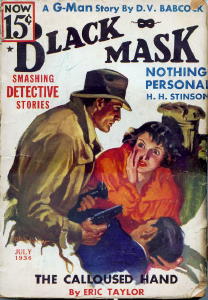 So far as the writers permit,
we select for an issue the best of as
many types as are available; in consequence, readers naturally have
preference for one over another in accordance with their individual
tastes, and all may be equally good as to workmanship quality.
There is
a story in the July issue, however, which can be pointed to for a
specific reason. It is “Nothing Personal,” by H. H. Stinson. So far as the writers permit,
we select for an issue the best of as
many types as are available; in consequence, readers naturally have
preference for one over another in accordance with their individual
tastes, and all may be equally good as to workmanship quality.
There is
a story in the July issue, however, which can be pointed to for a
specific reason. It is “Nothing Personal,” by H. H. Stinson.If a new writer should ask me to suggest what might be interesting to our readers, I would probably mention anything but what Mr. Stinson has in his story, in the way of characters, by name or position – that is, a reporter, an editor, a tough police official, and so on. They have been used so many, many times. Yet Mr. Stinson has done something with these familiar identities, with the ordinary action, which, to many readers, will make this an outstanding, a “model” story, in any company. The one word to describe it is “treatment.” He has brought every one of his characters vitally alive. The fact that they are this, that or the other is less important than that they are “real” personages; not once do they speak, act or react out of character – with a more or less commonplace setup, his handling of story detail, of constant menace, of action, is masterly. One careful reader refers to one of his scenes as the most vivid, the best of its type since Hammett told about Ned Beaumont in The Glass Key. The
fact that Mr. Stinson is
himself a newspaper man, a police reporter on one of the big Los
Angeles papers, may have contributed to the sense of reality which he
has infused into the story. But it isn’t every newspaperman who
can make a story live and throb
like this one. If it were, editors would have an easier time.
A “model” story. No – except for treatment. A marvelously entertaining and vital one? Yes – decidedly yes. [From
Ed Hulse:] Besides O’Hara in Black Mask, Stinson in the
post-WWII years wrote a series about a dick named Pete Rousseau for Dime Detective.
He stopped writing for both Mask and Detective in 1948. He wrote for other detective pulps, too; Cook-Miller credits him with 60-odd stories altogether. [From
Will Murray:] I just went through my copy of the
manuscript of the Joe Shaw bio written by his son, Milton. I find
no mention of HHS.
However, Shaw did pick one Stinson story for possible inclusion in his Hard-Boiled Omnibus, “Give a Man Rope.” His editor thought it weak in comparison to other selections and it was dropped along with several others. So we know what Shaw thought was his best BM story.
Me again. I’m back, and I’m assuming that after all of this talking, as interesting as I hope you found it, you’d like to hear about the book itself. Truth be told, it’s not very good, but for most of an evening or two, the entertainment value is still high enough that I did. Read it in an evening or two, that is. As the story begins, the primary protagonist has discovered that as of that very same morning, he is a pauper. The estate he believed that had been left to him by his overly generous father, he learned, had been badly (and sadly) overtaken by various notes, mortgages, liens and debts. Which therefore means, as of that very same evening, his marriage to Maryse Douglas is off. Not by any wishes of the young lady herself, far from it, but by Owen Kenrick, her guardian until she comes of age. Here is how the author describes the young lady, on page 5: ...Though Maryse Douglas had only the
standard
equipment of eyes, mouth, hair and other features with which any member
of the race goes through life, the component parts seemed to have been
arranged in such wise that most young men upon seeing her went away
mumbling to themselves of resolves to lead better lives and some day be
worthy of her.
The next morning Christopher is consoled by a gent by the name of Bosworth, who lives in the apartment upstairs from him. From page 13: “Cheerio, lad. Into every life a
couple of
showers have to fall, as some ass of a poet remarked. No doubt in
the least that you’ll get on.” He proceeded cautiously as became
a venture on delicate ground. “And if I can help, old onion,
you’ll make me thoroughly irritable by not letting me come to the fore.”
This is not the sort of dialogue that would make any kind of headway in the pages of either Black Mask or Dime Detective, nor would the mystery itself. When Kenrick is found dead, young Christopher is, of course, the obvious suspect. The only others in the running are the butler or Miss Douglas herself, and when Christopher’s fingerprints are found on the murder weapon, that just about clinches the case right then and here. 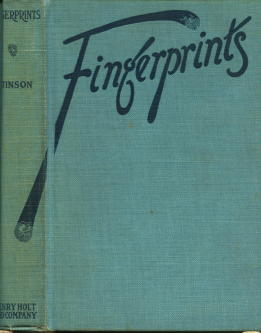 Except for one undeniable
fact, and that is that
Christopher
did not do it, and in the remaining 200 pages, it is up to him, Maryse,
and Bosworth (who has secrets of his own) to prove it. Except for one undeniable
fact, and that is that
Christopher
did not do it, and in the remaining 200 pages, it is up to him, Maryse,
and Bosworth (who has secrets of his own) to prove it.Also on Blake’s trail are a gang of jewel thieves (jewelry being a primary item of trade for the dead man) who kidnap Maryse as part of their nefarious doings, but she escapes and makes her way back to the city just as Blake and Bosworth discover the hideout where she had been kept a captive, and mystery upon mystery ensues. By page 209 Maryse has been captured again, by yet a third party to the drama, and rest of the book is devoted to her rescue, nothing more, and quite a lot less. A lot happens in this book, as you can tell, but when it comes down to it, as I’ve already implied, nothing really happens, if you know what I mean. And what about the phony fingerprints? You might ask, and rightly so. In 1925, they were still a novelty to mystery readers, and so in 1925 they must have been amazed as to what could be done with them, by both the investigators and (in this case) the villains. I checked online with Google, and guess what, what the chaps on the wrong side of the law did back then could really be done. Of course Mr. Stinson makes it sound easy, but in terms of the technology of 1925, I’m still not quite convinced it would have been as easy as he made it sound. September 2006
FOOTNOTE: I seem to have spoken somewhat ahead of myself. After some further investigation I have discovered that the novel was previously published as a three-part serial in the mystery fiction magazine Real Detective Tales and Mystery Stories, concluding in the February 1925 issue. Mostly, I think but am not sure, the stories that appeared in RDT&MS were either of the mansion house variety or out-and-out thrillers, and thusly not hard-boiled fare at all. Or am I making a judgment on a sample of size only one? Other authors who appeared in the magazine in 1925 include Seabury Quinn, Arthur J. Burks, Raoul Whitfield, Otis Adelbert Kline and Vincent Starrett. You tell me. SARAH ANDREWS - Dead Dry St. Martin’s, paperback reprint; 1st printing, September 2006. Hardcover: St. Martin’s Press, November 2005.  Em Hansen, the detective
of record in Dead Dry, is the
new forensic geologist for the state of Utah, and while she’s had nine
previous adventures on record, this is the first case of murder that’s
come her way since taking the new position. I’d tell you more
about some of her earlier cases, but as it happens, as I so often have
to admit, this is the first one of the ten that I’ve happened to read. Em Hansen, the detective
of record in Dead Dry, is the
new forensic geologist for the state of Utah, and while she’s had nine
previous adventures on record, this is the first case of murder that’s
come her way since taking the new position. I’d tell you more
about some of her earlier cases, but as it happens, as I so often have
to admit, this is the first one of the ten that I’ve happened to read.For the record, expanded from her entry in Crime Fiction IV, by Allen J. Hubin, here are the previous nine (plus this one, her tenth, along with the one that’s in the works) in chronological order, beginning with her earliest: Tensleep. Otto Penzler Books, hc, June 1994 [Wyoming] Signet, pb, December 1995 A Fall in Denver. Scribner, hc, December 1995. [Colorado] Signet, pb, December 1996 Mother Nature. St. Martin’s, hc, June 1997 [California] St. Martin’s; pb, July 1998 Only Flesh and Bones. St. Martin’s, hc, May 1998 [Wyoming] St. Martin’s; ; pb, August 1999 Bone Hunter. St. Martin’s, hc, September 1999 [Utah] St. Martin’s; pb, September 2000 An Eye for Gold. St. Martin’s, hc, September 2000 [Nevada] St. Martin’s; pb, Decmber 2001 Fault Line. St. Martin’s, hc, January 2002 [Utah] St. Martin’s; pb, January 2003 Killer Dust. St. Martin’s, hc, February 2003 [Florida] St. Martin’s; pb, March 2004 Earth Colors. St. Martin’s, hc, March 2004 [Pennsylvania] St. Martin’s; pb, December 2004 Dead Dry. St. Martin’s, hc, November 2005 [Utah] St. Martin’s; pb, September 2006 In Cold Pursuit. St. Martin’s, hc, Spring 2007 [Antarctica] For a photo of the author is the controls of her plane while researching her latest book, go to her website. You’ll also find a biography of the author there. Short version: “A geologist who writes mystery novels about a geologist.” For the long version, I’ll suggest you simply check out her website. It’s definitely worth a visit. While researching the publication dates of the books above, mostly on Amazon, I happened to glimpse some of the reviews, and unfortunately, some of them matched my opinion almost completely. Long discourses on matters geological, many of them, too little plot. In Dead Dry, for example, we (the reader) are given mini-lectures (some not so mini-) on the lack of water in Colorado, along with water resources (and ecology) in general. Not that I’m complaining, mind you, because it’s important, but when it becomes noticeable, as it does here, then maybe (just maybe) it’s overdone, at least in a (mere?) mystery novel. Which, in the case at hand, involves the death of an old colleague of Em’s, an eccentric geological consultant named Afton McWain, buried in a suspicious quarry wall collapse. Was he the victim of a horrific accident, or is this a case of murder? It is the latter, and the connection with the above-mentioned water resources in Colorado (or lack thereof) has a great deal to do with it. Besides working allover the western part of the US (see the settings as listed above), Em also seems to have a romantic interest in every book. Whether new ones or not, I do not know, but Fritz (in this one) seems to be rather new, while Ray seems to have been part of her past for some time longer, and it appears that he will stay there. Now you may have noticed that I have left the detective work involved until after discussing the romantic aspects of the book, mostly because, well, I found the detective work of a rather, um, perfunctory nature. Something invariably seemed lacking. On more than one occasion, I found myself commenting to myself – I almost always write notes to myself while I’m reading – that Em simply wasn’t asking the right questions, if she was asking questions at all. But she’s a character whose lively, animated outlook on life is definitely worth following – a series wouldn’t last as long as this has if that weren’t true – and it all turns out well in the end. In fact, there is no doubt in my mind that the book is considerably better than the one that I see (looking back) that I have described so far. But (still looking back) I don’t see anything I’ve said that I would change, so I won’t.
September
2006
KATHLEEN HILLS - Hunter’s Dance Poisoned Pen Press: Hardcover First Edition: January 2004. Trade Paperback: April 2006  For fans of detective
mysteries, there is a lot to enjoy in this, the second appearance of
township constable John McIntire, his first being Past Imperfect, which came out from
the same publisher two years earlier, in 2002. And for the very
same readers – fans of detective mysteries, that is – there is also a
huge disappointment in the ending, and I think that, if I may, I’ll put
off talking about that for a while. For fans of detective
mysteries, there is a lot to enjoy in this, the second appearance of
township constable John McIntire, his first being Past Imperfect, which came out from
the same publisher two years earlier, in 2002. And for the very
same readers – fans of detective mysteries, that is – there is also a
huge disappointment in the ending, and I think that, if I may, I’ll put
off talking about that for a while. Let me talk about the good news first, before getting to the not-so-good. In Hunter’s Dance, set in Michigan’s Upper Peninsula in late1950, the death of Bambi Morlen is one that would present a challenge for any detective who’d be worthy of the title. The boy is found tied up, poisoned, scalped, stabbed and worse: someone has attempted to drill a hole in his skull. Not all of these were done by the same individual, as it turns out, and thereby lie the pieces of the puzzle that McIntire and Pete Koski, sheriff of fictional Flambeau County, must juggle around and put back together. There are a good many local residents of rural St. Adele, also fictional, and the semi-wilderness surrounding it, and in time the reader is introduced to a good assortment of them, not all of whom get along well with one another: the Finns; the Chippewa Indians; the hardy, long-time resident woodsmen; the rich folks in their own enclave along Lake Superior. Bambi is the son of one of the latter, and yes, I know what you’ve been thinking, what kind of name is that? As a quick sidebar, I lived in the area for four years, and calling it a “semi-wilderness” is putting it mildly. There are small spots of civilization scattered here and there, but there are also long stretches of highway where the road is flat, never curves or bends, and goes on for fifty miles or more with absolutely no one in sight, and (unlike the Far West) surrounded on either side by trees and/or swampland on the entire way. Back to the text. During the long patient investigation that ensues, all of which is never less than interesting, the pieces slowly start snapping into place, but (here comes the not-so-good part) the ending, which comes as quite a surprise – to put that mildly as well – brings forth as many new questions as it answers. That’s in the next-to-the-last chapter. Well, OK, one thinks, there’s still plenty of time for some explanation. It wouldn’t take all that much, maybe, but – the final chapter is no help either. The events that occur in the final six pages are even more eye-opening – and I am not even attempting to put it mildly. There’s nothing in the final scene that’s related to Bambi’s death. All that this final turn of events does, as well-intended as it may have been, is to produce is even more head-scratching wonder (and dismay?) on the part of the reader, or at least those of us who prefer some sort of closure as far as the mystery in their mystery fiction is concerned. Does the good outweigh the bad? Not quite, to my way of thinking, but to be truthful, it does come close, and who knows? Your reaction to the ending may be totally different from mine. As far a being a historical mystery is concerned, there is little here to identify the year as being precisely 1950. The UP is isolated enough that the story could have happened in a period of time extending, say, ten years either way. But the countryside is perfectly described (not enough to make me truly homesick, mind you, but perhaps there’s not an author living who could do that) and the inhabitants are a joy to meet and (even as archetypes) to remember.
September 2006
Note:
A
shorter version
of this review appeared in Historical Novels Review.KATHLEEN HILLS - Witch Cradle Poisoned Pen Press. Hardcover First Edition: March 2006  What I said about Hunter’s Dance, Kathleen Hills’
previous book in her John McIntire series, in that it could have taken
place at any time between 1940 and 1960, was absolutely true. I
haven’t been back in a while, but I suspect there are locales in the UP
that have not changed at all in the over 40 years since I lived there. What I said about Hunter’s Dance, Kathleen Hills’
previous book in her John McIntire series, in that it could have taken
place at any time between 1940 and 1960, was absolutely true. I
haven’t been back in a while, but I suspect there are locales in the UP
that have not changed at all in the over 40 years since I lived there.Not similarly so with Witch Cradle, which takes place in early 1951, only a few months later than the conclusion of the events related in Hunter’s Dance. When a huge winter’s storm brings down trees across the countryside – and believe me when I tell you that reading about the snow and the wind and the cold in this book did definitely NOT make me homesick, not even a little, except in the purest form of the abstract – what’s found in the roots of one of the giant fallen pines, and hence the title, suggests that a married couple who had planned to make a pilgrimage to Russia sixteen years before, and to live in a commune there, never managed to take the trip. Tying in with the Communistic dreams that some innocent individuals in the UP had in the 1930s is the abrupt reality of the repugnant McCarthyism of the 1950s: that infamous era of national paranoia about seeing Reds around every corner, and in every schoolhouse and in every film and every radio program and in every government agency in the country. Worse. McIntire’s investigation seems to lead to tragedy and heartbreak at every turn of the tale: losses of jobs, jailing, threats of deportations, and what looks very suspiciously like a suicide. Because of his past, about which little but hints now and then have been known until this third book, McIntire finds an FBI agent breathing not so lightly down his own neck. Based on true events, Hills’ story certainly has a lot of resonance to it, and as a result it produces a lot of strong feelings in the reader, which is all to the good. Unfortunately it also reads as though too much has been crammed into it. Nor does the fact that one player’s characterization is completely reversed from the previous book help very much, either. The ending is rushed, and the nearly simultaneous revelation of secrets from McIntire’s hidden past also seems forced and not worked in as smoothly as it should (could) have been. A case of too much of what’s good for us, perhaps. The intention is admirable, but the execution is lacking.
September
2006
Note: A shorter version of this review appeared in Historical Novels Review. DOUG J. SWANSON - Dreamboat Harper, paperback reprint; first printing, January 1996. Hardcover: HarperCollins, February, 1995. The mystery shelves of used bookstores are filled with any number of series of detective fiction that appeared out of nowhere, flamed brightly for a short while, then just as suddenly disappeared. If there were still used bookstores, that is. They are, alas, an endangered species, are they not? I’m not going to digress off in that direction, though. Not this time. I’m going to stay focused and on track, even if I have to force myself. Private eye novels, which this one is, or cozies, which this one isn’t, it makes no difference. If they don’t catch on, in spite of critical acclaim, they gone, they’re history, and how many of the Jack Flippo PI novels can you name? Do you know what major city he worked out of? Had you heard of Jack Flippo before you began reading this review? One of the reasons I began this review the way that I did is that on the front cover Doug J. Swanson is described as an “Edgar Award Nominee.” Given all of the questions I just asked you, this is a fact I did not know myself – but it’s why my mind went poetic on me, re the fire “that flamed briefly brightly” and all, and I hope you’ll forgive me. Here’s the list of all of Swanson’s mystery fiction. The detective in each of them is Jack Flippo.  Big Town.
Harpercollins, hc, February 1994. Big Town.
Harpercollins, hc, February 1994.Harper, pb, February 1995 Dreamboat. Harpercollins, hc, February 1995 Harper, pb, January 1996. 96 Tears. Harpercollins, November 1996. No paperback edition. Umbrella Man. Putnam, hc, July 1999. Berkley, pb, May 2000. House of Corrections. Putnam, hc, August 2000. Berkley, pb, May 2001. That’s it. That’s all there were, and viewing it from the outside, it looks very much as though Flippo’s career was all but over after the first three. The Edgar nomination came in 1995 for Big Town in the category of Best First Novel of the Year. (It did not win. The award went to The Caveman’s Valentine by George Dawes Green, as I am sure you will recall.) Swanson himself was a long-time reporter for the Dallas Morning News, or so I’ve discovered, and at the age of only 53, there’s a good chance he still is. Luckily he’s had a day job to fall back upon. But what this also means is that he knows the Dallas area, and the people that live there, all kinds of them: the small-town hicks, the semi-slimy big-city entrepreneurs, the ladies of the evening, high and low, good folk and bad. He also has a sense of humor about his approach to mystery fiction (and probably life as well) that tickles my funny bone, and who knows, maybe yours as well. Jack Flippo used to be an Assistant D.A. in Dallas. At the beginning of this book, he’s a non-practicing lawyer, a newly licensed investigator, and he’s in jail for simple assault. The victim: his ex-wife’s boyfriend. (This turns out to be important.) The case he’s asked to work on, by the insurance exec who bails him out, is to look into the death by drowning of a gent with a half-million dollar policy on him Off he goes, therefore, to a small town called Baggett, somewhere in East Texas, where he meets a small town justice of the peace and an even smaller (five foot six) hick sheriff by the name of Loyce Slapp. You can bet that Flippo doesn’t get anywhere, and fast, even if he suspects foul play, and you would win. He also meets a girl named Sally, good-looking, of course, and who works for the dead man’s partner in an exotic-type night club in Dallas. This is important, too, since a friend of hers named Bobby has gone missing, and she’s starting to get worried. Apparently he is (or was) in on whatever business went on in Baggett, and is in hiding (or worse). Thieves do fall out, and in Texas everything does grow taller, including tales like this one. While Jack is quick with the quip and talks with a basket full of confidence, I have to say (reluctantly) that it would be nice if he had a small modicum of competence to go with the confidence. Things do not always go smoothly for Mr. Flippo, in other words. Spenser he is not, not to mention that he does not have a Hawk for a back-up. Nor even back-up plans for every contingency, for that matter either. On the other hand, not all of his various problems and ill-times mini-disasters are entirely his fault, exactly. So a somewhat warped sense of humor (like mine) is what you need as a reader, and if that is what you have, you will have a rattling good time. On the other hand, and you may be certain that there is one, the story also goes off into some dark and dangerous directions now and then as well. It isn’t all funny-named characters who are in over their head in matters criminous. Some of the bad guys are rather competent, as a matter of fact. The ending – if I may now at this juncture skip over some of the story lines which you are better off reading yourself anyway – is better than average, even in comparison with PI novels which take themselves a lot more seriously. I would imagine that the five Jack Flippo novels are all there are going to be. If you were ever to spot one in a used bookshop shelf someday, may I suggest that you don’t pass it by. If the description of this one hasn’t sent you running in the other direction already, which of course I realize that it very well may, do yourself a favor and give it a new home. You’ll thank me, I’m sure, and maybe as early as the very same evening.
September 2006
MAGGIE ESTEP - Flamethrower Three Rivers Press; trade paperback. First Edition, September 2006.  This is the third in
Maggie Estep’s Ruby Murphy
mystery series, and as usual, I came in late. The first two were Hex (Three Rivers, March 2003) and Gargantuan (Three Rivers, July
2004), and while I’ve been meaning to – and I haven’t yet – my
intentions are to get my hands on the first two as soon as possible. This is the third in
Maggie Estep’s Ruby Murphy
mystery series, and as usual, I came in late. The first two were Hex (Three Rivers, March 2003) and Gargantuan (Three Rivers, July
2004), and while I’ve been meaning to – and I haven’t yet – my
intentions are to get my hands on the first two as soon as possible.If I thought that the book by Swanson was somewhat over-the-top and humorous, and I did, I certainly didn’t see this one coming. Ruby Murphy, who lives as low-key and laid-back a life in Brooklyn and environs (post-Giuliani Manhattan, Queens, Coney Island) as anyone possibly could, begins this episode with a visit to her psychiatrist, Dr. Jody Ray. Ruby has been seeing Jody since the death of someone she cared about – well, Attila, her lover – in a previous book. Unfortunately, not having read the previous book, this did not mean a lot to me, personally, but having a sociopath murder someone close to you right before your eyes, I grant you, maybe a psychiatrist could help. And Ruby’s new boyfriend is obsessed by a new object of his affection, his new horse, making this her primary complaint to Jody during this particular visit. Which is summarily interrupted when Ruby discovers, you will not believe this, one of Jody’s husband’s legs in the fish tank outside her office. “Oh shit,” Jody said.
That’s when you know that you have a story that has gone completely off the tracks, and in fact there are no tracks in sight. Where, oh where, you could most reasonably ask, could a story possibly go from here? The quote above came from only page 11 and continues thusly: Ruby started wishing she were home, in
bed, with the covers pulled over her head. Instead, she was
standing there, watching her psychiatrist vomit. Dr. Jody Ray had
evidently eaten Chinese food for lunch.
Eventually, a few twists and turns of the plot later, Ruby is hired (after being mysteriously (and falsely) fired from her job at the Coney Island Sideshow Museum) to find the missing doc, who seems to have a past history that Ruby knew nothing absolutely about, including (page 211) the aspect of the previously mentioned past from which the title of the story arises. That the last 12 pages have nothing to do with the mystery end of things tells you something about where the priorities lie in the Ruby Murphy mysteries: not all that so very high. And truth be told, mystery-wise you will have had to have read the other two books to reap all you should from this one. The last chapter is about Ed, the new boyfriend, who became somewhat estranged from Ruby partway through this one, and Ed’s new horse, and Ruby’s new dog Spike. That you might not care (that the last 12 pages have nothing to do with the mystery end of things) – and I didn’t – shows you what kind of writer that Maggie Estep is, and how finely etched her characters are. Or, on the other hand, you being you and not me, it might do absolutely nothing of the kind. September
2006
EDWARD S. AARONS - Assignment–Stella Marni Gold Medal 666; paperback original. First printing, April 1957. Reprinted several times: as 906 (2nd pr., 1959), k1515 (4th pr., 1965), d1729 (5th pr., 1966), T2308 (6th pr., 1970), and M2949 (1973). Search as I may, I cannot determine what the number and date of the third printing might be. Although, of course, I fully realize that I may be the only person reading this who may care. The data as given above may also be suspect, it is true, determined as it was largely from listings on ABE and elsewhere, which is hardly the most reliable way of doing bibliographic research. But one thing that is clear is that the book, published as the fourth in the Sam Durell “Assignment” series, came out early enough to be reprinted again and again as later ones came along. (In the same way the the oldest child in the family gets the vast majority of the appearances in the family’s photo album.) What is not so obvious from the bibliographic data is that the book is not among the better ones in the series. At first I thought that this may have been due to the fact that the action takes place solely in the five boroughs of New York City. It’s been a while since I read one of the books in the series, but what I remember always enjoying is Aarons’ detailed descriptions of the exotic places of the world where he would place Durell next. But that’s not really the problem Even this early in the series Aarons shows how he could make even the most mundane places suddenly come to focus, and with a fresh perspective. Here, for example, is Sam on page 87 as he is tracking down a frightened girl’s father – well, all right: Stella Marni’s father – who has been kidnapped and may be hidden away on a freighter docked along Manhattan’s west side:
... She was a frightened girl hiding behind her mask of cool and
impersonal detachment. He knew her now. And he knew she was
not the proud goddess disdainful of men, the remote and chilling woman
she had seemed to be.
He pushed her aside in his mind with a deliberate effort. Nobody had challenged him in the busy shed, where he wandered alongside the white, rust-flaked plates of the freighter. An officer on the bridge was shouting something down to the longshoremen astern, his voice garbled and echoing through a hand amplifying phone. Most of the loading was being done through the cargo hatches aft of the center superstructure. But there were two loading ports in the side of the ship open to gangways nearby. So far as Durell could see, no one was on guard, and several men came and went on errands by that route, to and from the ship. He walked that way. He had no longshoreman’s badge authorizing him to be here, and he could be challenged at any moment ...  Stella Marni is a crucial
element in a campaign by several communist countries to “call home”
refugees who’ve come to the United States seeking political
asylum. Convinced that all is well back in their native land,
several such people have gone back, only to never to be seen
again. As a famous successful photographic model, Stella Marni
has gone before a Senate committee stating her willingness to return to
her native Hungary. Sam wonders why, and if there is any way to
change her mind. The final key to her mysterious change of heart:
her missing father. Stella Marni is a crucial
element in a campaign by several communist countries to “call home”
refugees who’ve come to the United States seeking political
asylum. Convinced that all is well back in their native land,
several such people have gone back, only to never to be seen
again. As a famous successful photographic model, Stella Marni
has gone before a Senate committee stating her willingness to return to
her native Hungary. Sam wonders why, and if there is any way to
change her mind. The final key to her mysterious change of heart:
her missing father.Stella is also one of those women who draw men to her like the proverbial moths to a flame, and even Sam may not be immune. On pages 72-73 he has a long and increasingly bitter confrontation with his close lady friend Deirdre, who, although she herself asked Sam to help Stella in the beginning, is also beginning to have second thoughts. As it has transpired, Sam has spent the previous night with Stella, causing Deirdre to become suspicious and increasingly jealous. And even though the night spent together by Sam and Stella was innocent enough, the fact remains that Deirdre has every right to be. The primary focus of this tale is therefore Stella: as an enchantress, as a unwitting Jezebel, and yet as an innocent victim. And if you are beginning to wonder if this makes the book a “cozy” in any sense of the term, the answer is no. There are some extremely tough fight scenes in this book also, one example of which is on page 127. (Severely tempted to add quotes both here and up above a paragraph, I decided to reconsider when I looked and saw just how long each of the insertions would have to be, in order to convey the full effect.) And this is strange. As I am typing up my comments on the book just now, based on the notes that I took (over a month ago) I am suddenly discovering that I may have liked the book more than I thought I did. But no, it is not so. The last comment I see that I made is that it is “lightweight at the core.” Which meant at the time, and still so now, that there are no twists or surprising turns of the plot. Paths I anticipated did not occur, even the less imaginative ones. The story has but one direction to go, and that it does so with skill – and a modicum of finesse – still does not mean that it is not going in any more than in one direction.
September 2006
Postscript: I wonder somewhat about Deirdre. Being the girl friend of an ruthless CIA agent whose jobs continue to take him to exotic places around the world, places in which equally exotic women are always available and/or near at hand, would hardly seem ideal for a long-lasting relationship. The future for her appears rather blaak and dismal. All seems well again at the end of this book, but just how long, I wonder (that is to say, for how many more books) does Deirdre manage to stick it out? Anyone know? RICHARD BURKE - The Frightened Pigeon Unicorn Mystery Book Club. Hardcover reprint, June 1946. First Edition: G. P. Putnam’s Sons, 1944. Paperback reprint: Dell 204, mapback edition, 1947. When Victor Berch, Bill Pronzini and I did our annotated bibliography of the Ziff Davis line of Fingerprint Mysteries , we included a short profile of Richard Burke, which of course you should go read. Many of his books, we said, involved a Broadway private detective named Quinny Hite, but as it happens, this is not one of them. In fact The Frightened Pigeon takes the reader to another part of the world and (one imagines) another kind of mystery altogether. 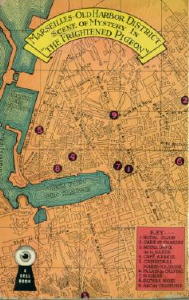  But first a word on the
cover
that’s shown, though, before getting down to details. This is,
of course, the Dell mapback edition that’s mentioned above, and
in case you can’t make out the
details, the map on the back is that of the city of Marseilles, which
is where the last eighty percent of the story takes place. But first a word on the
cover
that’s shown, though, before getting down to details. This is,
of course, the Dell mapback edition that’s mentioned above, and
in case you can’t make out the
details, the map on the back is that of the city of Marseilles, which
is where the last eighty percent of the story takes place.The setting of the first fifty pages is Paris, 1942, with the Germans solidly in control of the city. An American dancer named Valerie Bright is still there, however – the pigeon of the title – and very determined to stay non-political. From page 8, of the Unicorn edition: Of course after the Axis had decided to
include the United States in the war, she had regarded them as enemies,
but there wasn’t anything personal about her feeling.
Her close male friend, Charles John Dillon, nicknamed “Ching,” is working closely with the French underground, however, and events, beginning with a stolen German diary, bound to be embarrassing if it falls into the wrong hands – as, for example, into Ching’s hands – soon make the light-hearted Val realize how dirty – and dangerous – war really is, not knowing what will happen next nor whom your friends really are. By page 40, she is one frightened pigeon indeed, as off to Marseilles they and a small group of displaced others go, hoping to find a way out of France and its closed borders. The diary appears and disappears with amazing regularity. It is, in fact, amazing, how much mileage an author (Burke) can make of one small important object. Otherwise here is a novel one can learn a large amount from – supposing, that is, that one has never been in a place controlled by Nazi-like enemies one is trying his or her best to avoid – both in term of locale (well-described) and people, especially those like Valerie, whose mind is soon brought down to earth in satisfying (but not very surprising) fashion, but also the large number of others who find themselves caught up in events far beyond their say. Don’t get me wrong. This is by no means a major work. It’s no more than ordinary at best, in the overall scheme of things, but what it does have is atmosphere, and plenty of it.
September
2006
EVELYN PAYNE - Held Open for Death Arcadia House; hardcover; c. 1958. The author’s only mystery, nor is it particularly easy to find. There are two copies online that are both in the $30 range, and one other in Norway for $80 or so. I paid less than either asking price for mine, and – as long as you’re asking me my opinion – neither should you. It starts out promising enough, with a heroine sleuth with an unusual occupation for, um, a heroine sleuth: that of real estate agent. There certainly must have been others, before and since, but at the moment, none seem come to mind. Tillie Latimer is her name, the locale is El Paso, and truth be told, when the book begins, Tillie’s been a real estate agent for only a couple of weeks. Her first big assignment on her own: holding an open house for the home next door to her mother’s, where Tillie still lives. It proves to be a big success, so big that keeping track of incoming visitors proves impossible. This turns out to be a big problem when Granpa Tellfair, aged 89, and father of Miss Sadie, who owns the house, is later found dead in the basement, stabbed to death with a knife still in his back. Strangely enough, he also still has $1000 in his pocket. This is doubly strange. Since time he was once robbed, he never carried more than five dollars with him at a time.  Tillie had met
Granpa during the open house, and as
it so happens, while he managed to maintain his well-deserved status as
a curmudgeon in his short conversation with her, he was also one of the
more
likable people who happened to stop by. The question is, who’d
kill an old man like this, and why? Tillie had met
Granpa during the open house, and as
it so happens, while he managed to maintain his well-deserved status as
a curmudgeon in his short conversation with her, he was also one of the
more
likable people who happened to stop by. The question is, who’d
kill an old man like this, and why?To go along with the mystery, there is also a strong romantic interest for Tillie in the person of Miss Sadie’s son Rick, the “town’s star juvenile delinquent for a few years,” now out of the Army and perhaps on his way to becoming a solid citizen. Nor is Rick the only one who is showing an interest in Tillie. Trying to place the book into its proper category, I am not sure whether the two or three more murders that occur qualify this detective yarn as a cozy or not, but if Agatha Christie’s books are cozies, then so is this one. And after thinking about it some more, I shall happily concede that it is, no matter what. I mentioned Agatha Christie. That was a rather unfortunate reference, now that I think about it. While the author is obviously very familiar with the ins and outs of the real estate business, she’s also in over her head in making sure that the story keeps on going in the direction she wants it to. The characters are fun at first, but their lack of depth soon begins to tell. Soon after the halfway point, the many loose strands of the plot get tangled, cluttered and confused, and seemingly beyond repair. In wrapping things up, the author makes it clear she had a goal worthy of the telling in mind. It is the getting there that is the problem. Everything that a good mystery should have is in this book. It’s just that the ingredients have been assembled – well, not badly, exactly, and I have not come up with a more positive way of saying this – but by an amateur, in a truest sense of the word. Without a stronger pro at the helm, to come to the point a little more quickly, this is little more than a “nice try” and/or a “might have been.”
October
2006
MARY ROBERTS RINEHART - The Yellow Room Dell 9790; paperback reprint, later printing, April 1971. Hardcover, first edition: Farrar & Rinehart, 1945. Previously (?) published as an eight-part serial in The Saturday Evening Post, September 28 through October 27, 1945. Cassell & Co., UK hardcover, 1949; Thriller Book Club, UK hardcover, 1950. Bestseller B95, digest pb, 1947. Bantam 314, pb, April 1949. Other Dell paperback editions include: Dell D179, 1956; Dell 9790, October 1962; Dell 9790, 1967. Also: Zebra (Kensington), pb, 1973, 1988, 1990 (3rd pr.), 1991, 1996 (5th pr.). Included in Mary Roberts Rinehart: Three Complete Novels by America’s Mistress of Mystery : The Bat / The Haunted Lady / The Yellow Room, Zebra, pb, 1995.  It is quite possible that
I’ve missed a few editions of this book. In particular, there are
at least nine listings on ABE of a hardcover edition from 1955 (Farrar
& Rinehart), but whether that’s a misprint or no, I do not
presently know. There may also have been a US hardcover book club
edition, but with no definitive information to back this statement up,
I have not included it. Suffice it to say, however, if you’d like
to locate a copy of this book to read, even a hardcover edition, you
shouldn’t have any trouble. It is quite possible that
I’ve missed a few editions of this book. In particular, there are
at least nine listings on ABE of a hardcover edition from 1955 (Farrar
& Rinehart), but whether that’s a misprint or no, I do not
presently know. There may also have been a US hardcover book club
edition, but with no definitive information to back this statement up,
I have not included it. Suffice it to say, however, if you’d like
to locate a copy of this book to read, even a hardcover edition, you
shouldn’t have any trouble.Rinehart’s writing career, as least as far as her novels and collections are concerned, began with The Man in Lower Ten from Bobbs-Merrill in 1909, but the story’s even earlier appearance was in serialized form, in All-Story Magazine for January through April, 1906. According to various online sources which I haven’t attempted to verify, Rinehart suffered a severe heart attack in 1938 while living in Maine, and apparently was a semi-invalid for much of her later life. In any case, from that time on there were only four more novels to come from her pen – she never used a typewriter, according to one source – and of those, The Yellow Room is next to last. Only The Swimming Pool (1952) came later. (This statement excludes several collections of novelettes and short stories.) Still perhaps one of the most famous mystery writers of all time, Mary Roberts Rinehart died in 1958. Appearing after a three-year gap, following Haunted Lady in 1942, The Yellow Room was written when the author was 67, which may go a long way in explaining some apparent slippage in the her writing ability, or perhaps the flaws I saw were always present. I will have to rely on someone more familiar with her earlier work than I am to be able to say more. The book itself takes place in 1944, and the opening chapters go far in describing the general difficulties of life at home in wartime, what with rationing, limited travel opportunities, the absence of men except for the oldest and/or the feeblest, and the hardest of all – waiting for news of loved ones fighting (or reported missing) on the front lines. When Carol Spencer’s invalid mother wishes to move from New York City to the family’s summer home in Maine, it is up to Carol, with only three female servants to assist, to tackle the work involved in doing so. Little did she suspect or know – and yes, that’s the kind of book that Mrs. Rinehart is famous for writing – that she would find the house still shut up and not opened. Lucy, a local woman who is the housekeeper, she learns the next day, is in the hospital with a broken leg. Lights have been seen in the house, Carol is told, shining from the room where Lucy says she never was before her accident.  Another discovery occurs
on page 27: Another woman is found dead in a linen closet, partially
burned
as if someone had been hoping to dispose of her body. When asked,
Lucy’s story
does not ring true; there is something she is not telling. And it
is precisely here that the reader’s frustration begins, or at least
they did with at least one reader: me. There are many, many
questions that if asked are not answered, and there other questions
that seem never to be asked, and if they were answered, at the right
time and the right place, the mystery – one has the uncomfortable
feeling – would, at that time and that place, simply cease to exist. Another discovery occurs
on page 27: Another woman is found dead in a linen closet, partially
burned
as if someone had been hoping to dispose of her body. When asked,
Lucy’s story
does not ring true; there is something she is not telling. And it
is precisely here that the reader’s frustration begins, or at least
they did with at least one reader: me. There are many, many
questions that if asked are not answered, and there other questions
that seem never to be asked, and if they were answered, at the right
time and the right place, the mystery – one has the uncomfortable
feeling – would, at that time and that place, simply cease to exist.Coming to Carol’s aid is her next-door neighbor, the worldly but still young Major Dane, who has been injured from work for US Intelligence, or so it seems. He has been recuperating in the area until deemed fit to go back to duty. The police, generally speaking, are of little or no help. Truth be said, they seem far more antagonistic toward Carol than any evidence seems to say they should be. By page 126 – I jotted a note to myself to this effect at this exact spot, so I am indeed able to be this precise – the facts, what there are of them, are so far muddled that the average reader, it seems to me, will either (A) have given up or (B) have shrugged their shoulders and allowed themselves to follow along, no more and no less, just to see where the author may be headed. There are 256 pages of small print, so at page 126, it is an important decision that must be made whether or not to stop or plunge on, keep going, and rely on the author’s name and reputation that the story may yet be salvaged. I often exaggerate, and the previous paragraph is one of those times, but not by much. Considering Major Dame, who by proximity feels himself becoming closer and closer to Carol, to be the primary detective, there are too many times when we (the reader) are not given total access to his thoughts, and too many other times when the point of view has shifted, and we (the still faithful reader) are shown scenes that Dane knows nothing about. Frustration, yes, but please (if you are ever the reader) keep the faith. The ending, with all of its revelations, is worth waiting for. Mrs. Rinehart has some nifty tricks up her sleeve for you. Even though the buildup to the final couple of chapters might have been more capably accomplished, and whether the end result is realistic or not, I think that even at this late stage in her career, in terms of pulling off the (almost) totally unexpected, she still had the right stuff. I feel quite justified in myself in sticking with Plan B.
October
2006
JOHN GALLIGAN - The Nail Knot Worldwide; paperback reprint, October 2006. Trade paperback: Bleak House, May 2005. 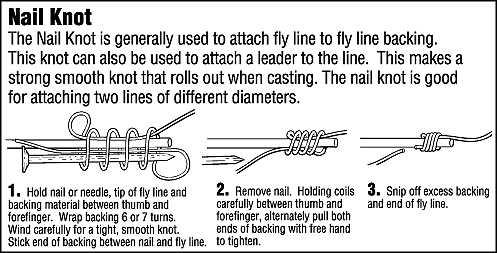 A
“nail knot” is one of those clever devices that are used most often by
fly fishermen, and as such it is something I knew nothing about before
reading this book. (The last time I went fishing was with my
grandfather when I was ten or so, when all we did was to drop our
lines into water off a long pier jutting out into Lake Michigan.
No casting abilities of any kind required. Nor did we catch
anything, but why do I still remember the day, now well over fifty
years ago?) The primary
protagonist of The Nail Knot,
a laid back sort of fellow who calls himself the Dog, is a fly
fisherman, however, and I’ll get back to him in a minute. A
“nail knot” is one of those clever devices that are used most often by
fly fishermen, and as such it is something I knew nothing about before
reading this book. (The last time I went fishing was with my
grandfather when I was ten or so, when all we did was to drop our
lines into water off a long pier jutting out into Lake Michigan.
No casting abilities of any kind required. Nor did we catch
anything, but why do I still remember the day, now well over fifty
years ago?) The primary
protagonist of The Nail Knot,
a laid back sort of fellow who calls himself the Dog, is a fly
fisherman, however, and I’ll get back to him in a minute.In the meantime, here is a short list of other mystery novels or series which I’ve just come up with in which fly fishing is a substantial component, in no particular order. Firehole River Murder, by Raymond Kieft, first book in the “Yellowstone Fly-Fishing Mystery Series.” Series character: name not known. Blood Atonement: A Dahlgren Wallace Mystery, by Jim Tenuto. Series character [SC]: fly-fishing guide Dahlgren Wallace. Bitch Creek, by William Tapply. SC: Stoney Calhoun, amnesiac worker in a bait and tackle shop in rural Maine. Pale Morning Done, by Jeff Hull. SC: Montana fly-fishing guide Marshall Tate. Dead Boogie: A Loon Lake Fishing Mystery, by Victoria Houston. SC: Chief Ferris, Doc Osborne and Ray Pradt. [There are several in this series.] There are probably others that I am not thinking of now. Please add others, if you can. This is the first of at least three books in John Galligan’s “Dog” series, but some research shows that he wais the author of one earlier mystery novel, Red Sky, Red Dragonfly, also published by Bleak House (in 2001), in which a hockey player from Wisconsin travels to Japan to teach English for a year and ends up being implicated in his predecessor’s disappearance. Subsequent and/or reportedly forthcoming follow-ups in John Galligan’s fly fishing series are: The Blood Knot. Bleak House, hardcover, October 2005. The Clinch Knot. Bleak House. Spring, 2007. The Surgeon’s Knot. The Wind Knot. The Hex.  This is a long-range
projection, and I suspect that some of these titles may turn out to be
totally
hypothetical. But assuming that you’re still with me, let’s take
a look at the book in hand. As mentioned above, “the Dog” is how
the
leading character refers to himself – he tells the story, and on a
strictly personal basis, it’s quite a story that has to tell. This is a long-range
projection, and I suspect that some of these titles may turn out to be
totally
hypothetical. But assuming that you’re still with me, let’s take
a look at the book in hand. As mentioned above, “the Dog” is how
the
leading character refers to himself – he tells the story, and on a
strictly personal basis, it’s quite a story that has to tell. The Dog’s real name is Ned Oglivie, and he is what you might call a dropout from the human race, wandering across the country and checking out fishing spots as he goes. A nomadic fly fisherman without parallel, you might say. Until he reaches Black Earth, Wisconsin, that is, where it is that he finds a body along the edge of the creek that leading into (or out of) local Lake Bud. (You can see that even though it may be an important plot point, it didn’t make much of an impression on me.) He also finds The Woman, but not until she removes from the crime scene all of the evidence that (Dog later learns) points to her semi-senile father. But let the Dog describe the lady, from page 13:
... and it was impossible for me to take my eyes off her.
You expect me, I suppose, to tell you that she was a gorgeous creature, or lay out for you some other such cunning nonsense. But it wasn’t like that. The last thing the Dog wanted in those days was attraction to a woman. Plus that was far from the mood, and this woman was anything but gorgeous. She was more like confusing. She had already shown me the clod-hopping ability of a teen-aged boy. She was dressed like that too – dirty jeans and work boots, a t-short that had once been white, a dirty-green John Deere cap with a pair of cheap sunglasses up on the brim. Her thighs and arms and shoulders were thick, and her posture atop the stream mud was on the dark side of dainty. But there was a frazzled spark of red-blond ponytail sticking out the back of the cap. There were breasts strapped down by a sports bra beneath the t-shirt. There were tears in her eyes. Earth to Dog: woman. You can tell at once that the Dog is hooked. Her name is Melvina Racheletta O’Malley, or Junior for short, and the Dog discovers to his dismap that he cannot walk away when she asks him to help her in what she insists is a frame-up of her father, Mel. The dead man has only lately been a local, which first of all is not a good thing in rural Wisconsin, and secondly he had been an activist in trying to revive and save the fish in Lake Bud, which is also definitely not a good thing – activism, that is. The solution to the mystery depends greatly on who was able to tie a nail knot, and at what time. It wouldn’t have been a terribly difficult case to solve, if one had a protagonist who was a little more, shall we say, pro-active on the case – you soon get the feeling that if the Dog were any more low key than he is, he wouldn’t be able to get up in the morning – but then again meeting all of the local folk, some more local and inbred than others, and some not, would have been not nearly so much fun as this.
October
2006
UPDATE. Quite coincidentally there has been a discussion of fly-fishing mysteries on DorothyL this past week (early November), in relation to a slightly different topic of “male cozies.” Here are a couple more mystery series that have been pointed out as belonging to the category, still small but obviously growing: Fly Fishing Can Be Fatal, by David Leitz. SC: Max Addams, owner of a northern Vermont fishing lodge. [There are several other books in this series.] Catch and Keep, by Ronald Weber. SC: Northern Michigan conservation officer Mercy Virdon and her boyfriend, newspaperman Donald Fitzgerald. [There is at least one other book in this series.] Death on a Cold, Wild River, by Bartholomew Gill. SC: Dublin police Chief Superintendent Peter McGarr, who is the detective in several other books by Gill. In Cold, Wild River, though, it’s the victim who is the fly fisherman, along with at least one of the suspects. MARGUERITE SILVERMAN - The Vet It Was That Died Nicholson & Watson; UK hardcover. First edition: 1945. No US edition. Of the three mystery novels written by this author, this one is the most common among those fopund offered for sale online: there are six copies available at the time I am writing this. Of Silverman’s second (Who Should Have Died?, Nicholson, 1948) there are none, and of her third (9 Had No Alibi, Nicholson, 1951) there is but one. According to Al Hubin’s CFIV, the primary detective in each is Chief Inspector Christopher Adrian. Coming to his assistance in this one, at least, a relatively minor affair, is a newly graduated veterinarian surgeon by the name of Helena Goodwin. Helena’s involvement with the mystery is due only to this, her first job, however, and in fact she’s one of those immediately on the scene when her body of her veterinarian employer is found. (Hence the title.) And yet, even though both the inspector and his wife are old friends of her family, it doesn’t seem as though there’s enough of a connection there to warrant her presence in any of Adrian’s other cases. I could be wrong. It will also be difficult to find out, but if and when I do, I will be sure to tell you. It comes as no surprise that “the vet it was that died,” as both Mr. Thorpe and his wife are two of the most terrifically unlikeable people that one can imagine. They are hated by their niece Carol, who lives with them; Dora, the other girl who works for them; their neighbors, and even their clientele, believe it or not. That the couple were not especially fond of each other is also an understatement, to put it mildly. When Mr. Thorpe is found poisoned to death, what Adrian and Helena quickly realize is that they have a lengthy list of suspects to work with. There is no need at all to start looking under rocks or for tramps passing by. By page 92, however, the list has been narrowed down to five: the only ones who had access to the brandy to which the strychnine was added, but with 100 pages yet to go, it takes quite a bit of time (and false leads) to whittle the list down any further. I called this mystery a “minor affair” a short while back, and truthfully that is all it is. The dialogue on occasion is rather juvenile in tone, and on other occasions one gets the unsettling feeling that the author is making up facts as she is going along. Neither of these are necessarily fatal flaws, mind you, but neither of them allows for much in the way of recommendation, either.
October 2006
JOHN WESSEL - This Far, No Further Island/Dell; paperback reprint, November 1997. Hardcover, first edition: Simon & Schuster, October 1996.  Here’s an even better
example of what I was rambling
on about back when I was reviewing Dreamboat,
the Jack Flippo PI novel by Doug J. Swanson, although I don’t think
this first book by John Wessel, also a private eye novel, caught
anyone’s eye for an Edgar nomination. Here’s an even better
example of what I was rambling
on about back when I was reviewing Dreamboat,
the Jack Flippo PI novel by Doug J. Swanson, although I don’t think
this first book by John Wessel, also a private eye novel, caught
anyone’s eye for an Edgar nomination.Wessel’s detective is named Harding, an unlicensed PI working in the Chicago area. Both he and the author seem to have had a three-novel run, and that was all that it appears there will ever be: This Far, No Further. Simon & Schuster, 1996; Island/Dell, 1997 Pretty Ballerina. Simon & Schuster, June 1998. No US paperback edition. Kiss It Goodbye. Simon & Schuster, January 2001. No US paperback edition. The fact that only the first one came out in paperback certainly says something, but of course it is never easy to interpret these things correctly. One obvious explanation is that for the last ten years (or more?) private eye novels no longer rule the roost as they did, once upon a time. Either Wessel’s writing never caught on, starting with his very first book, or perhaps even more likely, Island/Dell didn’t give him (or the books) the chance they needed. And there are not too many series with continuing characters which beat the odds and succeed in hardcover only. Without the paperback reprint coming out a year later, just about the time the next one in hardcover shows up, a series almost always seems to lose steam, then is forced to pack up and leave, never to be seen again. Should the Harding books have succeeded? Were they wrongly done in? I have mixed feelings about this. There is a lot to like in This Far, No Further, and there is a lot, well, let’s say that I had problems with, and maybe other readers did too. First to like: Harding tells his own story, first person (uh-oh) present tense. Present tense? I can live with that, even though it fought me a little. The telling is spirited and enthusiastic, even though Harding has been badly wronged in his life, so far, and the less-travelled (grittier) paths and neighborhoods in Chicago are described with the panache and style of a long-time inhabitant. Second to like: Harding’s lady friend Allison, a commercial photographer and (evidently) one-time girl friend who assists him on this case. The banter between them is relaxed, pointed, trenchant and (all at the same time) far more cutting than Spenser ever has had with Susan, as enjoyable as the Robert B. Parker books are and always have been. Nor has much of the past between Alison and Harding been made clear by the end of the book. Allison, who is also very good at the martial arts, seems as well to have close lady friends of her own. Not to like very much: The utter sleaziness of the dead girl’s death in a rundown motel outside of Chicago, the victim of what appears to have been a sex tryst that went way too far. Harding was following the male in the party, a noted plastic surgeon whose wife hired the lawyer who hired Harding. Much is made later of videotapes and other paraphernalia. Not to like even more: The plot itself eventually becomes verbal sludge and next to impossible to follow. You may take this as an overstatement born out of frustration, and you would be right, but nonetheless, it is true. Harding’s own past – the reason behind the loss of his license – eventually becomes entangled with the doc and his problems, and Harding’s attraction to his wife (and his client, twice removed), and I confess that by that time, I was only skimming the pages. As fast as I could. Was I about to about to quit? No. Absolutely not. Did I go online and buy the next two books in the series? Yes. Can there be more to be said than that? Probably, but I hope I don’t need to. MARI ULMER - Cart of Death Worldwide; paperback reprint, September 2006. Hardcover edition, as Carreta de la Muerte (Cart of Death): Poisoned Pen Press, April 2001. Subtitled “A Taos Festival Mystery,” this second adventure in which Christina Garcia y Grant finds herself involved takes place shortly before and during the celebration of the local Las Fiestas holiday. The first book in which Christy appeared was Midnight at the Camposanto (April 2000), which took place on a previous Good Friday through the following Easter Sunday.  According to the Poisoned
Pen website, the
latter was to have been “the first novel in a series planned to follow
the sacred and secular calendar through its annual cycle,” but thus
far, only the two books have been published. (Also on the PP
website is an announcement that “Mari is now working on More than Mischief at San Geronimo,”
but since on that same page is a link to her 2002 author’s tour, along
with the fact Ms. Ulmer is now 74 years old, I have a feeling that the
chances that it will appear are diminishing quickly.) According to the Poisoned
Pen website, the
latter was to have been “the first novel in a series planned to follow
the sacred and secular calendar through its annual cycle,” but thus
far, only the two books have been published. (Also on the PP
website is an announcement that “Mari is now working on More than Mischief at San Geronimo,”
but since on that same page is a link to her 2002 author’s tour, along
with the fact Ms. Ulmer is now 74 years old, I have a feeling that the
chances that it will appear are diminishing quickly.)Which is shame, for I rather enjoyed this book, in spite of some rather uncomplimentary comments some readers have left on Amazon. Christy is a former lawyer who now runs a bed-and-breakfast in a small town south of Taos while she attempts to begin a writing career. This means that there are numerous tenants whose humorous antics keep her hopping while she is trying to keep them happy. Her mother lives by, and when the festival begins, the guests are displaced by all of her relatives who come swarming in. One particular tenant is a permanent resident, a retired surgeon from Florida named McCloud, or Mac for short, and an attraction between Mac and Christy seems to be growing. At least enough so that when other men look at Christy longer than he thinks they should, Mac feels the pangs of jealousy. Especially gnawing at Mac is that the suave Evelyn Bottoms (male) would make such an ideal candidate for the murder of a young worker at a local art gallery. Missing is Bobby’s female assistant, Cindy, a close friend of Christy’s mournful friend Iggy (short for Ignacio), a young lawyer she has been mentoring. The mystery is strangely gruesome, with at point (page 140-141) three more deaths occurring within the span of two pages. The detective work? Well, it’s as satisfying as it is in most present-day cozies. The star attraction for this book, though, overshadowing everything else, is the locale, its history, its inhabitants, and the overall spirit of enthusiasm and joy that’s on continuous display for all of the above. Not quite so satisfying, given the lack of another tale to continue the series, is that the semi-romance between Christy and Mac, which is left badly hanging. All readers are would-be authors, though, are we not? Anyone who reads this rather charming look at contemporary New Mexico culture (plus mystery) will know exactly how that will come out, or already has.
November
2006
UPDATE [02-01-07] A representative of Poisoned Pen Press promised to pass on to Ms. Ulmer an email of inquiry I’d sent them, suggesting that perhaps she would respond to me directly. That was several weeks ago, and she has not. More, the information I quoted from the PP website is no longer there, or at least I am unable to find it again. I wish I had better news than this. ROMILLY & KATHERINE JOHN - Death by Request. Hogarth Crime; trade paperback. 1984. Also published as a Hogarth hardcover. Offset from the original [hardcover] Faber & Faber edition, 1933. I haven’t gotten the bibliography details tracked completely down yet. From looking at copies offered for sale on ABE, there appears to have been a US edition that Al Hubin doesn’t yet know about, published by Vintage/Ebury (A Division of Random House Group) in both hardcover and paperback in 1984. This might only be the Hogarth edition imported here, but after a quick, superficial investigation, it appears that there actually was a separate publication here. Also in question is the date of the Faber edition, for which Al in CFIV says 1935, but the information above [1933] comes from the reverse of the Hogarth title page. FOOTNOTE. No copies of the Faber edition are currently available on the Internet. It’s undoubtedly a scarce book. It’s also the only mystery that the married couple of Romilly and Katherine John wrote. Who were they, is one question, and how did it happen that Hogarth reprinted it some 50 years later? For at least partial answers, one must read the new introduction to this edition, written by Patricia Craig and Mary Cadogan, as part a series of Hogarth Crime reprints of classic detective fiction. Romilly, born in 1906, was in the RAF, was briefly a civil servant, then a poet and an amateur physicist before dying in 1986. Katherine was a reviewer as well as a translator of Scandinavian books. She died two years before her husband, in 1984. Other authors in the Hogarth series seem to have been Fergus Hume(*), Nicholas Blake, E. F. Benson(*), Cyril Hare, R. Austin Freeman, Freeman Wills Crofts, Margery Allingham, C. B. H. Kitchin, and S. S. van Dine. Those marked with a (*) are denoted as part of a Gaslight Crime series. Now these are all names that most fans of the Golden Age of Detection are familiar with. Not so the Johns, and the gap between 1933 and 1984 between editions may be one of the longest on record for any mystery novel. As far as discussion or another review of the book is concerned, I found a mention of it in: The London Mercury, Volume
XXVII, unknown date. Apparently only a publication notice.
The Library World, unknown
date. Apparently a review.
Whatever Happened to Sherlock
Holmes: Detective Fiction, Popular Theology, and Society by
Robert S. Paul (Southern Illinois University Press, 1991)
 This is not a lot of coverage for a book which Hogarth Press considered significant enough to reprint in a series of classic crime fiction; a locked-room mystery; and in its own inimitable way, a minor tour de force of one form or another, the details of which I most sincerely will do my best to avoid telling or revealing to you. The dead man is found in his bedroom at one of those old English manor residences so commonly found in works of mystery fiction, especially the English ones. He is found gassed to death in a heap on the floor, still dressed as he was the evening before, the window shut tightly, and (of course) the door was locked. It had to be broken down in order to enter in the morning. Could it have been suicide? No, Lord Malvern seems to have been well enough off, and he was off to visit his fiancée in London on the very same day as his death. Telling the story is the local vicar, an elderly man by the name of John Colchester, a long-time friend of Matthew Barry, the master of the house. Also staying over are various friends and relatives, including a comic-relief colonel who harrumphs all over the place; a weepy young girl; a recent widow only slightly older; the slightly deaf sister of Matthew; assorted staff, mostly female, save for a slightly villainous butler named Frampton. And to tell the truth Frampton is more than only slightly villainous. He’s a socialist, a seducer of young maids in the area, and – as the truth comes out – a blackmailer. Many letters which threaten to reveal secrets which others might wish kept unrevealed are found, some sent by Frampton, others perhaps not. Obviously, as these have a great deal to do with the plot, the letters – their contents, who received them, who sent them, and who may have intercepted them – must be given, as the book goes on, a exhaustive and thorough going over. And to tell you another truth, the going-over of the letters is probably too thorough and exhaustive. One is tempted, I must admit, to throw up one’s hands whenever another letter appears and must be discussed and put into the context of the previous ones. I see that I have neglected to mention the detective on the case. Nominally that would be Inspector Lockitt, but that particular gentleman seems content to do his work off-camera, as it were. Almost all of his activity is related to the vicar second-hand, and then of course the vicar must relay his impressions of the good Inspector Lockitt on to us, the reader. It seems a strange way to tell a mystery, but one must always get accustomed, eventually, to things we expect to occur in the usual way, but which do not, do we not? The bulk of the detective work is rather more accomplished, in fact, by an unusual twosome: (a) Mr. Nicholas Hatton, a friend of the dead man’s fiancée, one of those amateur detectives who are as common in British mystery fiction in the 1930s as damp old manor houses with murders committed within them, and (b) the aforementioned widow, Mrs. Fairfax, who proves to be a most tenacious (and efficacious) individual when it comes to solving mysteries. There are secrets galore that must come out before the solving is done, including at least two that should correctly be considered “bombshells” when they are revealed. There is, of course another secret at the end, which I promised not to tell or reveal to you, and looking back at what I have written, I do not believe that I have. So, is the book a classic? You may well ask, and you should. No, I say, but with a small hedge in the back of my mind. For today’s audiences, large portions of this exercise in murder-solving will be dreary and dull to the extreme. For those of you who like puzzles, well, the puzzle is there, and without a doubt, a double delight it is. The problem is that it’s, well, unskillfully told, when measured by more modern standards, say of five or so years later. That the door was locked on the inside, for example, is not revealed until page 50, whereas the body itself was found on page 24. Nor, surprisingly enough, is the locked room aspect very much – if at all – the focus of the tale. This may in part be due to the telling (see above) or the fact that (as is often the case) the solution (to the locked room aspect) is rather simple when explained, and therefore not very worthy of much dwelling upon. If you were to read this book – and if you are still with me, I would at least suggest that you should, for this must be the kind of mystery you prefer to read, not so? – you will also need to know what a geyser is, at least a geyser that one would find in the bathroom of a country house in England in the early 1930s. Readers of Dorothy L. Sayers’ Unnatural Death, for example, will have already come across one, if they were to think back upon it.
November-December
2006
FOOTNOTE: A reply on matters bibliographic from Al Hubin: “You’re right on both counts. The Revised CFIV will show the Faber edition as 1933 and that a U.S. edition appeared in paperback by Trafalgar in 1984.” Even though we agreed, I wasn't so sure about the publisher of the US edition, Trafalgar being, as I understand it, a distributor who imports books from England, and not a publisher per se. Continuing to discuss this with Al, in a later email he says, “Those import editions are a challenge/frustration ... lots of ’em in CFIV, I’m afraid. In some cases, I noted the appearance of a ‘real’ edition and replaced the import with the real. In this case, you’ve convinced me and Addenda #10 will include the correction to Vintage.” F. G. PARKE - First Night Murder A. L. Burt & Company; hardcover reprint; no date. First Edition: Dial Press, hc, 1931. The bad news first, perhaps, if you happen to read this review and if I happen to convince you that you might want to read the book for yourself. There are three copies on ABE at the present time, one the Dial Press edition for $35, one in French for under $20, and one the British hardcover (Stanley Paul, 1932) for over $40. (The one from Dial Press has a jacket, and I think it’s worth the money.) But what the heck, keep reading. I may not convince you anyway. And who’s F. G. Parke, you ask, and well you may. No one seems to know, and it’s not even his (or as it has suddenly occurred to me) her name. It’s a pseudonym. I think the author is male, however, thinking about it even as I sit at the keyboard. It’s not a woman’s tale, what with the many-faceted male point of view which so generally obvious if not blatant – and maybe so obvious that I could very well be wrong. But as I was reading this – and enjoying it, for the most part – and don’t worry, I will be sure to let you know at which point I stopped enjoying it – I pretended in my mind (and where else) that this was an unknown work of the cousins known as Ellery Queen, who needed some money at this point of their career, which would have been, roughly, between The French Powder Mystery (Stokes, 1930) and The Dutch Shoe Mystery (Stokes, 1931), perhaps. Or perhaps not, but it was fun to pretend – and who knows, I could very well be wrong, and they actually did write it. What got me thinking this way, though, was the locale where the first murder was committed: in a theater during the actual performance of a play, the New York City Police Commissioner in attendance, among many other notables, it being first night, of course. A mystery drama is about to reach its denouement, the lights go out, a woman’s wild scream rings out, the lights come back on, the villain (of the play) is in handcuffs – and a noted Broadway producer is found stabbed to death in his seat near the front of the theater, the space next to him unused. Fifteen seconds of darkness – hardly time enough for the killer to make a getaway – but no knife is found (everyone is searched) and no one heard anything, no one saw anything. There is no lack of potential murderers, for as if by pre-arrangement, motives for everyone seated in seats within a small vicinity are soon revealed. But once again, no one heard, saw or felt anyone move or pass by them, and – this is the key – there is no murder weapon anywhere in the theater. Doing the honors as the detective at hand is Martin Ellis, the author of the play, the first step of what he had hoped to be a long career as a playwright. The inner flap of the dust jacket (the only piece of the jacket I happen to have) compares him favorably with Philo Vance, but on the other hand, you know how the people who write story descriptions on the flaps of dust jackets often seem to exaggerate. No, it was Ellery Queen I kept thinking of (Ellis = Ellery?). The Roman Hat Mystery? And yes, I know that it was death by poison in that first novel the Queens wrote, but still, it was a during a play that the victim in that book, an unliked/unlikable lawyer, was killed. But Martin Ellis on his own, and as a writer of mystery fiction himself, seems to be amiable enough and competent enough to solve this case, even though he is in love with the girl, the actress on stage, whom the dead man married earlier the same day, which in most books would make him the number one suspect. (I did suggest that there are motives galore – what’s lacking are means and opportunity.) Both Lt. John B. Gradey of Homicide and District Attorney Moore eliminate him quickly as a suspect, however, as he was seen by two witnesses just before and after the lights went out, and nowhere near the scene of the crime. To help demonstrate Ellis’s prowess as a detective, along either Queenian lines, or Vancian, you choose, here’s a quote from page 98: Considering that he [Ellis] had during the past few years conducted
theoretical investigations strictly along scientific lines, it would do
him no harm, he thought, to borrow a leaf out of one of his own
books. All the best detectives sported a fine flair for calm,
unbiased reasoning. They analyzed. They synthesized.
They equipped themselves with a supply of cold, hard facts and from
these they made unfailing deductions with mathematical precision.
The hundred per cent sleuth of fiction, in short, did everything but
beat his breast passionately with both fists and gather himself for a
leap at the most obvious conclusion in his maiden chapter.
As I say, you choose. More deaths occur, with plenty of influence on the thinking processes of Martin Ellis, but as it occurred to me, with very little emotional impact. As for the solution, as I skip over in this short essay anything more about all of the suspects and the all of the suspicious activity that goes on in this book, it is the solution that tells the tale, and to tell you the truth, while I was ready for it, already having made a note to myself about the paragraph I quoted to you above, I really wasn’t ready for it. Don’t know as I still am, as a matter of fact, but I guess that means that I should take my hat off to Mr. Parke, whoever he was. The gentlemen behind Ellery Queen could never have been quite this melodramatic – could they?
December
2006
UPDATE [02-10-07] I emailed the seller of the Dial first edition of this book a couple of days ago, asking if there was anything helpful that was said about the author on either the back panel of the dust jacket or its flaps. Perhaps asking for too much, I also inquired if a scan of the cover might be possible. I’m still hoping, but to this date, I have not heard back. M. E. KNERR - Travis Pike Book #214; paperback original. First printing, April 1962. I seem to be specializing in obscure books this month, and this one is about as obscure as you can get. Even though it is a private eye novel – and I’ll get back to that in a minute – it was published by one of those small sleazy paperback outfits in the early 1960s that promised more than they could possibly deliver at the time. And even so, if you happened to have purchased this one in 1962 for its sexy parts, you’d be sadly disappointed, since in that regard, it’s really rather tame. If sexy passages were what you were looking for back then, you’d have been far better off buying a copy of Peyton Place than this. This book does not even appear in Al Hubin’s Crime Fiction IV, but it will, or at least in the Addenda. The author does appear, however, and to show you something of his track record, here’s his present entry: KNERR, MICHAEL E. (1908?-1984?) * Operation: Lust (Epic, 1962, hc) as by M. E. Knerr. * The Violent Lady (Monarch, 1963, pb) Listed below are other titles by Knerr (under either byline) which I found listed for sale at various places on the Internet, but not included in CFIV, and probably for good reason. I do not have descriptions of the story lines for any of these first three, so your guess is as good as mine:  * Brazen Broad (Pike #206, pbo, 1961) * Heavy Weather (Belmont/Tower, pbo, 1979) [** -See UPDATE below.] * Port of Passion (Imperial #737, pbo, n.d.) These I found descriptions for * Night in Guyana (Belmont/Tower, pbo, 1978) A non-fiction account of the of the mass suicide of the Jim Jones cult. * Sasquatch: Monster of the Northwest Woods (Belmont/Tower, pbo, 1977) Quoting from the cover: “Though based upon factual research, this is a fictional tale of what could conceivably happen in the Pacific Northwest: a chain of events that could create a monster out of a normally timid and gentle giant.” * The Sex Life of the Gods (Uptown Books #703, pbo, 1962) “Science Fiction erotica.” [** UPDATE 02-27-07] At first I was doubtful, but now that I’ve found a cover scan of Heavy Weather, I’d say that it’s also a prime candidate for inclusion in Crime Fiction IV. If you can’t make out the small print on the bottom of the cover, it says, and I quote: “On the Mexico run the Pandora carried a cargo of drugs, danger and death!” LATER THE SAME DAY: Al Hubin agrees. In it goes. (The book pictured below is described as a Horwitz edition published in Hong Kong.) But let’s get on with things and the book Travis itself. There’s only one copy offered for sale on the Internet, making it not only obscure but scarce. I mention this even though I’m sure you know that the two are usually, but not always, one and the same. Telling the story, though, in his debut and probably his only appearance in print, is Mike Travis, a “sailor of fortune, who loves life, and woman, especially women.” It is not difficult to deduce what other reasonably well-known character was the inspiration for Mike Travis. Travis in this book had previously been in the charter boat business in Florida, but when times went bad, he went to California to accept an offer made by one of his former customers, a multi-millionaire named Del Houston, to look him up if and when Travis headed out that way. And Del does indeed have a job for him. After some quick string-pulling and the greasing of certain political hands, Del hands Travis a PI license and a gun, and a three-fold request: to find his son; get him off narcotics; and break up the gang who’s been supplying them. It’s not a bad opening for a PI yarn, and the story maintains its way reasonably well for about half of its just under 160 pages: the usual PI stuff, the things that PI’s do, and the usual bad things happen to some of the people who just happen to get in the way, with all of the coincidences that make one or more aspects of one PI investigation dovetail nicely into another. Even though it goes without saying, I’ll say it anyway. Travis himself is one of those guys who is irresistible to beautiful women. In this book that includes both his employer’s foster daughter, from page 20 ...  She had a body to make dead men come to
life and dead women come back to haunt their living husbands.
With a skin tone tanned to an almost artistic hue, hair the color of a
burnished copper skillet, eyes as blue as an ocean trough and lips as
soft and warm looking as an afternoon at the beach, Abby Houston was a
woman to set pulses racing and libidos leaping. Mine was right up
there too.
... and a stripper who the first time they met, tripped him into a pool at Houston’s house. From page 68: Marcia, if that was her real name, was
rigged up in the getup of an Indian squaw, but the way she filled out
the tan buckskin and beads of her ensemble would have made Pocohontas
whirl in her grave. If this was an example of the way that Indian
women of a hundred years ago, I could see why the west had been wild.
I think you can tell a lot of about a story by looking closely at how the author describes his characters, don’t you? With an ending that doesn’t directly address the clues that have been set up for it, though, the tale does two things simultaneously and hence the apparent impossible. The action-packed finale (a) goes all but out of control, and (b) withers away from lack of interest, as if there were a deadline set that had to be met, and it didn’t matter precisely how. Although overall not without flashes of acceptable writing, and every once in a while better than acceptable, the overall impact of this novel is still rather like a third-rate Carter Brown or a tenth-rate John D. MacDonald, either of whom, if you’re a fan, you know what I’m talking about and whom you’re far better off pursuing. Or let’s put it this way. One of the reasons for collecting and reading unknown and long-neglected works of mystery fiction is the hope that never dies of discovering an unknown and long-neglected classic of mystery fiction. Sometimes you have to settle for unknown and long-neglected.
December
2006
UPDATE. If you were to google “M. E. Knerr” on the Internet, you would find, as I did, that there was a Michael E. Knerr who was a friend of SF (and occasional) mystery writer H. Beam Piper, who committed suicide in 1964 when he ran into financial troubles. I’ve not been able to confirm that the two Knerr’s are one and same, nor have the birth and death years for either one been verified. Accounts vary on the latter. Knerr may have also written under the name of “Brent Hart,” but that’s another loose end not yet tied down. But the Knerr who was a friend of Piper apparently wrote a hitherto unpublished biography of him, and upon Piper’s death, went through his manuscripts and salvaged, among other things, the “lost” third Fuzzy novel, Fuzzies and Other People. If and when I know more, I will as always, let you know. VALERY SHORE - Final Payment Major Books 3236, paperback original; copyright 1978; no other date stated. Next on the agenda, and the final book I read in 2006, is the only mystery written by the pseudonymous Valery Shore. Al Hubin in Crime Fiction IV says that Shore was the pen name of Lon Viser, born in 1932. All I’ve been able to come up with regarding Mr. Viser is that he had something to do with the American Art Agency, a publisher based in North Hollywood in 1965.  From the small print
inside Atualidades Globo Controle Da
Natalidade, written in Portuguese and illustrated throughout,
aka The Complete Book of Birth
Control: From the small print
inside Atualidades Globo Controle Da
Natalidade, written in Portuguese and illustrated throughout,
aka The Complete Book of Birth
Control:Parliament News, Inc.
Publisher: Milton Luros. Executive Editor: Harold
Straubing. Managing Editor: Lon Viser. Art Director: Wil
Hulsey. Associate Art Director: J. D. Pecoraro.
It’s not a common name. Maybe it’s the same man. All that comes up for Valery Shore, in case you were wondering, are a few dealers offering this book for sale on eBay, or maybe it’s the same book offered at different times. I didn’t check. The dedication reads as follows: “To Yvonne, Rhoda, and Lon, without whose help this book could not have been written,” so I assume that Al is correct – not that there’s any reason to doubt him. The primary detective in Final Payment is a former Scotland Yard inspector by the name of Christopher Camel, still young, who’d recently been left a fortune by an aunt, in her day a sex symbol of the silver screen. Staying with Camel in his aunt’s Tudor-style Hollywood mansion is “his beautiful Eurasian companion, Kim Lee Chance.” I’m quoting from the back cover. In attendance upon them both is Potter Goodleigh, his aunt’s former lover and a long ago movie director who’d been exiled to the guest cottage, but who is now cook, butler and father figure to the two young people who are now “livening up the old museum,” as he puts it. It is Potter’s daughter Felicia who’s murdered, her body found in the piano in her living room. Unfortunately Felicia was also a blackmailer, and there are thirteen suspects that Camel, Kim Lee, and the local lieutenant of police named Davidson have to deal with. In spite of his new-found money and all of his resultant leisure time, there is no way Camel can be kept off the case, as you can well imagine if it had happened to you and sunny fortune had smiled your way in such a fashion. The story, as I’ve relayed to you so far, may also sound to you as the basis for a made-for-TV mystery movie. If so, you share my feelings exactly, and I have the advantage of having actually read the book. If you also were to suspect that on page 177 there would be a gathering of the suspects in the dead woman’s living room, in an attempt to recreate the crime, I would certainly begin to wonder about you. How could you possibly know that it was on page 177? As entertaining as made-for-TV mystery movies may be, and some more than others, in general I’ve always had a relatively low opinion of them. This one, I’ll conclude by saying, is better than most of them. If there had ever been a second book in the series, I’d make sure that I had it in my collection too.
December 2006
UPDATE: Victor Berch has done some preliminary spadework on Lon Viser, and so far he’s come up with the following: His full name as Lorenzo Ludwick Viser, born February 28, 1932 in FL, died August 9, 1994 in LA. There was a Lorenzo M. Viser living with him in the 90s, probably a son. More later, if and when! YOUR COMMENTS ARE WELCOME. |




 courtesy
of
courtesy
of